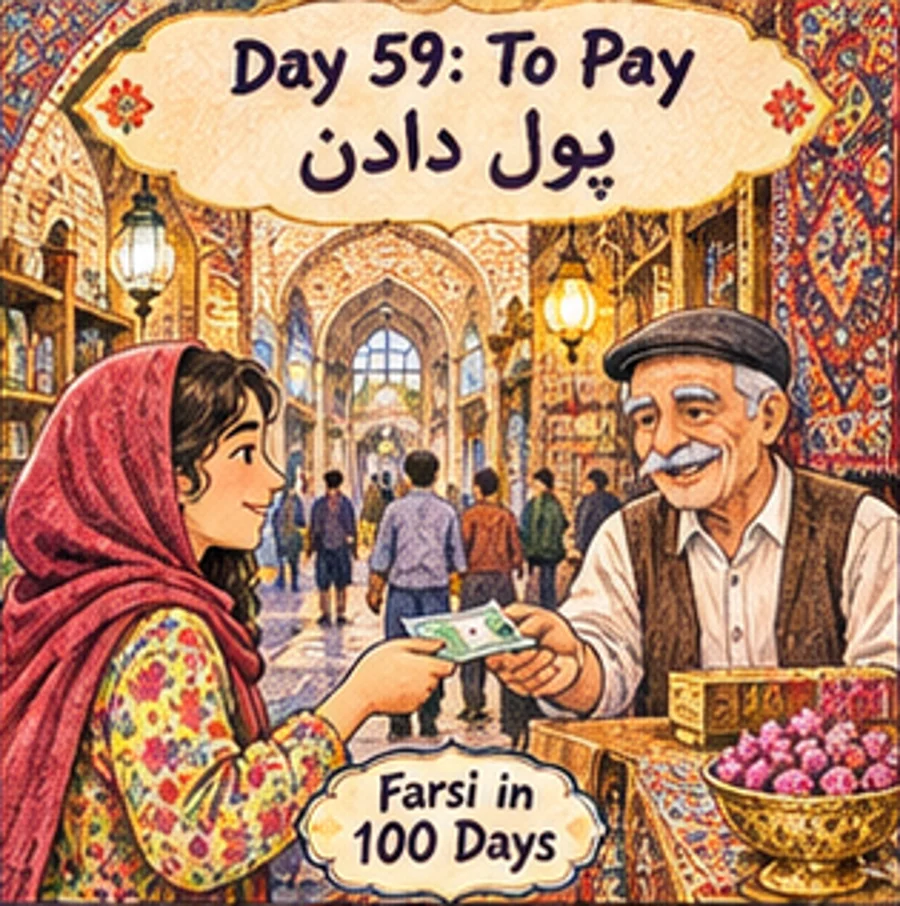
Day 59 of Learn Farsi in 100 Days, our free step-by-step Persian course: Paying. The lesson has four parts, with every Persian word in Persian script, pronunciation and English, and each part ends with a quick check.
Part 1Conversation and grammar
Day 59, Part 1 has a customer asking for the bill (صورت حساب, surat-hesâb) in a restaurant and taking food to go, and shows how spoken Persian joins چند (chand, a few) and خیلی (kheyli, many) to personal suffixes: چندتامون (chandtâmun, a few of us), خیلیهاشون (kheyli-hâshun, many of them).
Conversation: paying the bill
| Speaker | Persian | English and pronunciation |
|---|---|---|
| Customer مشتری | ببخشید. ممکن است صورت حساب غذای ما را بیاورید؟ | Excuse me. Could you bring us the bill for our meal? bebakhshid. momken ast surat-hesâb-e ghazâ-ye mâ râ biyâvarid? |
| Clerk منشی | بسیار خوب، از غذا راضی بودید؟ | Certainly. Were you happy with the food? besyâr khub, az ghazâ râzi budid? |
| Customer مشتری | خیلی خوب بود، ممنون. | It was very good, thank you. kheyli khub bud, mamnun. |
| Clerk منشی | این غذا را میخواهید با خود ببرید؟ | Would you like to take this food with you? in ghazâ râ mikhâhid bâ khod bebarid? |
| Customer مشتری | بله، ممکن است آن را در یک کیسهی پلاستیک بگذارید؟ | Yes. Could you put it in a plastic bag? bale, momken ast ân râ dar yek kise-ye pelâstik bogzârid? |
| Clerk منشی | حتما، مشکلی نیست. بفرمایید. | Of course, no problem. Here you are. hatman, moshkeli nist. befarmâyid. |
| Customer مشتری | ممنون، صورت حساب ما چقدر است؟ | Thanks. How much is our bill? mamnun, surat-hesâb-e mâ cheghadr ast? |
| Clerk منشی | ۴۵ هزار تومان میشود. | It comes to 45,000 tomans. chehel o panj hezâr tomân mishavad. |
| Customer مشتری | بفرمایید. | Here you are. befarmâyid. |
| Clerk منشی | ممنون، ممنون، دوباره تشریف بیاورید. | Thank you, thank you. Please come again. mamnun, mamnun, dobâre tashrif biyâvarid. |
Grammar: چند and خیلی with personal suffixes (spoken)
In spoken Persian, “a few of us” and “many of us” are usually not said with از (az, of) and a separate pronoun. Instead, چند (chand, a few) takes تا (tâ) and خیلی (kheyli, many) takes ها (hâ), and then a spoken personal suffix is added: -mun (us), -tun (you), -shun (them). So چند نفر از ما (chand nafar az mâ) becomes چندتامون (chandtâmun), and خیلی از آنها (kheyli az ân-hâ) becomes خیلیهاشون (kheyli-hâshun).
| Persian | Pronunciation | English |
|---|---|---|
| چند نفر از ما = چندتامون | chand nafar az mâ = chandtâmun | a few of us |
| چند نفر از شما = چندتاتون | chand nafar az shomâ = chandtâtun | a few of you |
| چند نفر از آنها = چندتاشون | chand nafar az ân-hâ = chandtâshun | a few of them |
| خیلی از ما = خیلیهامون | kheyli az mâ = kheyli-hâmun | many of us |
| خیلی از شما = خیلیهاتون | kheyli az shomâ = kheyli-hâtun | many of you |
| خیلی از آنها = خیلیهاشون | kheyli az ân-hâ = kheyli-hâshun | many of them |
Quick check
- What is the spoken short form of چند نفر از شما (a few of you)?
Show answer
چندتاتون (chandtâtun) - How do you ask a waiter for the bill?
Show answer
ممکن است صورت حساب غذای ما را بیاورید؟ (momken ast surat-hesâb-e ghazâ-ye mâ râ biyâvarid?) - What does دوباره تشریف بیاورید (dobâre tashrif biyâvarid) mean?
Show answer
Please come again.
Part 2Idiom of the day, common phrases, poetry and word of the day
Day 59, Part 2 gives three proverbs, such as دل دادن و قلوه گرفتن (del dâdan o gholve gereftan, to talk sweetly to each other), the phrase قیمتها دارند بالا میروند (prices are going up), a couplet by Hafez, and the word پولدار (puldâr, wealthy).
Idiom of the day
دست به دامن کسی شدن
dast be dâman-e kasi shodan
Word for word: to put one’s hand on someone’s skirt (hem)
Meaning in Persian: به کسی پناه بردن.
Meaning: To turn to someone for help or protection; to beg someone for help.
English equivalent: to throw oneself on someone’s mercy
Idiom of the day
دست راست و چپ را نشناختن
dast-e râst o chap râ nashenâkhtan
Word for word: not to know the right hand from the left
Meaning in Persian: بسیار کودن و ابله بودن.
Meaning: To be very dim-witted and foolish.
English equivalent: not to know one’s left from one’s right
Idiom of the day
دل دادن و قلوه گرفتن
del dâdan o gholve gereftan
Word for word: to give heart and take kidney
Meaning in Persian: با محبت با یکدیگر سخن گفتن.
Meaning: To talk to each other lovingly and affectionately (usually said of a couple).
English equivalent: to whisper sweet nothings; to bill and coo
Common phrases
| Persian | Pronunciation | English |
|---|---|---|
| قیمتها دارند بالا میروند. | gheymat-hâ dârand bâlâ miravand. | Prices are going up. |
Poetry: a couplet by Hafez (حافظ)
A couplet by Hafez. The book’s English: “O heart! complain not of thy work enfolded like the rose-bud: For the knot-loosening breeze, the morning wind hath brought.”
| Persian | Pronunciation | English |
|---|---|---|
| دلا چو غنچه شکایت ز کار بسته مکن | delâ cho ghonche shekâyat ze kâr-e baste makon | O heart, do not complain like a rosebud about your closed-up affairs, |
| که باد صبح نسیم گرهگشا آورد | ke bâd-e sobh nasim-e gereh-goshâ âvard | for the morning wind has brought a knot-loosening breeze. |
Word of the day: پولدار (puldâr)
Meaning: wealthy, rich
My father is very wealthy.
Quick check
- What does دست به دامن کسی شدن mean?
Show answer
to turn to someone for help or protection (dast be dâman-e kasi shodan) - How do you say “Prices are going up”?
Show answer
قیمتها دارند بالا میروند. (gheymat-hâ dârand bâlâ miravand.) - What does پولدار (puldâr) mean?
Show answer
wealthy, rich
Part 3Currencies, conversation and idiom of the day
Day 59, Part 3 names world currencies such as دلار (dolâr, dollar), یورو (yuro, euro) and تومان (tomân, toman), has a customer paying by credit card (کارت اعتباری, kârt-e e’tebâri) at the checkout, and gives the idiom سر به سر کسی گذاشتن (to tease someone).
Currencies (ارزها)
| Persian | Pronunciation | English |
|---|---|---|
| دلار | dolâr | dollar |
| تومان | tomân | toman (Iranian unit of money, 10 rials) |
| یورو | yuro | euro |
| ریال | riyâl | rial |
| کرون | korun | krone, krona |
| روپیه | rupiye | rupee |
| ین | yen | yen |
| پوند | pond | pound |
| دینار | dinâr | dinar |
| لیره | lire | lira |
Conversation: at the checkout
| Speaker | Persian | English and pronunciation |
|---|---|---|
| Customer مشتری | ممکن است این خریدهای من را حساب کنید؟ | Could you ring up my purchases? momken ast in kharid-hâ-ye man râ hesâb konid? |
| Cashier صندوقدار | بله حتما … ۱۵۰ هزار تومان میشود. | Yes, of course… That comes to 150,000 tomans. bale hatman … sad o panjâh hezâr tomân mishavad. |
| Customer مشتری | ممکن است از کارت اعتباری استفاده کنم؟ | May I use a credit card? momken ast az kârt-e e’tebâri estefâde konam? |
| Cashier صندوقدار | بله بفرمایید. | Yes, go ahead. bale befarmâyid. |
| Customer مشتری | موجودی حسابم کم است. امکان دارد مقداری از خریدهایم را برگردانم؟ | My account balance is low. Could I put back some of my purchases? mojudi-ye hesâbam kam ast. emkân dârad meghdâri az kharid-hâyam râ bargardânam? |
| Cashier صندوقدار | بله مشکلی نیست. | Yes, no problem. bale moshkeli nist. |
Idiom of the day
سر به سر کسی گذاشتن
sar be sar-e kasi gozâshtan
Word for word: to put head to someone’s head
Meaning in Persian: با کسی شوخی کردن، کسی را دست انداختن.
Meaning: To joke with someone, to tease someone or make fun of them.
English equivalent: Do not pick on me. (to tease someone, to pull someone’s leg)
Quick check
- What is the Persian word for “euro”?
Show answer
یورو (yuro) - How do you ask “May I use a credit card?”
Show answer
ممکن است از کارت اعتباری استفاده کنم؟ (momken ast az kârt-e e’tebâri estefâde konam?) - What does سر به سر کسی گذاشتن mean?
Show answer
to tease someone, to joke with someone (sar be sar-e kasi gozâshtan)
Part 4Reading and new words
Day 59, Part 4 is a reading about Darband (دربند, darband), a leisure spot in north Tehran with the Mountaineer statue (کوهنورد, kuhnavard), followed by vocabulary such as صورت حساب (surat-hesâb, bill), تشریف آوردن (tashrif âvardan, to come, polite) and پناه بردن (panâh bordan, to take refuge).
Reading: Darband
دربند یک مکان تفریحی در تهران است. دربند در شمال شهر تهران قرار دارد. خیابان دربند یکی از زیباترین خیابانهای شهر تهران است.
Darband is a leisure spot in Tehran. It is in the north of the city. Darband Street is one of the most beautiful streets in Tehran.
مردم تهران روزهای تعطیل به این خیابان میروند و از مناظر زیبای آن لذت میبرند. این منطقه بسیار خوش آب و هوا است.
On holidays the people of Tehran go to this street and enjoy its beautiful views. The area has a very pleasant climate.
خیابان دربند رستورانها و کافههای زیادی دارد. یک تندیس در میدان دربند قرار دارد که نام آن تندیس، کوهنورد است.
Darband Street has many restaurants and cafés. There is a statue in Darband Square called “The Mountaineer.”
New words
| Persian | Pronunciation | English |
|---|---|---|
| چک | chek | check (bank check) |
| حقارت | heghârat | humiliation, lowliness |
| کیسه | kise | bag |
| حقیقت | haghighat | truth |
| مستطیل | mostatil | rectangle |
| پلاستیک | pelâstik | plastic |
| صورت حساب | surat-hesâb | bill |
| تشریف آوردن | tashrif âvardan | to come (polite) |
| پناه بردن | panâh bordan | to take refuge, to seek shelter |
| کودن | kowdan | dull, dim-witted |
| نور | nur | light |
| ابله بودن | ablah budan | to be stupid |
| قلوه | gholve | kidney |
| وقیح | vaghih | shameless, impudent |
| هنجار | hanjâr | norm |
| مشتاقانه | moshtâghâne | eagerly |
| سپهر | sepehr | sky, heavens |
| تعمق | ta’ammogh | contemplation, deep thought |
| چشیدن | cheshidan | to taste |
| نوبت | nobat | turn; shift |
| خوشدلی | khoshdeli | cheerfulness, gaiety |
| نوازش | navâzesh | caress |
| واقعیت | vâghe’iyyat | reality, fact |
| جور | jowr | oppression, cruelty |
| شوخی کردن | shukhi kardan | to joke, to kid |
| دست انداختن | dast andâkhtan | to mock, to make fun of |
| یاقوت | yâghut | ruby |
| یادگاری | yâdegâri | memento, keepsake |
| تفریحی | tafrihi | recreational, leisure |
| یکسان | yeksân | equal, the same |
Quick check
- Where in Tehran is Darband?
Show answer
in the north of the city: در شمال شهر تهران (dar shomâl-e shahr-e tehrân) - What is the name of the statue in Darband Square?
Show answer
کوهنورد (kuhnavard), “The Mountaineer” - What does صورت حساب (surat-hesâb) mean?
Show answer
bill (the check at a restaurant or shop)
Take this lesson further

Study with the book
Learn Farsi in 100 Days: The Ultimate Crash Course to Learning Farsi Fast
This free lesson is part of Learn Farsi in 100 Days. The book puts the whole series in one printable PDF you can study offline.
Serious about Persian? Get all 30 of our Persian learning books for $199.99 (55% less than buying them one by one).
Free Persian Starter Pack: Alphabet + 100 Core Words
Get the 14-page printable Starter Pack (all 32 letters, a 7-day reading plan, 100 core words and 20 survival phrases) and a short 5-email course. Free.
Free. Every morning: that day’s four videos and the full lessons, with every Persian word, its pronunciation and its English meaning. Stop or pause with one click.