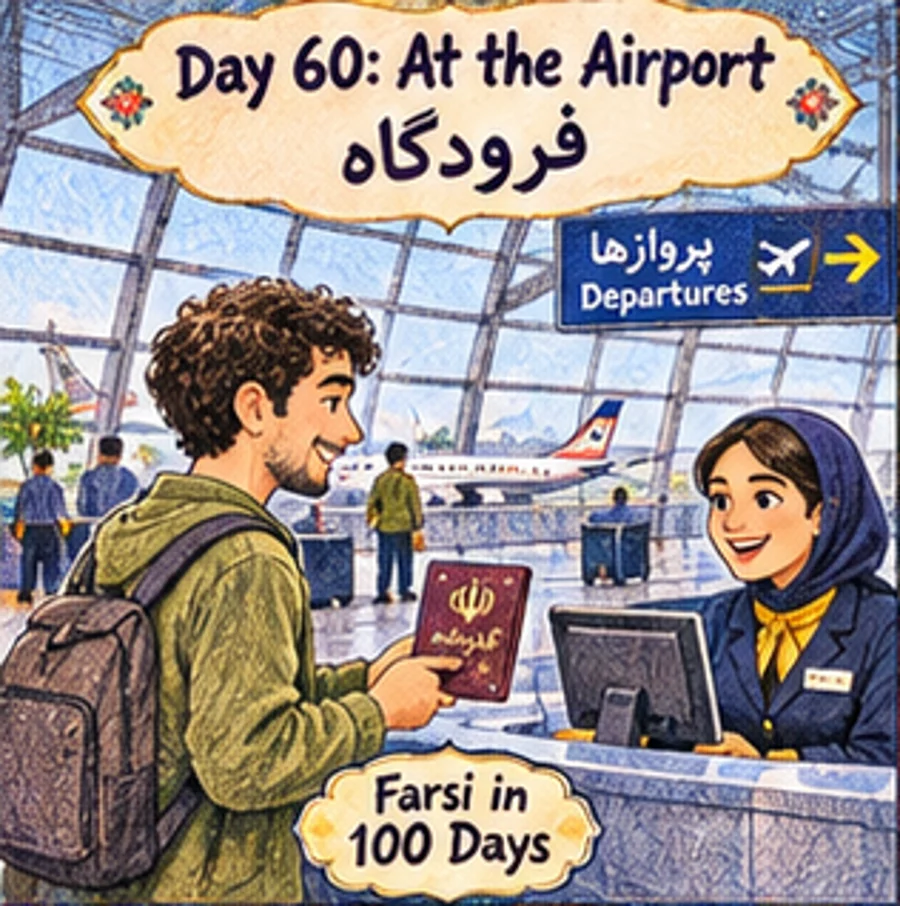
Day 60 of Learn Farsi in 100 Days, our free step-by-step Persian course: At the Airport. The lesson has four parts, with every Persian word in Persian script, pronunciation and English, and each part ends with a quick check.
Part 1Conversation and grammar
Day 60, Part 1 has Arezoo buying a round-trip (دوطرفه, dotarafe) plane ticket to Isfahan at an airport counter, and starts the question words (کلمات سؤالی, kalamât-e so’âli) with کجا (kojâ, where) and کی (ki, who), as in کجا زندگی میکنید؟ (where do you live?).
Conversation: a ticket to Isfahan
| Speaker | Persian | English and pronunciation |
|---|---|---|
| Clerk منشی | بعدی لطفا، میتوانم کمکتان کنم؟ | Next, please. Can I help you? ba’di lotfan, mitavânam komaketân konam? |
| Arezoo آرزو | یک بلیط برای اصفهان میخواهم. | I’d like a ticket to Isfahan. yek belit barâ-ye esfahân mikhâham. |
| Clerk منشی | یکطرفه یا دوطرفه میخواهید؟ | One-way or round-trip? yektarafe yâ dotarafe mikhâhid? |
| Arezoo آرزو | دوطرفه. | Round-trip. dotarafe. |
| Clerk منشی | برای چه موقع میخواهید؟ | For when? barâ-ye che mogh’e mikhâhid? |
| Arezoo آرزو | هواپیمای بعدی کی پرواز میکند؟ | When does the next plane leave? havâpeymâ-ye ba’di key parvâz mikonad? |
| Clerk منشی | در حدود دو ساعت دیگر. | In about two hours. dar hodud-e do sâ’at-e digar. |
| Arezoo آرزو | من یک بلیط برای آن هواپیما میخواهم. | I’d like a ticket for that flight. man yek belit barâ-ye ân havâpeymâ mikhâham. |
| Clerk منشی | بسیار خوب، اجازه بدهید موجودی را چک کنم. متأسفم. بلیطها برای آن هواپیما فروخته شده است. | All right, let me check availability. I’m sorry, that flight is sold out. besyâr khub, ejâze bedahid mojudi râ chek konam. mota’assefam. belit-hâ barâ-ye ân havâpeymâ forukhte shode ast. |
| Arezoo آرزو | بعد از آن چطور؟ | What about the one after that? ba’d az ân chetor? |
| Clerk منشی | اجازه بدهید ببینم. بله، یک صندلی هنوز موجود است. | Let me see. Yes, there is still one seat available. ejâze bedahid bebinam. bale, yek sandali hanuz mojud ast. |
Grammar: question words (1)
Question words (کلمات سؤالی, kalamât-e so’âli) usually stand where the answer would go in the sentence, and the word order otherwise stays the same as in a statement. کجا (kojâ) means “where”. کی (ki) means “who” and is the everyday form of چه کسی (che kasi, which person). Do not confuse it with کی (key), “when”, which is spelled the same: هواپیمای بعدی کی پرواز میکند؟ (when does the next plane leave?).
| Persian | Pronunciation | English |
|---|---|---|
| کجا | kojâ | where |
| کی (چه کسی) | ki (che kasi) | who |
Examples
Where do you live?
Who introduced us to you?
Quick check
- How do you ask “Where do you live?” in Persian?
Show answer
کجا زندگی میکنید؟ (kojâ zendegi mikonid?) - What is the difference between یکطرفه and دوطرفه?
Show answer
یکطرفه (yektarafe) is one-way; دوطرفه (dotarafe) is round-trip. - Which longer phrase has the same meaning as کی (ki, who)?
Show answer
چه کسی (che kasi)
Part 2Idiom of the day, common phrases, poetry and word of the day
Day 60, Part 2 gives two proverbs, such as در کار خیر، حاجت هیچ استخاره نیست (don’t hesitate to do a good deed), a phrase for a stopover (توقف, tavaghghof) in Thailand, a Khayyam quatrain about wine, and the word دشوار (doshvâr, difficult).
Idiom of the day
در دروازه را میتوان بست، دهان مردم را نمیتوان بست
dar-e darvâze râ mitavân bast, dahân-e mardom râ nemitavân bast
Word for word: You can shut the city gate, but you cannot shut people’s mouths.
Meaning in Persian: منظور سخنچینی کردن مردم و طعنه زدن آنها است.
Meaning: It refers to people’s gossip and their snide remarks, which no one can stop.
English equivalent: You can’t stop people from talking.
Idiom of the day
در کار خیر، حاجت هیچ استخاره نیست
dar kâr-e kheyr, hâjat-e hich estekhâre nist
Word for word: For a good deed there is no need to consult an omen.
Meaning in Persian: در انجام کار خیر، تردید نباید کرد.
Meaning: One should not hesitate when it comes to doing a good deed.
English equivalent: Never hesitate to do a good deed.
Common phrases
| Persian | Pronunciation | English |
|---|---|---|
| ما در تایلند توقف داریم. آنجا هواپیما عوض میکنیم. | mâ dar tâyland tavaghghof dârim. ânjâ havâpeymâ avaz mikonim. | We have a stopover in Thailand. We’ll change planes there. |
Poetry: a quatrain by Khayyam (خیام)
A quatrain attributed to Omar Khayyam; “the daughter of the vine” means wine. The book gives FitzGerald’s English version: “You know, my Friends, how long since in my House For a new Marriage I did make Carouse: Divorced old barren Reason from my Bed, And took the Daughter of the Vine to Spouse.”
| Persian | Pronunciation | English |
|---|---|---|
| امشب می جام یک منی خواهم کرد | emshab mey jâm-e yek mani khâham kard | Tonight I will fill a huge cup (one holding a whole man) with wine; |
| خود را به دو جام می غنی خواهم کرد | khod râ be do jâm-e mey ghani khâham kard | with two cups of wine I will make myself rich. |
| اول سه طلاق عقل و دین خواهم کرد | avval se talâgh-e aghl o din khâham kard | First I will divorce reason and religion three times over (for good); |
| پس دختر رز را به زنی خواهم کرد | pas dokhtar-e raz râ be zani khâham kard | then I will take the daughter of the vine as my wife. |
Word of the day: دشوار (doshvâr)
Meaning: difficult, hard
To reach my goal, I have to travel a difficult road.
Quick check
- What does در دروازه را میتوان بست، دهان مردم را نمیتوان بست mean?
Show answer
You can’t stop people from gossiping (literally “you can shut the city gate, but not people’s mouths”). - How do you say “We have a stopover in Thailand”?
Show answer
ما در تایلند توقف داریم. (mâ dar tâyland tavaghghof dârim.) - What does دشوار (doshvâr) mean?
Show answer
difficult, hard
Part 3Countries, conversation and idiom of the day
Day 60, Part 3 names countries such as برزیل (berezil, Brazil) and سوئیس (su’is, Switzerland), has a passenger asking about the gate (گیت, geyt) and excess baggage (اضافه بار, ezâfe bâr) for a flight to Shiraz, and gives the idiom چوب دیگران را خوردن (to be punished for others’ deeds).
Countries (کشورها)
| Persian | Pronunciation | English |
|---|---|---|
| برزیل | berezil | Brazil |
| ایرلند | irland | Ireland |
| شیلی | shili | Chile |
| سوئیس | su’is | Switzerland |
| کلمبیا | kolombiyâ | Colombia |
| رومانی | rumâni | Romania |
| اکوادر | ekvâdor | Ecuador |
| نیوزلند | niyuzland | New Zealand |
Conversation: the Shiraz flight
| Speaker | Persian | English and pronunciation |
|---|---|---|
| Passenger مسافر | ببخشید پرواز شیراز از کدام گیت است؟ | Excuse me, which gate does the Shiraz flight leave from? bebakhshid parvâz-e shirâz az kodâm geyt ast? |
| Clerk منشی | اجازه بدهید نگاه کنم، پرواز شما چه ساعتی است؟ | Let me look. What time is your flight? ejâze bedahid negâh konam, parvâz-e shomâ che sâ’ati ast? |
| Passenger مسافر | ساعت هفت و سی دقیقه. | Seven thirty. sâ’at-e haft o si daghighe. |
| Clerk منشی | گیت شمارهی ۹ است. | It’s gate number 9. geyt-e shomâre-ye noh ast. |
| Passenger مسافر | این پرواز رأس ساعت حرکت میکند؟ | Does this flight leave on time? in parvâz ra’s-e sâ’at harekat mikonad? |
| Clerk منشی | نه! حدود پنج دقیقه تأخیر دارد. | No, it’s about five minutes late. na! hodud-e panj daghighe ta’khir dârad. |
| Passenger مسافر | میدانید هزینهی اضافه بار چقدر است؟ | Do you know how much the excess baggage fee is? midânid hazine-ye ezâfe bâr cheghadr ast? |
| Clerk منشی | برای هر کیلو اضافه بار ۲۳۰۰ تومان باید پرداخت کنید. | You have to pay 2,300 tomans for each extra kilo. barâ-ye har kilo ezâfe bâr do hezâr o sisad tomân bâyad pardâkht konid. |
Idiom of the day
چوب دیگران را خوردن.
chub-e digarân râ khordan.
Word for word: to take the beating (of the stick) meant for others
Meaning in Persian: به خاطر کارهای دیگران مجازات شدن.
Meaning: To be punished for what other people have done.
English equivalent: Adam ate the apple, and our teeth still ache. (to take the rap for someone else)
Quick check
- What is the Persian name for Switzerland?
Show answer
سوئیس (su’is) - Which gate is the Shiraz flight, and is it on time?
Show answer
gate 9, گیت شمارهی ۹ (geyt-e shomâre-ye noh); it is about five minutes late. - What does چوب دیگران را خوردن mean?
Show answer
to be punished for what others have done (chub-e digarân râ khordan)
Part 4Reading and new words
Day 60, Part 4 is a reading about Amir Kabir (امیرکبیر, amir kabir), the Qajar-era chief minister who founded the Dar ul-Funun school (دارالفنون, dâr-ol-fonun), followed by vocabulary including اضافه بار (ezâfe bâr, excess baggage), چراغ قوه (cherâgh ghovve, flashlight) and سخنچینی (sokhan-chini, gossip).
Reading: Amir Kabir
میرزا محمد تقیخان فراهانی که به امیرکبیر معروف است از صدراعظمهای ایران در زمان ناصرالدینشاه قاجار بود.
Mirza Mohammad Taghi Khan Farahani, known as Amir Kabir, was one of Iran’s chief ministers in the time of Naser al-Din Shah Qajar.
اصلاحات امیرکبیر اندکی پس از رسیدن او به مقام وزارت آغاز شد و تا پایان وزارت کوتاه او ادامه یافت. مدت وزارت امیرکبیر ۳۹ ماه (سه سال و سه ماه) بود.
Amir Kabir’s reforms began shortly after he took office and continued until the end of his short time as minister. He served for 39 months (three years and three months).
امیرکبیر بنیانگذار دارالفنون بود که برای آموزش دانش و فناوریهای نو در تهران تأسیس شد. همچنین انتشار روزنامهی وقایع اتفاقیه از جمله کارهای او محسوب میشود.
Amir Kabir founded the Dar ul-Funun, which was established in Tehran to teach modern science and technology. Publishing the newspaper Vaghaye’-e Ettefaghiyye is also counted among his achievements.
New words
| Persian | Pronunciation | English |
|---|---|---|
| دروازه | darvâze | gate, city gate |
| چربزبانی | charb-zabâni | glibness, smooth talk |
| غیبت | gheybat | absence; backbiting |
| سخنچینی | sokhan-chini | gossip, telling tales |
| نعره | na’re | roar, loud shout |
| عموم | omum | the public |
| حاجت | hâjat | need; wish |
| استخاره | estekhâre | consulting an omen for guidance (divination) |
| چراغ قوه | cherâgh ghovve | flashlight |
| پیوسته | peyvaste | continuous, uninterrupted |
| روانشناسی | ravânshenâsi | psychology |
| پیمان | peymân | agreement, pact; oath |
| پیشکش کردن | pishkesh kardan | to offer (as a gift) |
| ریشه | rishe | root; fringe, tassel |
| زیستن | zistan | to live, to exist |
| غنی | ghani | rich |
| برچسب | barchasb | label, tag |
| پوشش | pushesh | covering, cover |
| زنبیل | zanbil | basket |
| ذوب کردن | zowb kardan | to melt |
| فناوری | fannâvari | technology |
| رطوبت | rotubat | moisture, humidity |
| عرش | arsh | throne (of God), highest heaven |
| رنجآور | ranj-âvar | painful |
| زوال | zavâl | decline, fall |
| اضافه بار | ezâfe bâr | excess baggage |
| دوردست | durdast | far, remote |
| مجازات | mojâzât | punishment |
| دولتمند | dowlatmand | wealthy, rich |
| ردیف | radif | row, rank |
| نگهدارنده | negahdârande | preservative |
| وزارت | vezârat | ministry; office of minister |
Quick check
- Which school did Amir Kabir found?
Show answer
دارالفنون (dâr-ol-fonun), the Dar ul-Funun in Tehran, for teaching modern science and technology - How long did Amir Kabir serve as minister?
Show answer
۳۹ ماه (si o noh mâh), 39 months, three years and three months - What does اضافه بار (ezâfe bâr) mean?
Show answer
excess baggage
Take this lesson further

Study with the book
Learn Farsi in 100 Days: The Ultimate Crash Course to Learning Farsi Fast
This free lesson is part of Learn Farsi in 100 Days. The book puts the whole series in one printable PDF you can study offline.
Serious about Persian? Get all 30 of our Persian learning books for $199.99 (55% less than buying them one by one).
Free Persian Starter Pack: Alphabet + 100 Core Words
Get the 14-page printable Starter Pack (all 32 letters, a 7-day reading plan, 100 core words and 20 survival phrases) and a short 5-email course. Free.
Free. Every morning: that day’s four videos and the full lessons, with every Persian word, its pronunciation and its English meaning. Stop or pause with one click.