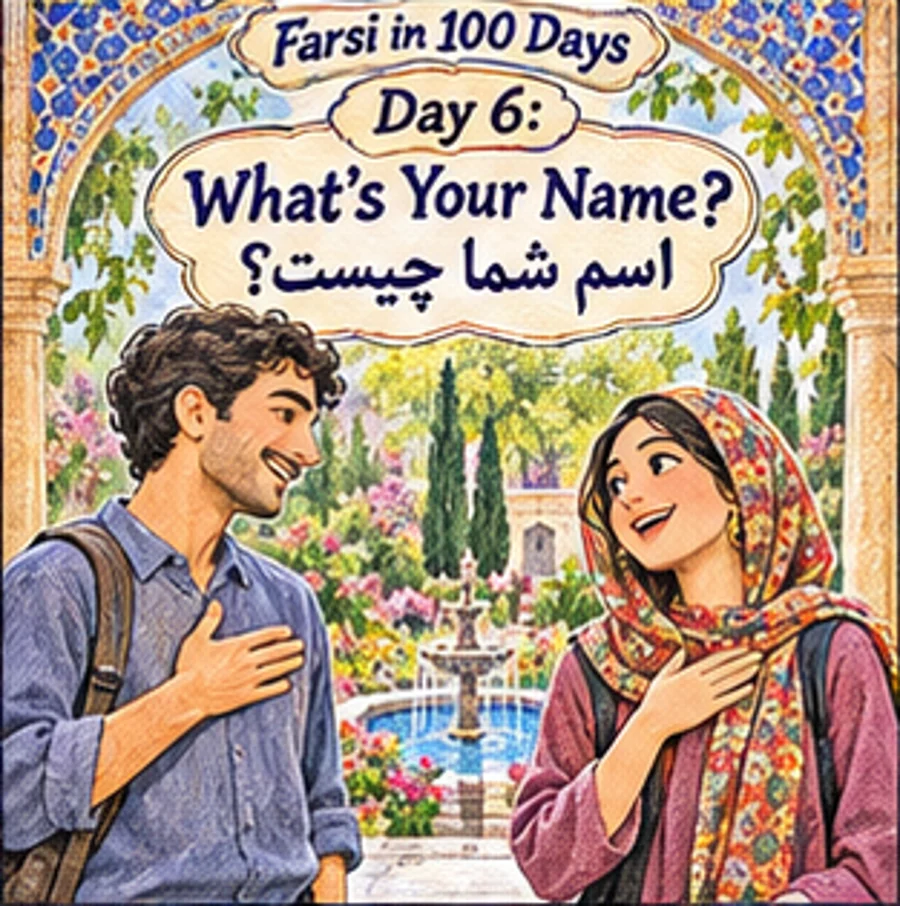
Day 6 of Learn Farsi in 100 Days, our free step-by-step Persian course: What Is Your Name?. The lesson has four parts, with every Persian word in Persian script, pronunciation and English, and each part ends with a quick check.
Part 1Grammar and conversation
Day 6, Part 1 teaches the negative of “to have” (ندارم, nadâram, “I don’t have”; ندارند, nadârand, “they don’t have”) and a first-meeting conversation where Azin and Behnam ask each other’s names (اسم تو چیست؟, esm-e to chist?, “What is your name?”) and say thanks (مرسی, mersi).
Grammar: the negative of “to have”
To say you do not have something, put نـ (na-) in front of the present forms of داشتن (dâshtan, to have): دارم (dâram, I have) becomes ندارم (nadâram, I don’t have). The personal endings stay the same: -am, -i, -ad, -im, -id, -and. The thing you don’t have comes before the verb, as in من خواهر ندارم (man khâhar nadâram, I don’t have a sister).
| Persian | Pronunciation | English |
|---|---|---|
| ندارم | nadâram | I don’t have |
| نداری | nadâri | you (singular) don’t have |
| ندارد | nadârad | he/she doesn’t have |
| نداریم | nadârim | we don’t have |
| ندارید | nadârid | you (plural) don’t have |
| ندارند | nadârand | they don’t have |
Examples
I don’t have a sister.
You don’t have a brother.
They don’t have a house.
Conversation: What is your name?
| Speaker | Persian | English and pronunciation |
|---|---|---|
| Azin آذین | اسم تو چیست؟ | What is your name? esm-e to chist? |
| Behnam بهنام | اسم من بهنام است. تو چی؟ | My name is Behnam. And you? esm-e man behnâm ast. to chi? |
| Azin آذین | من آذین هستم. | I am Azin. man âzin hastam. |
| Behnam بهنام | از دیدن شما خوشبخت هستم. | Nice to meet you! az didan-e shomâ khoshbakht hastam. |
| Azin آذین | شما فارسی را خیلی خوب صحبت میکنید. | You speak Farsi very well. shomâ fârsi râ kheyli khub sohbat mikonid. |
| Behnam بهنام | مرسی! | Thanks. mersi! |
Quick check
- How do you say “we don’t have” in Persian?
Show answer
نداریم (nadârim) - What does من خواهر ندارم mean?
Show answer
man khâhar nadâram, “I don’t have a sister.” - How do you ask a friend “What is your name?”
Show answer
اسم تو چیست؟ (esm-e to chist?)
Part 2Speech vs. writing, grammar and word of the day
Day 6, Part 2 contrasts spoken and written Persian (اسمت چیه؟, esmet chiye?, versus اسم شما چیست؟, “What is your name?”), lists the present personal endings that match each pronoun (من … ـم, -am), and gives the word of the day, فامیلی (fâmili, last name).
Speech vs. writing
In speech, هستم، هستی (hastam, hasti) are usually shortened to an ending on the word before (خوشبختم, khoshbakhtam), -id becomes -in, and چیست (chist) becomes چیه (chiye). The spoken form is on the left of each pair, the written form on the right.
| Spoken | Written | English |
|---|---|---|
| اسمت چیه؟ esmet chiye? | اسم شما چیست؟ esm-e shomâ chist? | What is your name? |
| صحبت میکنین. sohbat mikonin. | صحبت میکنید. sohbat mikonid. | You speak. |
| دیدنتون. didanetun. | دیدن شما. didan-e shomâ. | seeing you |
| تو استادی. to ostâdi. | تو استاد هستی. to ostâd hasti. | You are a professor. |
| خوشبختم. khoshbakhtam. | خوشبخت هستم. khoshbakht hastam. | Nice to meet you (literally: I am happy). |
| من مهندسم. man mohandesam. | من مهندس هستم. man mohandes hastam. | I am an engineer. |
Grammar: present verb endings
Persian verbs show the subject with a personal ending, so each pronoun has its own ending: من (man, I) takes ـم (-am), تو (to, you) takes ـی (-i), ما (mâ, we) takes ـیم (-im), شما (shomâ, you, plural or polite) takes ـید (-id), and آنها or ایشان (ân-hâ, ishân, they) take ـند (-and). The book leaves او (u, he/she) blank: with “to be” it uses است (ast), and with other present verbs it takes -ad, as in دارد (dârad, he/she has).
| Persian | Pronunciation | English |
|---|---|---|
| من ← ـم | man → -am | I |
| تو ← ـی | to → -i | you (singular) |
| او ← … | u → (ast / -ad) | he/she |
| ما ← ـیم | mâ → -im | we |
| شما ← ـید | shomâ → -id | you (plural or polite) |
| آنها – ایشان ← ـند | ân-hâ, ishân → -and | they |
Word of the day: فامیلی (fâmili)
Meaning: last name
What is your last name? My last name is Amiri.
Quick check
- What is the written form of the spoken خوشبختم (khoshbakhtam)?
Show answer
خوشبخت هستم (khoshbakht hastam), “Nice to meet you” - Which ending goes with ما (mâ, we)?
Show answer
ـیم (-im) - How do you ask “What is your last name?”
Show answer
فامیلی شما چیست؟ (fâmili-ye shomâ chist?)
Part 3Numbers, common phrases and idiom of the day
Day 6, Part 3 counts by tens from ده (dah, 10) to صد (sad, 100), teaches everyday phrases such as متوجه نمیشوم! (motevajjeh nemishavam, “I don’t understand!”) and فشار دهید (feshâr dahid, “Push”), and explains the idiom دستپاچه شدن (dastpâche shodan, to get flustered).
Numbers: the tens
Persian words run right to left, but numbers are written from left to right, just as in English. Each row shows the Persian digits, the Western digits and the word.
| Persian digits | Number | Word | Pronunciation |
|---|---|---|---|
| ۱۰ | 10 | ده | dah |
| ۲۰ | 20 | بیست | bist |
| ۳۰ | 30 | سی | si |
| ۴۰ | 40 | چهل | chehel |
| ۵۰ | 50 | پنجاه | panjâh |
| ۶۰ | 60 | شصت | shast |
| ۷۰ | 70 | هفتاد | haftâd |
| ۸۰ | 80 | هشتاد | hashtâd |
| ۹۰ | 90 | نود | navad |
| ۱۰۰ | 100 | صد | sad |
Common phrases
| Persian | Pronunciation | English |
|---|---|---|
| روز خوبی داشته باشی! | ruz-e khubi dâshte bâshi! | Have a nice day! |
| متوجه نمیشوم! | motevajjeh nemishavam! | I don’t understand! |
| خوشحال شدم دیدمت! | khoshhâl shodam didamet! | Glad to see you! |
| چقدر طول میکشد؟ | cheghadr tul mikeshad? | How long does it take? |
| ببین! | bebin! | Look! |
| فشار دهید. | feshâr dahid. | Push. |
| از کی باید بپرسم؟ | az ki bâyad beporsam? | Whom should I ask? |
| بکشید. | bekeshid. | Pull. |
Idiom of the day
دستپاچه شدن
dastpâche shodan
Word for word: to become hand-and-leg (in a fluster)
Meaning in Persian: گیج شدن، عجله کردن، با عجله کار کردن.
Meaning: To get confused, to rush, to do things in a hurry.
English equivalent: I got cold feet.
Quick check
- How do you write and say 60 in Persian?
Show answer
۶۰, شصت (shast) - What does بکشید (bekeshid) mean on a door?
Show answer
Pull. - What does دستپاچه شدن (dastpâche shodan) mean?
Show answer
To get flustered: confused and rushing.
Part 4Reading and new words
Day 6, Part 4 is a short reading in which Sara introduces her family (من یک خواهر و یک برادر دارم, “I have a sister and a brother”) and a vocabulary list with words like نام خانوادگی (nâm-e khânevâdegi, last name) and زندگی کردن (zendegi kardan, to live).
Reading: Sara’s family
اسم من سارا است. نام خانوادگی من کیانی است. من یک خواهر و یک برادر دارم.
My name is Sara. My last name is Kiani. I have one sister and one brother.
خواهر من ایران زندگی میکند. برادر من آمریکا زندگی میکند.
My sister lives in Iran. My brother lives in America.
New words
| Persian | Pronunciation | English |
|---|---|---|
| چیست؟ | chist? | what is it? |
| خوشبخت | khoshbakht | lucky, happy |
| نام خانوادگی | nâm-e khânevâdegi | last name |
| داشتن | dâshtan | to have |
| گیج شدن | gij shodan | to be confused |
| دستپاچه | dastpâche | flustered, confused |
| خواهر | khâhar | sister |
| برادر | barâdar | brother |
| زندگی کردن | zendegi kardan | to live |
| رفتن | raftan | to go |
| ماندن | mândan | to stay |
| کلمه | kalame | word |
| بعضی | ba’zi | some |
| دنیا | donyâ | world |
| زشت | zesht | ugly |
| پشت | posht | back |
| هفته | hafte | week |
| حالا | hâlâ | now |
| سر | sar | head, top |
| قیمت | gheymat | price, fee |
| جمعه | jom’e | Friday |
| وقت | vaght | time |
| دوست | dust | friend |
| سفر | safar | trip |
| شاید | shâyad | maybe |
| باید | bâyad | must |
| قشنگ | ghashang | beautiful |
| نزدیک | nazdik | near |
| شماره | shomâre | number |
| راه | râh | path, way |
| مردم | mardom | people |
| اول | avval | first |
| دور | dur | far |
| پلیس | polis | police |
| سخت | sakht | hard |
Quick check
- Where does Sara’s brother live?
Show answer
In America: برادر من آمریکا زندگی میکند (barâdar-e man âmrikâ zendegi mikonad). - What is Sara’s last name?
Show answer
کیانی (kiyâni), Kiani - What is the opposite of نزدیک (nazdik, near)?
Show answer
دور (dur), far
Take this lesson further

Study with the book
Learn Farsi in 100 Days: The Ultimate Crash Course to Learning Farsi Fast
This free lesson is part of Learn Farsi in 100 Days. The book puts the whole series in one printable PDF you can study offline.
Serious about Persian? Get all 30 of our Persian learning books for $199.99 (0% less than buying them one by one).
Free Persian Starter Pack: Alphabet + 100 Core Words
Get the 14-page printable Starter Pack (all 32 letters, a 7-day reading plan, 100 core words and 20 survival phrases) and a short 5-email course. Free.
Free. Every morning: that day’s four videos and the full lessons, with every Persian word, its pronunciation and its English meaning. Stop or pause with one click.