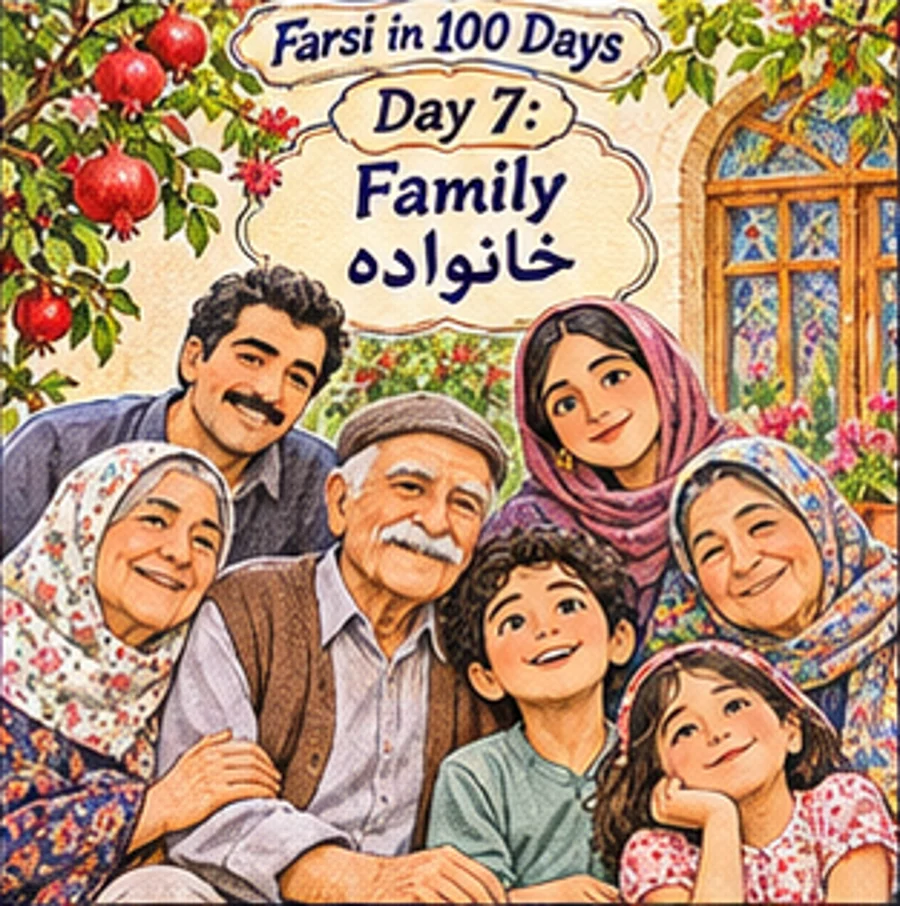
Day 7 of Learn Farsi in 100 Days, our free step-by-step Persian course: Family. The lesson has four parts, with every Persian word in Persian script, pronunciation and English, and each part ends with a quick check.
Part 1Grammar and conversation
Day 7, Part 1 introduces the ezâfe, the short -e sound that links two words and shows possession (کتاب من, ketâb-e man, “my book”; ماشین او, mâshin-e u, “his/her car”), and a conversation about children (چند تا بچه داری؟, chand tâ bachche dâri?, “How many children do you have?”).
Grammar: the ezâfe (possessive -e)
Persian links a noun to the word that follows it with a short -e sound, called ezâfe (the book calls it حرف اضافه). It sounds like the “e” in “men” and is usually not written, so کتاب من is read ketâb-e man, “my book” (literally “book of me”). The owner comes after the thing owned, and the same -e also joins a noun to an adjective. After a vowel the link becomes -ye.
| Persian | Pronunciation | English |
|---|---|---|
| مداد شما | medâd-e shomâ | your pencil |
| کیف آنها | kif-e ân-hâ | their bags |
| کفش تو | kafsh-e to | your shoes |
| کتاب من | ketâb-e man | my book |
| لباس ما | lebâs-e mâ | our clothes |
| ماشین او | mâshin-e u | his/her car |
Conversation: Do you have children?
| Speaker | Persian | English and pronunciation |
|---|---|---|
| Donya دنیا | تو بچه داری؟ | Do you have children? to bachche dâri? |
| Ramin رامین | بله. | Yes. bale. |
| Donya دنیا | چند تا بچه داری؟ | How many children do you have? chand tâ bachche dâri? |
| Ramin رامین | دو تا بچه دارم. یک پسر و یک دختر. | I have two kids. A boy and a girl. do tâ bachche dâram. yek pesar va yek dokhtar. |
| Donya دنیا | اسم آنها چیست؟ | What are their names? esm-e ân-hâ chist? |
| Ramin رامین | بهداد و بهار. | Behdad and Bahar. behdâd va bahâr. |
Quick check
- How do you say “our clothes” in Persian?
Show answer
لباس ما (lebâs-e mâ) - What sound links کتاب and من in کتاب من?
Show answer
The ezâfe -e: ketâb-e man, “my book” - How do you ask “How many children do you have?”
Show answer
چند تا بچه داری؟ (chand tâ bachche dâri?)
Part 2Speech vs. writing, grammar and word of the day
Day 7, Part 2 shows spoken shortcuts like اونا (unâ) for آنها (ân-hâ, “they”), teaches the ezâfe after vowels with ی (خانهی تو, khâne-ye to, “your house”; بچهی من, bachche-ye man, “my child”), and gives the word of the day, دوست (dust, friend).
Speech vs. writing
Spoken Persian shortens many common words: یک (yek) becomes یه (ye), â before n turns into u (آنها → اونا, میدانم → میدونم), and the verb endings -ad and -and become -e and -an. The spoken form is on the left of each pair, the written form on the right.
| Spoken | Written | English |
|---|---|---|
| یه. ye. | یک. yek. | one, a |
| میدونم. midunam. | میدانم. midânam. | I know. |
| اونا. unâ. | آنها. ân-hâ. | they |
| متوجه نمیشم. motevajjeh nemisham. | متوجه نمیشوم. motevajjeh nemishavam. | I don’t understand. |
| زندگی میکنن. zendegi mikonan. | زندگی میکنند. zendegi mikonand. | They live. |
| اشکالی نداره. eshkâli nadâre. | اشکالی ندارد. eshkâli nadârad. | It doesn’t matter. / No problem. |
Grammar: the ezâfe after vowels
When a noun ends in a vowel, the ezâfe -e cannot sit directly on it, so a y sound is added: -ye. After words ending in silent ه (-e), such as خانه (khâne, house), it is written ـهی: خانهی تو (khâne-ye to, your house). After و or ا, a ی is added: دانشجوی (dâneshju-ye, student of).
| Persian | Pronunciation | English |
|---|---|---|
| دانشجوی زبان فارسی | dâneshju-ye zabân-e fârsi | Farsi student |
| خانهی تو | khâne-ye to | your house |
| بچهی من | bachche-ye man | my child |
| نامهی آنها | nâme-ye ân-hâ | their letter |
Examples
Our house is big.
My child’s name is Artin.
Word of the day: دوست (dust)
Meaning: friend
I am friends with Mahsa. Shahin is my friend.
Quick check
- How do you say “my child” in Persian?
Show answer
بچهی من (bachche-ye man) - What is the written form of the spoken اونا (unâ)?
Show answer
آنها (ân-hâ), “they” - What does دوست (dust) mean?
Show answer
friend
Part 3Family members, common expressions and idiom of the day
Day 7, Part 3 names family members, including the four Persian words for aunt and uncle such as عمو (amu, father’s brother) and خاله (khâle, mother’s sister), lists short expressions like چرا؟ (cherâ?, “Why?”), and explains the idiom کله پوک (kalle puk, empty-headed).
Family members
Persian has separate words for aunts and uncles on the father’s side and on the mother’s side.
| Persian | Pronunciation | English |
|---|---|---|
| مادربزرگ | mâdarbozorg | grandmother |
| مادر | mâdar | mother |
| پدر | pedar | father |
| پدربزرگ | pedarbozorg | grandfather |
| خواهر | khâhar | sister |
| دختر | dokhtar | daughter |
| پسر | pesar | son |
| برادر | barâdar | brother |
| عمو | amu | uncle (father’s brother) |
| عمه | amme | aunt (father’s sister) |
| دایی | dâyi | uncle (mother’s brother) |
| خاله | khâle | aunt (mother’s sister) |
Common expressions
| Persian | Pronunciation | English |
|---|---|---|
| آره – بله. | âre – bale. | Yes. (informal – polite) |
| چقدر راه است؟ | cheghadr râh ast? | How far is it? |
| خیر – نه. | kheyr – na. | No. (polite – informal) |
| چقدر؟ | cheghadr? | How much? |
| میدانم. | midânam. | I know. |
| چرا؟ | cherâ? | Why? |
| چندتا؟ | chand tâ? | How many? |
| کی؟ | ki? | Who? |
| استعمال دخانیات ممنوع است. | este’mâl-e dokhâniyât mamnu’ ast. | No smoking. |
Idiom of the day
کله پوک
kalle puk
Word for word: hollow head
Meaning in Persian: احمق، نادان. مثال: او کله پوک است.
Meaning: Stupid, ignorant. Example: او کله پوک است (u kalle puk ast), “He/She is empty-headed.”
English equivalent: Thick skull.
Quick check
- What is the Persian word for your mother’s sister?
Show answer
خاله (khâle) - How do you ask “Why?” in Persian?
Show answer
چرا؟ (cherâ?) - What does کله پوک (kalle puk) mean?
Show answer
Empty-headed, stupid (literally “hollow head”).
Part 4Reading and new words
Day 7, Part 4 is a short reading in which Neda names her sister and brother and her classmate Sahar (همکلاسی, hamkelâsi, “classmate”), followed by a vocabulary list with family words like نوه (nave, grandchild), خواهرزاده (khâharzâde, sister’s child) and داماد (dâmâd, son-in-law).
Reading: Neda’s family and friend
اسم من ندا است. من یک خواهر و یک برادر دارم.
My name is Neda. I have one sister and one brother.
اسم خواهر من مهنوش است. اسم برادر من مهیار است.
My sister’s name is Mahnoush. My brother’s name is Mahyar.
من و سحر دوست هستیم. سحر همکلاسی من است.
Sahar and I are friends. Sahar is my classmate.
New words
| Persian | Pronunciation | English |
|---|---|---|
| چند؟ | chand? | how many?, how much? |
| زبان | zabân | language |
| بچه | bachche | child |
| دانستن | dânestan | to know |
| کله | kalle | head |
| احمق | ahmagh | stupid |
| همکلاسی | hamkelâsi | classmate |
| پایین | pâyin | below |
| روز | ruz | day |
| شوهر | shohar | husband |
| آخر | âkhar | end |
| جهان | jahân | world |
| فهمیدن | fahmidan | to understand |
| نادان | nâdân | ignorant, stupid |
| داماد | dâmâd | son-in-law |
| برادرزاده | barâdarzâde | nephew/niece (brother’s child) |
| دانشگاه | dâneshgâh | university |
| نان | nân | bread |
| عدد | adad | number |
| ماه | mâh | moon |
| آدم | âdam | human |
| یخ | yakh | ice |
| یاد گرفتن | yâd gereftan | to learn |
| نوه | nave | grandchild |
| خواهرزاده | khâharzâde | nephew/niece (sister’s child) |
| آرزو | ârezu | wish |
| هیچکس | hichkas | nobody |
| هوا | havâ | weather |
| پرسیدن | porsidan | to ask |
| ازدواج | ezdevâj | marriage |
| مراسم | marâsem | ceremony |
| مردن | mordan | to die |
| بیوه | bive | widow |
| مرد | mard | man |
Quick check
- What is the name of Neda’s brother?
Show answer
مهیار (mahyâr), Mahyar - Who is Sahar?
Show answer
Neda’s friend and classmate: سحر همکلاسی من است (sahar hamkelâsi-ye man ast). - What does نوه (nave) mean?
Show answer
grandchild
Take this lesson further

Study with the book
Learn Farsi in 100 Days: The Ultimate Crash Course to Learning Farsi Fast
This free lesson is part of Learn Farsi in 100 Days. The book puts the whole series in one printable PDF you can study offline.
Serious about Persian? Get all 30 of our Persian learning books for $199.99 (55% less than buying them one by one).
Free Persian Starter Pack: Alphabet + 100 Core Words
Get the 14-page printable Starter Pack (all 32 letters, a 7-day reading plan, 100 core words and 20 survival phrases) and a short 5-email course. Free.
Free. Every morning: that day’s four videos and the full lessons, with every Persian word, its pronunciation and its English meaning. Stop or pause with one click.