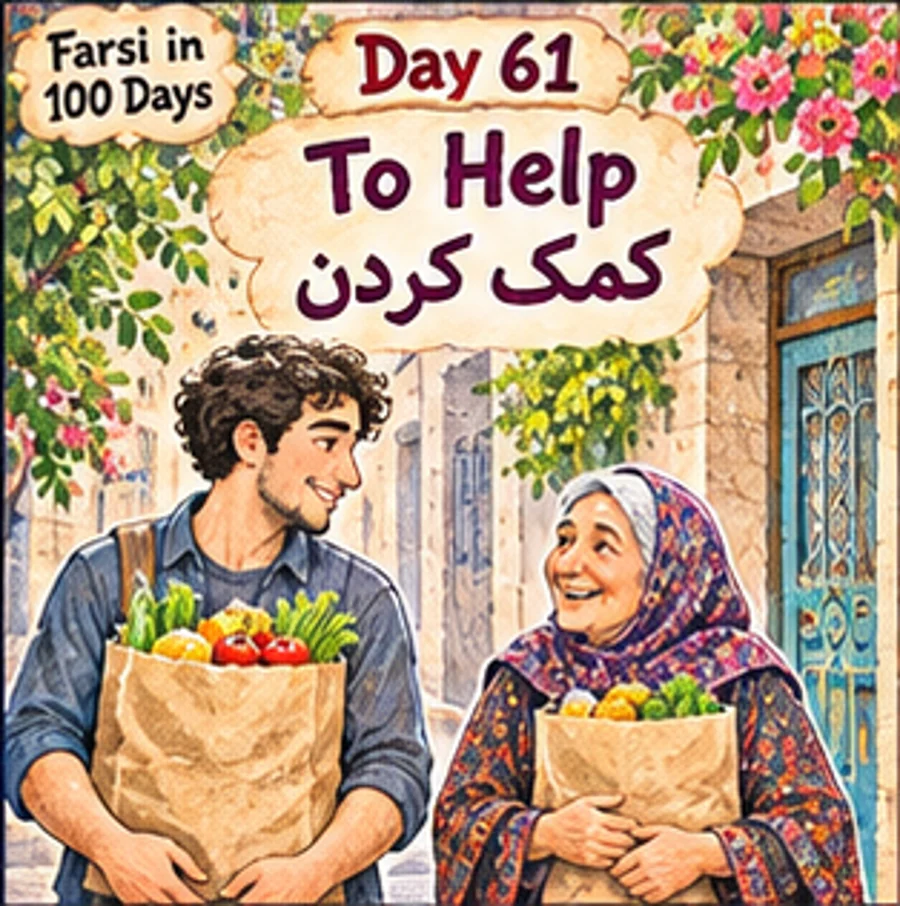
Day 61 of Learn Farsi in 100 Days, our free step-by-step Persian course: Helping. The lesson has four parts, with every Persian word in Persian script, pronunciation and English, and each part ends with a quick check.
Part 1Conversation and grammar
Day 61, Part 1 is a conversation in which Keyvan helps Katayoun find her lost bag, with requests like میتوانی به من کمک کنی؟ (mitavâni be man komak koni?, can you help me?), and introduces the question words کی (key, when) and چه (che, what).
Conversation: the lost bag
| Speaker | Persian | English and pronunciation |
|---|---|---|
| Katayoun کتایون | ممکن است یک لطفی به من بکنی؟ | Could you do me a favor? momken ast yek lotfi be man bokoni? |
| Keyvan کیوان | حتما! | Sure! hatman! |
| Katayoun کتایون | من کیفم را پیدا نمیکنم. میتوانی به من کمک کنی؟ | I can’t find my bag. Can you help me? man kifam râ peydâ nemikonam. mitavâni be man komak koni? |
| Keyvan کیوان | بله حتما، من اتاق نشیمن را میگردم. | Yes, of course. I’ll search the living room. bale hatman, man otâgh-e neshiman râ migardam. |
| Katayoun کتایون | آیا آن را پیدا کردی؟ | Did you find it? âyâ ân râ peydâ kardi? |
| Keyvan کیوان | نه اینجا نیست. آخرین بار کی آن را دیدهای؟ | No, it isn’t here. When did you last see it? na injâ nist. âkharin bâr key ân râ dide’i? |
| Katayoun کتایون | صبح که به کتابخانه رفتم آن را داشتم. | I had it this morning when I went to the library. sobh ke be ketâbkhâne raftam ân râ dâshtam. |
| Keyvan کیوان | آیا فکر میکنی ممکن است آنجا جا گذاشته باشی؟ | Do you think you might have left it there? âyâ fekr mikoni momken ast ânjâ jâ gozâshte bâshi? |
| Katayoun کتایون | شاید. من با کتابخانه تماس میگیرم و از آنها میپرسم کسی آن را پیدا کرده است. | Maybe. I’ll call the library and ask them if anyone has found it. shâyad. man bâ ketâbkhâne tamâs migiram va az ân-hâ miporsam kasi ân râ peydâ karde ast. |
| Keyvan کیوان | صبر کن! آیا این است؟ | Wait! Is this it? sabr kon! âyâ in ast? |
| Katayoun کتایون | بله، آن کیف من است. ممنون برای اینکه کمک کردی تا آن را پیدا کنم. | Yes, that’s my bag. Thanks for helping me find it. bale, ân kif-e man ast. mamnun barâye inke komak kardi tâ ân râ peydâ konam. |
Grammar: question words
Question words (کلمات سؤالی, kalamât-e so’âli) usually stand in the place of the information being asked about, and the sentence keeps normal Persian word order with the verb at the end. کی (key) asks “when,” and چه (che) asks “what”; چه چیزی (che chizi) means “what thing.” Note that کی pronounced key means “when,” while the same spelling pronounced ki means “who.”
| Persian | Pronunciation | English |
|---|---|---|
| کی | key | when |
| چه | che | what |
Examples
When does the class start?
What do we need for the trip?
Quick check
- How do you say “Can you help me?” in Persian?
Show answer
میتوانی به من کمک کنی؟ (mitavâni be man komak koni?) - Where did Katayoun go in the morning when she still had her bag?
Show answer
To the library: کتابخانه (ketâbkhâne). - Which question word means “when”?
Show answer
کی (key), as in کی کلاس شروع میشود؟ (key kelâs shoru’ mishavad?, When does the class start?)
Part 2Idiom of the day, common phrases, poetry and word of the day
Day 61, Part 2 explains two proverbs, including در حوضی که ماهی نیست قورباغه سپهسالار است (where there are no fish, the frog is commander), gives phrases like یک لطفی در حقم میکنی؟ (would you do me a favor?), a line of Hafez, and the word وفادار (vafâdâr, loyal).
Idiom of the day
در باغ سبز نشاندادن
dar-e bâgh-e sabz neshân dâdan
Word for word: to show (someone) the gate of the green garden
Meaning in Persian: با وعده و وعید فریب دادن.
Meaning: To deceive someone with big promises. (Compare the English “to lead someone up the garden path” or “to promise the moon.”)
Idiom of the day
در حوضی که ماهی نیست قورباغه سپهسالار است.
dar howzi ke mâhi nist ghurbâghe sepahsâlâr ast.
Word for word: In a pool where there are no fish, the frog is the commander-in-chief.
Meaning in Persian: در جایی که آدم شایستهای نیست، آدم ناشایست مدیر میشود.
Meaning: Where there is no capable person, an unqualified person becomes the manager. (Compare the English “In the land of the blind, the one-eyed man is king.”)
Common phrases
| Persian | Pronunciation | English |
|---|---|---|
| چیزی نظرم را جلب کرد. | chizi nazaram râ jalb kard. | There is one thing I noticed. (literally: Something caught my attention.) |
| راهحلی برای این مشکل داری؟ | râh-e hali barâye in moshkel dâri? | Do you have any solution for this problem? |
| یک لطفی در حقم میکنی؟ | yek lotfi dar haghgham mikoni? | Would you do me a favor? |
| همه چیز خوب پیش میرود. | hame chiz khub pish miravad. | Things are going great. |
Poetry: Hafez
A couplet by Hafez (حافظ). The book’s verse translation: “The Saki’s smile is our feeble heart’s remedy; / Bring forth thy hand. For the physician hath come; and the remedy, hath brought.” The Saki (ساقی, sâghi) is the cupbearer who pours the wine.
| Persian | Pronunciation | English |
|---|---|---|
| علاج ضعف دل ما کرشمهی ساقیست | elâj-e za’f-e del-e mâ kereshme-ye sâghist | The cure for our weak heart is the cupbearer’s charming glance; |
| برآر سر که طبیب آمد و دوا آورد | bar-âr sar ke tabib âmad o davâ âvard | raise your head, for the physician has come and brought the remedy. |
Word of the day: وفادار (vafâdâr)
Meaning: loyal
A dog is loyal to its owner.
Quick check
- What does the proverb در باغ سبز نشاندادن (dar-e bâgh-e sabz neshân dâdan) mean?
Show answer
To deceive someone with big promises. - How do you say “Would you do me a favor?” in Persian?
Show answer
یک لطفی در حقم میکنی؟ (yek lotfi dar haghgham mikoni?) - What does وفادار (vafâdâr) mean?
Show answer
loyal, as in سگ به صاحب خود وفادار است (A dog is loyal to its owner).
Part 3Tools, conversation and idiom of the day
Day 61, Part 3 names eight tools such as تبر (tabar, ax) and انبردست (anbordast, pliers), presents a shop conversation that opens with شما کمکی نیاز ندارید؟ (do you need any help?), and explains the idiom کاسه کوزهها را سر کسی شکستن (to make someone the scapegoat).
Tools
| Persian | Pronunciation | English |
|---|---|---|
| تبر | tabar | ax |
| سوهان | sohân | file |
| اره دستی | arre-ye dasti | handsaw |
| انبردست | anbordast | pliers |
| میخ | mikh | nail |
| سمباده | sombâde | sandpaper |
| پیچ | pich | screw, bolt |
| نوار متر | navâr metr | tape measure |
Conversation: buying a handbag
| Speaker | Persian | English and pronunciation |
|---|---|---|
| Salesperson فروشنده | شما کمکی نیاز ندارید؟ | Do you need any help? shomâ komaki niyâz nadârid? |
| Mahnaz مهناز | بله! من به دنبال یک کیف دستی میگردم. | Yes! I’m looking for a handbag. bale! man be donbâl-e yek kif-e dasti migardam. |
| Salesperson فروشنده | همهی کیفهای ما این قسمت هستند. چه نوع کیفی میخواهید؟ | All our bags are in this section. What kind of bag do you want? hame-ye kif-hâ-ye mâ in ghesmat hastand. che no’ kifi mikhâhid? |
| Mahnaz مهناز | یک کیف نسبتا متوسط با رنگ روشن. | A fairly medium-sized bag in a light color. yek kif-e nesbatan motevaset bâ rang-e roshan. |
| Salesperson فروشنده | این چطور است؟ | How about this one? in chetor ast? |
| Mahnaz مهناز | کمی بزرگ است. | It’s a little big. kami bozorg ast. |
| Salesperson فروشنده | این یکی چطور است؟ | How about this one? in yeki chetor ast? |
| Mahnaz مهناز | خوب است. قیمت آن چند است؟ | It’s good. How much is it? khub ast. gheymat-e ân chand ast? |
| Salesperson فروشنده | پنجاه هزار تومان. | Fifty thousand tomans. panjâh hezâr tomân. |
| Mahnaz مهناز | بسیار خوب. همین را میخرم. | Very well. I’ll buy this one. besyâr khub. hamin râ mikharam. |
Idiom of the day
کاسه کوزهها را سر کسی شکستن!
kâse kuze-hâ râ sar-e kasi shekastan!
Word for word: to break the bowls and jugs over someone’s head
Meaning in Persian: فردی را مقصر جلوهدادن و همهی مشکلات را به عهدهی او گذاشتن.
Meaning: To make someone look guilty and put the blame for all the problems on him or her. (Compare the English “to make someone the scapegoat.”)
Quick check
- What is the Persian word for “pliers”?
Show answer
انبردست (anbordast) - What kind of bag is Mahnaz looking for?
Show answer
A fairly medium-sized bag in a light color: یک کیف نسبتا متوسط با رنگ روشن (yek kif-e nesbatan motevaset bâ rang-e roshan). - What does کاسه کوزهها را سر کسی شکستن mean?
Show answer
To make someone look guilty and blame all the problems on him or her (to make someone the scapegoat).
Part 4Reading and new words
Day 61, Part 4 is a reading about برج آزادی (borj-e âzâdi, Azadi Tower), the Tehran landmark once called برج شهیاد (Shahyad Tower), followed by 32 new words such as قورباغه (ghurbâghe, frog), مقصر (moghasser, guilty) and یادبود (yâdbud, commemoration).
Reading: Azadi Tower
برج آزادی یکی از نمادهای شهر تهران است. این برج بیش از چهل سال پیش توسط معمار ایرانی، حسین امانت ساخته شدهاست. برج آزادی در گذشته برج شهیاد نام داشت و برای یادبود جشنهای ۲۵۰۰ سالهی شاهنشاهی ایران طراحی شده بود.
Azadi Tower is one of the symbols of the city of Tehran. The tower was built more than forty years ago by the Iranian architect Hossein Amanat. In the past, Azadi Tower was called Shahyad Tower, and it was designed to commemorate the celebrations of 2,500 years of the Persian monarchy.
میدان آزادی که برج آزادی در آن قرار دارد، بزرگترین میدان شهر تهران است. برج شهیاد، پس از انقلاب ایران در سال ۱۹۷۹ میلادی به نام «برج آزادی» معروف شدهاست.
Azadi Square, where Azadi Tower stands, is the largest square in Tehran. After the Iranian Revolution in 1979, Shahyad Tower became known as “Azadi (Freedom) Tower.”
New words
| Persian | Pronunciation | English |
|---|---|---|
| وعده و وعید | va’de va va’id | promises (and threats) |
| حوض | howz | pool, pond |
| قورباغه | ghurbâghe | frog |
| شایسته | shâyeste | competent, worthy |
| گرو گذاشتن | gerow gozâshtan | to pledge, to pawn |
| ناشایست | nâshâyest | improper, unworthy |
| همهکاره | hamekâre | versatile; in charge of everything |
| مجال | majâl | opportunity, chance |
| جلب کردن | jalb kardan | to attract, to draw (attention) |
| حق | hagh | right |
| ابراز داشتن | ebrâz dâshtan | to express, to show |
| متوسط | motevaset | average, medium |
| پیش رفتن | pish raftan | to progress |
| صبوح | sabuh | morning wine |
| صنم | sanam | idol; beloved |
| آنگاه | ângâh | then |
| فرخ | farrokh | auspicious, blessed |
| پیشآور | pish-âvar | bring forward |
| کثیف | kasif | dirty |
| سینک | sink | sink |
| یادبود | yâdbud | commemoration, memorial |
| وان | vân | bathtub |
| توالت | tuâlet | toilet |
| کوزه | kuze | jug |
| مقصر | moghasser | guilty, at fault |
| جلوه دادن | jelve dâdan | to make (someone or something) appear, to present as |
| آییننامه | âyin-nâme | regulation |
| برفراز | bar-farâz-e | over, above |
| برعهده گذاشتن | bar ohde gozâshtan | to make (someone) responsible for |
| برج | borj | tower |
| قوی بودن | ghavi budan | to be strong |
| نسبتا | nesbatan | relatively, fairly |
Quick check
- Who built Azadi Tower, according to the reading?
Show answer
The Iranian architect Hossein Amanat: معمار ایرانی، حسین امانت (me’mâr-e irâni, hoseyn amânat). - What was Azadi Tower called before 1979?
Show answer
برج شهیاد (borj-e shahyâd), Shahyad Tower - What does قورباغه (ghurbâghe) mean?
Show answer
frog
Take this lesson further

Study with the book
Learn Farsi in 100 Days: The Ultimate Crash Course to Learning Farsi Fast
This free lesson is part of Learn Farsi in 100 Days. The book puts the whole series in one printable PDF you can study offline.
Serious about Persian? Get all 30 of our Persian learning books for $199.99 (55% less than buying them one by one).
Free Persian Starter Pack: Alphabet + 100 Core Words
Get the 14-page printable Starter Pack (all 32 letters, a 7-day reading plan, 100 core words and 20 survival phrases) and a short 5-email course. Free.
Free. Every morning: that day’s four videos and the full lessons, with every Persian word, its pronunciation and its English meaning. Stop or pause with one click.