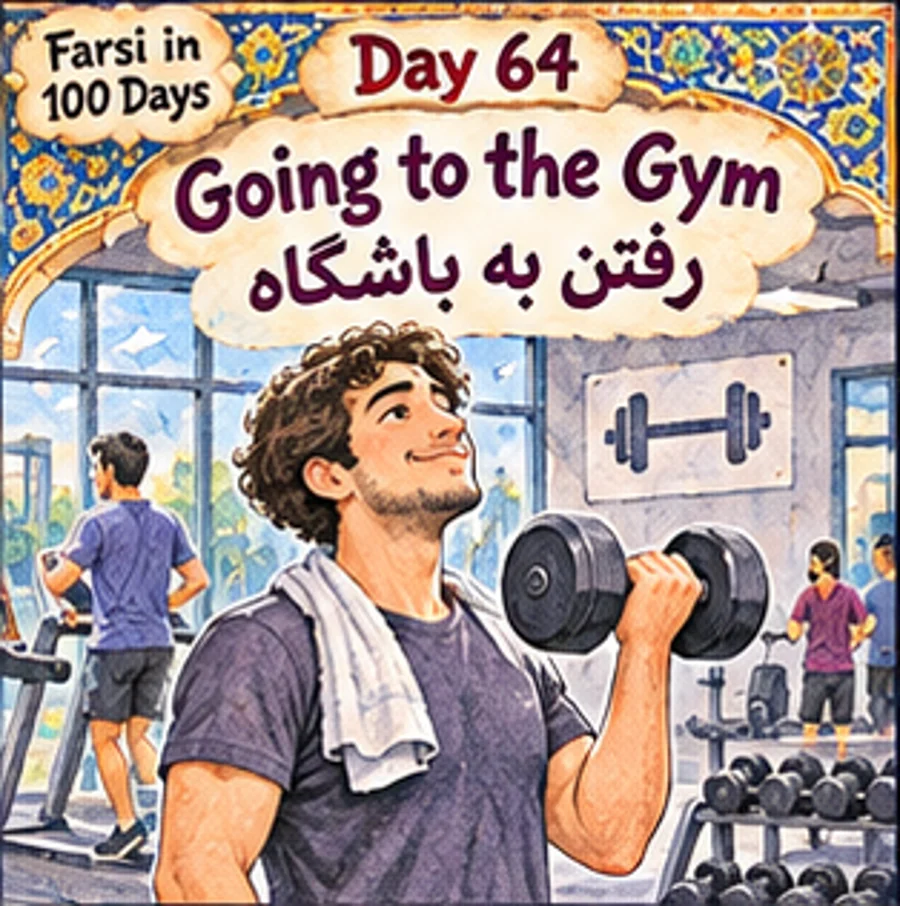
Day 64 of Learn Farsi in 100 Days, our free step-by-step Persian course: Going to the Gym. The lesson has four parts, with every Persian word in Persian script, pronunciation and English, and each part ends with a quick check.
Part 1Conversation and grammar
Day 64, Part 1 is a conversation between Behrad and Arta planning to play بسکتبال (basketbâl, basketball) at the gym, and introduces the adverb, قید (gheyd), with examples like هرگز (hargez, never), هنوز (hanuz, still) and البته (albatte, of course).
Conversation: going to the gym
| Speaker | Persian | English and pronunciation |
|---|---|---|
| Behrad بهراد | امروز میخواهی چه کاری انجام بدهی؟ | What do you want to do today? emruz mikhâhi che kâri anjâm bedahi? |
| Arta آرتا | تمام هفته درس میخواندم، دوست دارم ورزش کنم. | I was studying all week. I’d like to get some exercise. tamâm-e hafte dars mikhândam, dust dâram varzesh konam. |
| Behrad بهراد | من هم همینطور، بیا برویم باشگاه. | Me too. Let’s go to the gym. man ham hamintor, biyâ beravim bâshgâh. |
| Arta آرتا | فکر خوبی است. میخواهی آنجا چه کاری انجام دهیم؟ | Good idea. What do you want us to do there? fekr-e khubi ast. mikhâhi ânjâ che kâri anjâm dahim? |
| Behrad بهراد | ما میتوانیم بسکتبال بازی کنیم. | We can play basketball. mâ mitavânim basketbâl bâzi konim. |
| Arta آرتا | من بازی بسکتبال را دوست دارم. تو خوب بلدی؟ | I like playing basketball. Are you good at it? man bâzi-ye basketbâl râ dust dâram. to khub baladi? |
| Behrad بهراد | نه زیاد، اما بازیش را دوست دارم. من قبلا وقتی مدرسه میرفتم بازی میکردم. | Not very, but I like playing it. I used to play when I went to school. na ziyâd, ammâ bâzish râ dust dâram. man ghablan vaghti madrese miraftam bâzi mikardam. |
| Arta آرتا | میدانم چه میگویی. من قبلا فوتبال زیاد بازی میکردم. فکر میکنی بتوانیم آنجا فوتبال بازی کنیم؟ | I know what you mean. I used to play a lot of soccer. Do you think we can play soccer there? midânam che miguyi. man ghablan futbâl ziyâd bâzi mikardam. fekr mikoni betavânim ânjâ futbâl bâzi konim? |
| Behrad بهراد | نه آنجا فضای کافی ندارد. من فکر میکنم که بهتر است بیرون بازی کنیم، اما امروز هوا خیلی سرد است. | No, there isn’t enough space there. I think it’s better to play outside, but it’s very cold today. na ânjâ fazâ-ye kâfi nadârad. man fekr mikonam ke behtar ast birun bâzi konim, ammâ emruz havâ kheyli sard ast. |
| Arta آرتا | پس صبر میکنیم تا هوا کمی گرمتر شود. | Then we’ll wait until it gets a little warmer. pas sabr mikonim tâ havâ kami garm-tar shavad. |
Grammar: adverbs (قید)
An adverb, قید (gheyd), is a word that shows how the action of a verb happens, or links the meaning of another word to time, place, manner and so on. Adverbs do not change their form, and they usually come before the verb, as in هرگز (hargez, never) or هنوز (hanuz, still, yet). Many adverbs borrowed from Arabic end in -an, written with a final ا: مثلا (masalan), احیانا (ahyânan), اتفاقا (ettefâghan).
| Persian | Pronunciation | English |
|---|---|---|
| قید کلمهای است که چگونگی انجام یافتن فعل را نشان میدهد، یا معنی کلمهی دیگری را به زمان، مکان، حالت و … مرتبط میکند. | gheyd kalame’i ast ke chegunegi-ye anjâm yâftan-e fe’l râ neshân midahad, yâ ma’ni-ye kalame-ye digari râ be zamân, makân, hâlat va … mortabet mikonad. | An adverb is a word that shows how the action of a verb is done, or relates the meaning of another word to time, place, manner, etc. |
| هرگز | hargez | never |
| هنوز | hanuz | still, yet |
| البته | albatte | of course |
| مثلا | masalan | for example |
| احیانا | ahyânan | possibly, by any chance |
| اتفاقا | ettefâghan | as it happens, actually |
Quick check
- What sport do Behrad and Arta plan to play at the gym?
Show answer
Basketball: بسکتبال (basketbâl) - Why can’t they play soccer at the gym?
Show answer
There isn’t enough space: آنجا فضای کافی ندارد (ânjâ fazâ-ye kâfi nadârad). - What is the Persian word for “adverb,” and what does هرگز mean?
Show answer
قید (gheyd); هرگز (hargez) means “never.”
Part 2Idiom of the day, common phrases, poetry and word of the day
Day 64, Part 2 explains three proverbs, including با دمش گردو میشکند (bâ domash gerdu mishekanad, he cracks walnuts with his tail), gives the phrase من اغلب به باشگاه میروم (I often go to the gym), a Khayyam quatrain, and the verb دلسرد کردن (delsard kardan, to discourage).
Idiom of the day
با دمش گردو میشکند.
bâ domash gerdu mishekanad.
Word for word: He cracks walnuts with his tail.
Meaning in Persian: از اتفاق افتاده خیلی شاد و خرسند است.
Meaning: He is delighted with what has happened. (Compare the English “to be over the moon.”)
Idiom of the day
تا نباشد چیزکی، مردم نگویند چیزها
tâ nabâshad chizaki, mardom naguyand chiz-hâ
Word for word: Unless there is a little something, people do not say many things.
Meaning in Persian: حرفهایی که مردم میگویند معمولا بر حقیقت مبتنی است.
Meaning: What people say is usually based on some truth. (Compare the English “Where there’s smoke, there’s fire.”)
Idiom of the day
چرا عاقل کند کاری که باز آرد پشیمانی؟
cherâ âghel konad kâri ke bâz ârad pashimâni?
Word for word: Why would a wise person do something that brings regret later?
Meaning in Persian: در کارها باید آیندهنگر و محتاط بود.
Meaning: In everything you do, you should think ahead and be careful. (Compare the English “Look before you leap.”)
Common phrases
| Persian | Pronunciation | English |
|---|---|---|
| من اغلب به باشگاه میروم و ورزش میکنم. | man aghlab be bâshgâh miravam va varzesh mikonam. | I often go to the gym to work out. |
Poetry: Khayyam
A quatrain (rubâ’i) by Khayyam (خیام) comparing human beings to a cup shaped by a potter. The book gives this English verse: “Another said ‘Why, ne’er a peevish Boy, / Would break the Bowl from which he drank in Joy; / And He that with his hand the Vessel made / Will surely not in after Wrath destroy.'”
| Persian | Pronunciation | English |
|---|---|---|
| ترکیب پیالهای که در هم پیوست | tarkib-e piyâle’i ke dar ham peyvast | A cup whose parts have been joined together, |
| بشکستن آن روا نمیدارد مست | beshkastan-e ân ravâ nemidârad mast | even a drunkard would not think it right to break. |
| چندین سر و پای نازنین از سر و دست | chandin sar o pâ-ye nâzanin az sar o dast | So many lovely heads and feet, heads and hands: |
| از مهر که پیوست و به کین که شکست؟ | az mehr-e ke peyvast o be kin-e ke shekast? | out of whose love were they joined, and out of whose anger were they broken? |
Word of the day: دلسرد کردن (delsard kardan)
Meaning: to discourage, to dishearten
The team’s players were discouraged by the coach’s words.
Quick check
- What does با دمش گردو میشکند (bâ domash gerdu mishekanad) mean?
Show answer
He is delighted with what has happened. - How do you say “I often go to the gym to work out” in Persian?
Show answer
من اغلب به باشگاه میروم و ورزش میکنم (man aghlab be bâshgâh miravam va varzesh mikonam). - What does دلسرد کردن (delsard kardan) mean?
Show answer
to discourage, to dishearten
Part 3Sports equipment, conversation and idiom of the day
Day 64, Part 3 names eight pieces of sports equipment such as کلاه ایمنی (kolâh-e imeni, helmet) and راکت (râket, racket), presents a conversation about joining a gym, and explains the idiom مثل این که برای خر یاسین میخوانی (like reciting scripture to a donkey).
Sports equipment
| Persian | Pronunciation | English |
|---|---|---|
| اسکیت روی یخ | eskeyt-e ru-ye yakh | ice skate |
| چوب بیسبال | chub-e beysbâl | baseball bat |
| کلاه ایمنی | kolâh-e imeni | helmet |
| راکت | râket | racket |
| توپ گلف | tup-e golf | golf ball |
| توپ فوتبال | tup-e futbâl | soccer ball |
| تختهی دارت | takhte-ye dârt | dartboard |
| تیر و کمان | tir o kamân | bow and arrow |
Conversation: joining a gym
| Speaker | Persian | English and pronunciation |
|---|---|---|
| Shokoufeh شکوفه | وزنم خیلی زیاد شده است، باید رژیم بگیرم و ورزش کنم. | I’ve put on a lot of weight. I need to go on a diet and exercise. vaznam kheyli ziyâd shode ast, bâyad rezhim begiram va varzesh konam. |
| Sarvenaz سروناز | من هم همینطور، یک باشگاه خوب نزدیک خانهی ما است. | Me too. There’s a good gym near our house. man ham hamintor, yek bâshgâh-e khub nazdik-e khâne-ye mâ ast. |
| Shokoufeh شکوفه | مربیهای خوبی دارد؟ | Does it have good trainers? morabbi-hâ-ye khubi dârad? |
| Sarvenaz سروناز | بله، همسایهام که به این باشگاه میرود خیلی راضی است. | Yes. My neighbor, who goes to this gym, is very happy with it. bale, hamsâye-am ke be in bâshgâh miravad kheyli râzi ast. |
| Shokoufeh شکوفه | دوست داری باهم به این باشگاه برویم؟ | Would you like us to go to this gym together? dust dâri bâham be in bâshgâh beravim? |
| Sarvenaz سروناز | البته، میتوانیم فردا به آنجا برویم و ثبت نام کنیم. | Of course. We can go there tomorrow and sign up. albatte, mitavânim fardâ be ânjâ beravim va sabt-e nâm konim. |
| Shokoufeh شکوفه | خیلی خوب است. | That’s great. kheyli khub ast. |
Idiom of the day
مثل این که برای خر یاسین میخوانی!
mesl-e in ke barâye khar yâsin mikhâni!
Word for word: It’s as if you’re reciting the Yasin chapter (of the Quran) to a donkey!
Meaning in Persian: کنایه از کار بیهوده است. کار بیفایده انجام دادن.
Meaning: A figure of speech for wasted effort: doing something pointless, especially giving advice to someone who will not listen.
English equivalent: Your words fall on deaf ears.
Quick check
- What is the Persian word for “helmet”?
Show answer
کلاه ایمنی (kolâh-e imeni) - How do you say “We can go there tomorrow and sign up” in Persian?
Show answer
میتوانیم فردا به آنجا برویم و ثبت نام کنیم (mitavânim fardâ be ânjâ beravim va sabt-e nâm konim). - When would you say مثل این که برای خر یاسین میخوانی?
Show answer
When someone’s effort is pointless, for example giving advice to someone who won’t listen; like talking to deaf ears.
Part 4Reading and new words
Day 64, Part 4 is a reading about زاهدان (zâhedân, Zahedan), capital of Sistan and Baluchestan province, once called دزداب (dozdâb), followed by 32 new words such as مربی (morabbi, coach), خرسند (khorsand, happy) and محتاط (mohtât, cautious).
Reading: Zahedan
زاهدان از کلانشهرهای ایران و مرکز استان سیستان و بلوچستان است. نام پیشین آن «دزداب» بودهاست که در زمان رضا شاه به «زاهدان» تغییر یافته است.
Zahedan is one of Iran’s major cities and the capital of Sistan and Baluchestan province. Its former name was Dozdab, which was changed to Zahedan in the time of Reza Shah.
اکثر مردم این شهر به زبان بلوچی و زبان فارسی صحبت میکنند. آب و هوای زاهدان در اکثر روزهای سال گرم و معتدل است. تنها در شبهای زمستان آب و هوای این شهر کمی سرد میشود.
Most people in this city speak Baluchi and Persian. Zahedan’s weather is warm and mild on most days of the year. Only on winter nights does the weather here get a little cold.
New words
| Persian | Pronunciation | English |
|---|---|---|
| چگونگی | chegunegi | how (something is done), manner |
| بنیاد | bonyâd | foundation, basis |
| تسلی دادن | tasalli dâdan | to console, to comfort |
| انجام یافتن | anjâm yâftan | to be done |
| حالت | hâlat | state, manner |
| بلاعوض | belâ-avaz | free of charge, non-repayable |
| توسعه | towse’e | development |
| بشاش | bashshâsh | cheerful |
| مرتبط ساختن | mortabet sâkhtan | to link, to connect |
| مربی | morabbi | coach, trainer |
| راضی | râzi | satisfied |
| احیانا | ahyânan | possibly, by any chance |
| تنومند | tanumand | sturdy |
| اتفاقا | ettefâghan | as it happens, actually |
| دم | dom | tail |
| تهویه | tahviye | ventilation |
| بقالی | baghghâli | grocery store |
| تشریفات | tashrifât | formalities, ceremony |
| بس بودن | bas budan | to be enough, to suffice |
| شکستن | shekastan | to break |
| خرسند | khorsand | happy, pleased |
| دردآور | dardâvar | painful |
| مبتنی بر | mobtani bar | based on |
| دریچه | dariche | small window, hatch |
| آیندهنگر | âyande-negar | forward-looking, far-sighted |
| محتاط | mohtât | cautious |
| پیوستن | peyvastan | to join |
| روا داشتن | ravâ dâshtan | to consider right, to allow |
| مهر | mehr | kindness, love |
| درجه | daraje | degree, grade |
| سزاوار بودن | sezâvâr budan | to deserve |
| کین (کینه) | kin (kine) | hatred, rancor |
Quick check
- What was Zahedan’s former name?
Show answer
دزداب (dozdâb) - Which languages do most people in Zahedan speak?
Show answer
Baluchi and Persian: زبان بلوچی و زبان فارسی (zabân-e baluchi va zabân-e fârsi) - What does مربی (morabbi) mean?
Show answer
coach, trainer
Take this lesson further

Study with the book
Learn Farsi in 100 Days: The Ultimate Crash Course to Learning Farsi Fast
This free lesson is part of Learn Farsi in 100 Days. The book puts the whole series in one printable PDF you can study offline.
Serious about Persian? Get all 30 of our Persian learning books for $199.99 (55% less than buying them one by one).
Free Persian Starter Pack: Alphabet + 100 Core Words
Get the 14-page printable Starter Pack (all 32 letters, a 7-day reading plan, 100 core words and 20 survival phrases) and a short 5-email course. Free.
Free. Every morning: that day’s four videos and the full lessons, with every Persian word, its pronunciation and its English meaning. Stop or pause with one click.