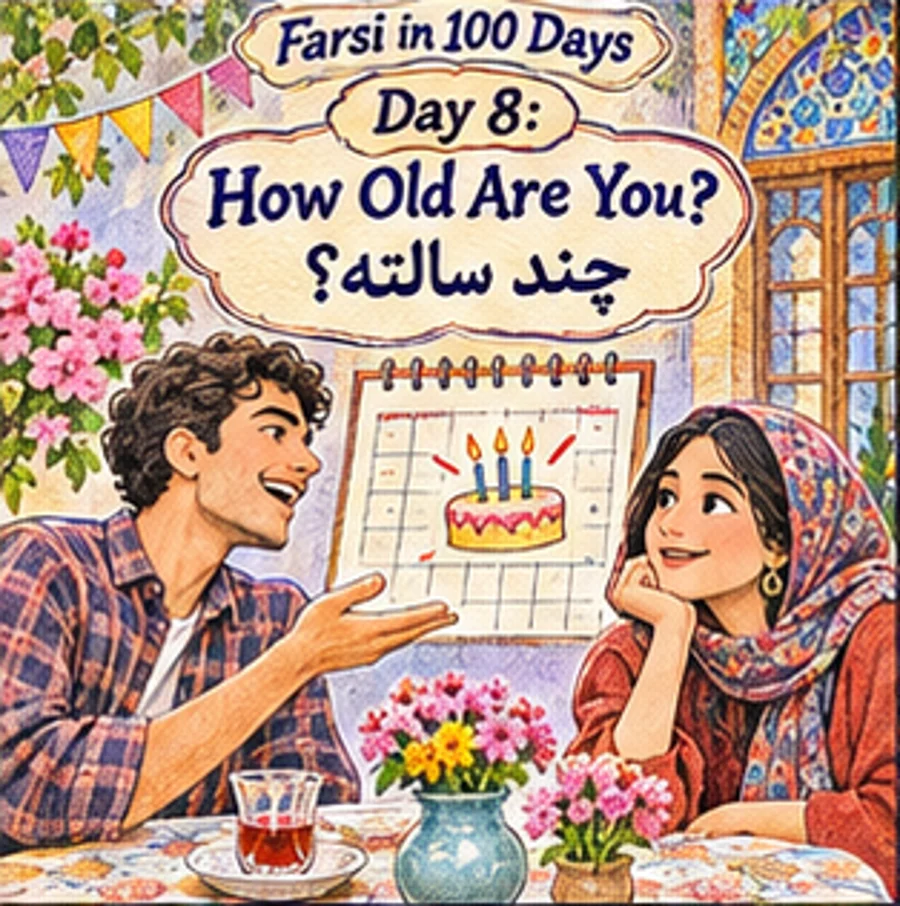
Day 8 of Learn Farsi in 100 Days, our free step-by-step Persian course: How Old Are You?. The lesson has four parts, with every Persian word in Persian script, pronunciation and English, and each part ends with a quick check.
Part 1Grammar and conversation
Day 8, Part 1 explains the question word چیست (chist, “what is it?”), a short form of چه است, as in این چیست؟ (in chist?, “What is this?”), and a conversation about age and family: چند سال دارد؟ (chand sâl dârad?, “How old is he?”) and مجرد (mojarrad, single).
Grammar: the question word چیست (what is it?)
چیست (chist) means “what is it?” and is a short form of چه است (che ast) or چی است (chi ast): the question word چه or چی (“what”) joined to است (ast, “is”). It goes at the end of the sentence, after the thing you are asking about. The same pattern with کی (ki, who) gives کیست (kist, “who is it?”).
Examples
What is this?
What is your name?
Conversation: How old is he?
| Speaker | Persian | English and pronunciation |
|---|---|---|
| Parham پرهام | این کیست؟ | Who is this? in kist? |
| Arman آرمان | برادرم است. | He is my brother. barâdaram ast. |
| Parham پرهام | چند سال دارد؟ | How old is he? chand sâl dârad? |
| Arman آرمان | پانزده سال دارد. | He is 15 years old. pânzdah sâl dârad. |
| Parham پرهام | اسم او چیست؟ | What is his name? esm-e u chist? |
| Arman آرمان | اسم او آرش است. | His name is Arash. esm-e u ârash ast. |
| Parham پرهام | آیا او متأهل است؟ | Is he married? âyâ u mote’ahhel ast? |
| Arman آرمان | نه، او مجرد است. | No, he is single. na, u mojarrad ast. |
Quick check
- What two words make up چیست (chist)?
Show answer
چه (che, what) + است (ast, is) - How do you ask “How old is he?”
Show answer
چند سال دارد؟ (chand sâl dârad?) - What is the Persian word for “married”?
Show answer
متأهل (mote’ahhel); “single” is مجرد (mojarrad).
Part 2Speech vs. writing, grammar and word of the day
Day 8, Part 2 shows how speech turns است (ast) into a short -e (کیه؟, kiye?, for کی است؟, “Who is it?”), teaches yes/no questions with آیا (âyâ), as in آیا او استاد شما است؟ (“Is he/she your teacher?”), and gives the word of the day, سال (sâl, year).
Speech vs. writing
In speech, است (ast, is) usually becomes a short -e attached to the word before it (برادرمه, barâdarame), and a possessive like اسم او (esm-e u) is said with the ending -esh (اسمش, esmesh). The spoken form is on the left of each pair, the written form on the right.
| Spoken | Written | English |
|---|---|---|
| کیه؟ kiye? | کی است؟ ki ast? | Who is it? |
| متأهله. mote’ahhele. | متأهل است. mote’ahhel ast. | He/She is married. |
| برادرمه. barâdarame. | برادر من است. barâdar-e man ast. | He is my brother. |
| مجرده. mojarrade. | مجرد است. mojarrad ast. | He/She is single. |
| چند سالشه؟ chand sâleshe? | چند سال دارد؟ chand sâl dârad? | How old is he/she? |
| اسمش. esmesh. | اسم او. esm-e u. | his/her name |
Grammar: questions with آیا
In written Persian, a yes/no question can begin with آیا (âyâ), a question marker with no English equivalent; the rest of the sentence keeps normal statement word order and ends with a question mark. In everyday speech آیا is usually dropped and the question is shown by rising intonation alone.
Examples
Is this your notebook?
Is he/she your teacher?
Is your name Neda?
Word of the day: سال (sâl)
Meaning: year
He/She is one year old. New year. Last year.
Quick check
- What is the written form of the spoken کیه؟ (kiye?)
Show answer
کی است؟ (ki ast?), “Who is it?” - Turn او استاد شما است into a written yes/no question.
Show answer
آیا او استاد شما است؟ (âyâ u ostâd-e shomâ ast?), “Is he/she your teacher?” - How do you say “last year” in Persian?
Show answer
سال گذشته (sâl-e gozashte)
Part 3Family members, common phrases and idiom of the day
Day 8, Part 3 adds more family words such as مادرزن (mâdarzan, wife’s mother) and پسرخاله (pesarkhâle, cousin), phrases about marital status like من مجرد هستم (man mojarrad hastam, “I am single”), and the idiom با کله آمد (bâ kalle âmad, “he came running”).
Family members
| Persian | Pronunciation | English |
|---|---|---|
| نوه | nave | grandchild |
| برادرزاده | barâdarzâde | nephew, niece (brother’s child) |
| خواهرزاده | khâharzâde | nephew, niece (sister’s child) |
| دخترخاله | dokhtarkhâle | cousin (daughter of mother’s sister) |
| پسرخاله | pesarkhâle | cousin (son of mother’s sister) |
| مادرزن | mâdarzan | mother-in-law (wife’s mother) |
| داماد | dâmâd | son-in-law |
| مادرشوهر | mâdarshohar | mother-in-law (husband’s mother) |
Common phrases
| Persian | Pronunciation | English |
|---|---|---|
| من ازدواج کردم. | man ezdevâj kardam. | I am married. |
| من تنها هستم. | man tanhâ hastam. | I am alone. |
| من مجرد هستم. | man mojarrad hastam. | I am single. |
| من با نامزدم هستم. | man bâ nâmzadam hastam. | I am with my fiancé(e). |
| کی همراه شما است؟ | ki hamrâh-e shomâ ast? | Who is with you? |
| من طلاق گرفتم. | man talâgh gereftam. | I am divorced. |
| من با خانوادهام هستم. | man bâ khânevâde-am hastam. | I am with my family. |
| من برای کار آمدم. | man barâye kâr âmadam. | I am on business. |
Idiom of the day
با کله آمد!
bâ kalle âmad!
Word for word: He came with his head!
Meaning in Persian: سریع آمد. مثال: او برای ناهار با کله آمد.
Meaning: He came quickly. Example: او برای ناهار با کله آمد (u barâye nâhâr bâ kalle âmad), “He came running for lunch.”
English equivalent: He came running!
Quick check
- What is the Persian word for a wife’s mother?
Show answer
مادرزن (mâdarzan) - How do you say “I am single”?
Show answer
من مجرد هستم (man mojarrad hastam) - What does با کله آمد (bâ kalle âmad) mean?
Show answer
He came running (came very quickly).
Part 4Reading and new words
Day 8, Part 4 is a reading about a brother and sister’s ages, using بیست و پنج سال دارد (bist-o panj sâl dârad, “he is twenty-five”), plus a vocabulary list with words like جوان (javân, young), متولد شدن (motevalled shodan, to be born) and نوزاد (nowzâd, baby).
Reading: My sister and brother
اسم خواهر من مهناز است. اسم برادر من فرهاد است.
My sister’s name is Mahnaz. My brother’s name is Farhad.
برادر من بیست و پنج سال دارد. خواهر من دوازده سال دارد. مهناز مجرد است. فرهاد متأهل است.
My brother is twenty-five years old. My sister is twelve years old. Mahnaz is single. Farhad is married.
New words
| Persian | Pronunciation | English |
|---|---|---|
| چی است؟ | chi ast? | what is it? |
| خوشتیپ | khoshtip | handsome, stylish |
| حرف زدن | harf zadan | to talk |
| مجرد | mojarrad | single |
| متأهل | mote’ahhel | married |
| سریع | sari’ | fast |
| آمدن | âmadan | to come |
| فوری | fowri | urgent, immediate |
| کجا؟ | kojâ? | where? |
| برای | barâye | for |
| نگاه کردن | negâh kardan | to look (at) |
| پیر | pir | old (of people) |
| بازی کردن | bâzi kardan | to play |
| جوان | javân | young |
| متولد شدن | motevalled shodan | to be born |
| کودک | kudak | child |
| نوزاد | nowzâd | baby |
| بزرگ شدن | bozorg shodan | to grow up |
| سن | sen | age |
| توانستن | tavânestan | to be able to |
| روی | ru-ye | on |
| شستن | shostan | to wash |
| مکان | makân | place |
| داستان | dâstân | story |
| تمیز کردن | tamiz kardan | to clean |
| طلاق | talâgh | divorce |
| ترش | torsh | sour |
| چشیدن | chashidan | to taste |
| جواب دادن | javâb dâdan | to answer |
| دستمال | dastmâl | napkin |
| کمد | komod | closet, dresser |
| لباس | lebâs | clothes, dress |
| آیینه | âyine | mirror |
| ظرف | zarf | dish |
| عروسک | arusak | doll |
| شیرین | shirin | sweet |
Quick check
- How old is Farhad?
Show answer
Twenty-five: برادر من بیست و پنج سال دارد (barâdar-e man bist-o panj sâl dârad). - Which of the two is married?
Show answer
Farhad: فرهاد متأهل است (farhâd mote’ahhel ast). - What does نوزاد (nowzâd) mean?
Show answer
baby
Take this lesson further

Study with the book
Learn Farsi in 100 Days: The Ultimate Crash Course to Learning Farsi Fast
This free lesson is part of Learn Farsi in 100 Days. The book puts the whole series in one printable PDF you can study offline.
Serious about Persian? Get all 30 of our Persian learning books for $199.99 (0% less than buying them one by one).
Free Persian Starter Pack: Alphabet + 100 Core Words
Get the 14-page printable Starter Pack (all 32 letters, a 7-day reading plan, 100 core words and 20 survival phrases) and a short 5-email course. Free.
Free. Every morning: that day’s four videos and the full lessons, with every Persian word, its pronunciation and its English meaning. Stop or pause with one click.