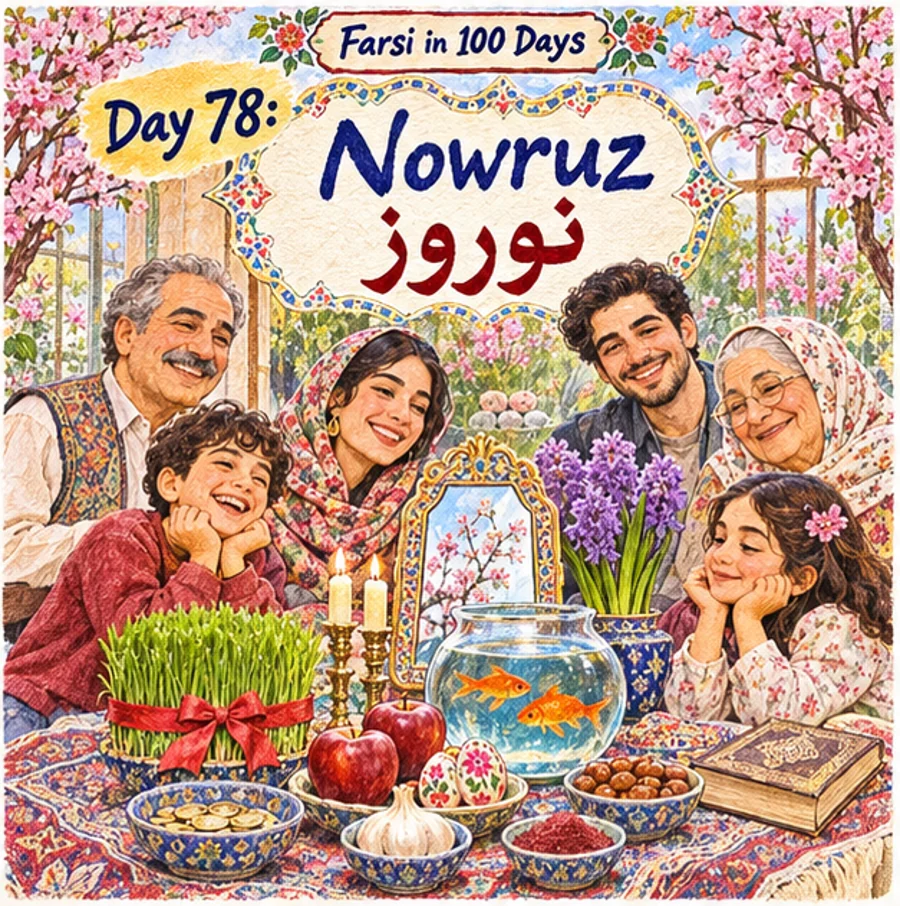
Day 78 of Learn Farsi in 100 Days, our free step-by-step Persian course: Nowruz, the Persian New Year. The lesson has four parts, with every Persian word in Persian script, pronunciation and English, and each part ends with a quick check.
Part 1Conversation and joke
Day 78, Part 1 has a conversation between Behnaz and Asal about going shopping before Nowruz (نوروز, nowruz), with phrases like کار خاصی نمیکنم (kâr-e khâssi nemikonam, I’m not doing anything special), and a joke about a student sleeping in class (سر کلاس, sar-e kelâs).
Conversation: shopping before Nowruz
| Speaker | Persian | English and pronunciation |
|---|---|---|
| Behnaz بهناز | تقریبا نوروز است. تو آخر هفته چهکار میکنی؟ | It’s almost Nowruz. What are you doing this weekend? taghriban nowruz ast. to âkhar-e hafte chekâr mikoni? |
| Asal عسل | کار خاصی نمیکنم، فقط کار. چرا میپرسی؟ | Nothing special, just work. Why do you ask? kâr-e khâssi nemikonam, faghat kâr. cherâ miporsi? |
| Behnaz بهناز | من هنوز خریدهایم را تمام نکردهام. میخواهی با من آخر هفته به خرید بیایی؟ | I still haven’t finished my shopping. Do you want to come shopping with me this weekend? man hanuz kharid-hâyam râ tamâm nakarde-am. mikhâhi bâ man âkhar-e hafte be kharid biyâyi? |
| Asal عسل | من دوست دارم بیایم، اما مطمئن نیستم بتوانم. چرا نمیآیی چهارشنبه به جایش برویم؟ | I’d like to come, but I’m not sure I can. Why don’t we go on Wednesday instead? man dust dâram biyâyam, ammâ motma’en nistam betavânam. cherâ nemiâyi chahârshanbe be jâyash beravim? |
| Behnaz بهناز | چهارشنبه خوب نیست. من فکر میکنم مغازهها خیلی شلوغ هستند. | Wednesday isn’t good. I think the shops will be very crowded. chahârshanbe khub nist. man fekr mikonam maghâze-hâ kheyli sholugh hastand. |
| Asal عسل | بسیار خوب. پس سعی میکنیم آخر هفته برویم. | All right. Then we’ll try to go on the weekend. besyâr khub. pas sa’y mikonim âkhar-e hafte beravim. |
| Behnaz بهناز | بله. خوب است. | Yes. That’s good. bale. khub ast. |
Joke: sleeping in class
معلمی در کلاس در حال درس دادن بود که ناگهان بر سر دانشآموزی فریاد زد و گفت: «تو نمیتوانی سر کلاس من بخوابی!»
A teacher was teaching a class when he suddenly shouted at a student, “You can’t sleep in my class!”
دانشآموز در حالی که چشمان خود را میمالید جواب داد:
Rubbing his eyes, the student answered:
«درست است آقای معلم چون شما خیلی بلند حرف میزنید»
“That’s true, sir, because you talk very loudly.”
Quick check
- How do you say “I’m not doing anything special” in Persian?
Show answer
کار خاصی نمیکنم. (kâr-e khâssi nemikonam.) - Why doesn’t Behnaz want to go shopping on Wednesday?
Show answer
She thinks the shops will be very crowded: مغازهها خیلی شلوغ هستند (maghâze-hâ kheyli sholugh hastand). - In the joke, why does the student say he can’t sleep in class?
Show answer
because the teacher talks very loudly: خیلی بلند حرف میزنید (kheyli boland harf mizanid)
Part 2Common phrases, poetry and word of the day
Day 78, Part 2 gives shopping phrases such as دنبال چرخ دستی میگردم (donbâl-e charkh dasti migardam, I’m looking for a shopping cart) and پوشاک مردانه (pushâk-e mardâne, menswear), a quatrain by Khayyam on enjoying life, and the word سقوط (soghut, fall, crash).
Common phrases
| Persian | Pronunciation | English |
|---|---|---|
| دنبال چرخ دستی میگردم. | donbâl-e charkh dasti migardam. | I’m looking for a shopping cart (trolley). |
| ممکن است بگویید صندوق کجاست؟ | momken ast beguyid sandugh kojâst? | Could you tell me where the cashier is? |
| من مشتری دائمی اینجا هستم. | man moshtari-ye dâemi-ye injâ hastam. | I’m a regular customer here. |
| پوشاک مردانه در کدام طبقه است؟ | pushâk-e mardâne dar kodâm tabaghe ast? | Which floor is menswear on? |
Poetry: Khayyam
A quatrain (robâ’i) by Omar Khayyam. The book gives Edward FitzGerald’s English version: “Ah, make the most of what we yet may spend, / Before we too into the Dust descend; / Dust into Dust, and under Dust to lie, / Sans Wine, sans Song, sans Singer, and — sans End!”
| Persian | Pronunciation | English |
|---|---|---|
| مگذار که غصه در کنارت گیرد | magozâr ke ghosse dar kenârat girad | Do not let sorrow hold you in its arms, |
| و اندوه محال روزگارت گیرد | v-andoh-e mahâl ruzegârat girad | or pointless grief take over your days. |
| مگذار کتاب و لب آب و لب کشت | magozâr ketâb o lab-e âb o lab-e kesht | Do not give up books, the riverbank and the edge of the fields, |
| زان پیش که خاک در حصارت گیرد | zân pish ke khâk dar hesârat girad | before the earth closes around you. |
Word of the day: سقوط (soghut)
Meaning: fall, crash
The passengers were afraid the plane would crash.
Quick check
- How do you say “I’m a regular customer here” in Persian?
Show answer
من مشتری دائمی اینجا هستم. (man moshtari-ye dâemi-ye injâ hastam.) - What does صندوق (sandugh) mean in a store?
Show answer
the cashier, the checkout (literally “box, till”) - What does سقوط کردن (soghut kardan) mean when said of a plane?
Show answer
to crash, to fall
Part 3Idiom of the day and conversation
Day 78, Part 3 explains the proverbs حرفش را به کرسی نشاند (harfash râ be korsi neshând, he got his way) and کلکش را کندند (they finished him off), a conversation about Nowruz plans and a wedding (عروسی, arusi), and the idiom خواستن توانستن است (where there’s a will, there’s a way).
Idiom of the day
حرفش را به کرسی نشاند.
harfash râ be korsi neshând.
Word for word: He sat his word on the chair (of honor).
Meaning in Persian: هنگامی که شخصی برای اثبات حرفهای خود پافشاری کند و حرفش را به دیگران تحمیل کند میگویند: «حرفش را به کرسی نشاند.»
Meaning: When someone insists on proving what they say and forces their view on others, people say, “He got his way (made his word win).”
English equivalent: He made his point stick; he got his way.
Idiom of the day
کلکش را کندند.
kalakash râ kandand.
Word for word: They pulled out his trick (dug up his reed).
Meaning in Persian: این ضربالمثل هنگامی بهکار میرود که شخصی را از بین ببرند یا ضرری به او رسانند و از جایی بیرونش کنند. در این موارد گفته میشود: کلکش را کندند.
Meaning: This proverb is used when people do away with someone, or harm him and throw him out of a place. In such cases it is said, “They finished him off.”
English equivalent: They finished him off; they got rid of him.
Conversation: plans for Nowruz
| Speaker | Persian | English and pronunciation |
|---|---|---|
| Sadaf صدف | برنامهات برای عید نوروز چیست؟ | What are your plans for Nowruz? barnâme-at barâ-ye eyd-e nowruz chist? |
| Sayeh سایه | هنوز تصمیم قطعی نگرفتم. اما با خانواده به مسافرت میرویم. | I haven’t made a final decision yet, but we’re going on a trip with the family. hanuz tasmim-e ghat’i nagereftam. ammâ bâ khânevâde be mosâferat miravim. |
| Sadaf صدف | ما یک مراسم عروسی داریم. باید برای مراسم لباس بخرم. | We have a wedding. I have to buy clothes for the ceremony. mâ yek marâsem-e arusi dârim. bâyad barâ-ye marâsem lebâs bekharam. |
| Sayeh سایه | عروسی کی؟ | Whose wedding? arusi-ye ki? |
| Sadaf صدف | عروسی برادرم. روز پنجم فروردین است. من هنوز خریدهایم را انجام ندادهام. | My brother’s wedding. It’s on the fifth of Farvardin. I haven’t done my shopping yet. arusi-ye barâdaram. ruz-e panjom-e farvardin ast. man hanuz kharid-hâyam râ anjâm nadâde-am. |
| Sayeh سایه | خوب من شنیدهام فروشگاه آریا پیراهنهای جدیدی آورده است. آنجا رفتهای؟ | Well, I’ve heard the Arya store has brought in some new dresses. Have you been there? khob, man shenide-am forushgâh-e âriyâ pirâhan-hâ-ye jadidi âvarde ast. ânjâ rafte-i? |
| Sadaf صدف | نه نرفتهام. پس آخر هفته میروم. کاش بتوانم یک پیراهن زیبا پیدا کنم. | No, I haven’t. I’ll go this weekend, then. I hope I can find a beautiful dress. na, narafte-am. pas âkhar-e hafte miravam. kâsh betavânam yek pirâhan-e zibâ peydâ konam. |
Idiom of the day
خواستن توانستن است!
khâstan tavânestan ast!
Word for word: Wanting is being able!
Meaning in Persian: آنچه را انسان بخواهد میتواند به دست آورد.
Meaning: Whatever a person really wants, they can achieve.
English equivalent: Where there’s a will, there’s a way.
Quick check
- Whose wedding is Sadaf going to, and when is it?
Show answer
her brother’s: عروسی برادرم (arusi-ye barâdaram), on the fifth of Farvardin - What does حرفش را به کرسی نشاند (harfash râ be korsi neshând) mean?
Show answer
He insisted until he got his way and made others accept his view. - Give the Persian for “Where there’s a will, there’s a way.”
Show answer
خواستن توانستن است! (khâstan tavânestan ast!)
Part 4Reading and new words
Day 78, Part 4 is a reading about the Afifabad Garden (باغ عفیفآباد, bâgh-e afifâbâd) in Shiraz, now a museum of weapons (موزهی سلاح, muze-ye selâh), followed by a vocabulary list with words like اندوه (anduh, grief) and پافشاری (pâfeshâri, insistence).
Reading: the Afifabad Garden in Shiraz
باغ عفیفآباد از آثار تاریخی شهر شیراز است. این باغ هماکنون در اختیار ارتش ایران است و به یکی از بزرگترین موزههای سلاح خاورمیانه تبدیل شده است.
The Afifabad Garden is one of the historical sites of the city of Shiraz. The garden now belongs to the Iranian army and has become one of the largest weapons museums in the Middle East.
باغ عفیفآباد یک نمونهی کامل از هنر گلکاری ایرانی است و در یکی از مناطق اعیاننشین شیراز قرار دارد. این باغ در سال ۱۸۶۳ میلادی ساخته شده است.
The Afifabad Garden is a perfect example of the Persian art of garden planting, and it lies in one of the upscale neighborhoods of Shiraz. The garden was built in 1863.
این مجموعه شامل یک کاخ سلطنتی، موزهی سلاحهای قدیمی و یک باغ ایرانی است که برای بازدید عموم آماده هستند.
The complex includes a royal palace, a museum of old weapons and a Persian garden, all open to the public.
New words
| Persian | Pronunciation | English |
|---|---|---|
| اندوه | anduh | grief, sorrow |
| محال | mahâl | impossible; vain, pointless |
| نابود کردن | nâbud kardan | to destroy |
| هنگامیکه | hengâmi ke | when |
| اثبات کردن | esbât kardan | to prove |
| پافشاری | pâfeshâri | insistence |
| تحمیل کردن | tahmil kardan | to impose, to force (on) |
| از بین بردن | az beyn bordan | to destroy, to get rid of |
| روزمره | ruzmarre | daily, routine |
| رونق یافتن | ronagh yâftan | to thrive, to flourish |
| رویارویی | ruyâruyi | encounter, confrontation |
| زایشگاه | zâyeshgâh | maternity hospital |
| زجر دادن | zajr dâdan | to torment, to torture |
| زحمت کشیدن | zahmat keshidan | to toil, to work hard |
| آرزو داشتن | ârezu dâshtan | to wish |
| آزمودن | âzmudan | to test, to examine |
| آماده ساختن | âmâde sâkhtan | to prepare |
| ابراز داشتن | ebrâz dâshtan | to express, to show |
| احاطه | ehâte | encirclement, surrounding |
| احسان | ehsân | goodness, kindness, charity |
| ادغام | edghâm | merger |
| از یاد بردن | az yâd bordan | to forget |
| استحمام | estehmâm | bathing |
| اشتیاق | eshtiyâgh | eagerness, longing |
| اطمینان | etminân | confidence, assurance |
| افتتاح | eftetâh | opening, inauguration |
| اکتشاف | ekteshâf | exploration, discovery |
| انبوه | anbuh | mass, crowd; dense |
| اجتماع | ejtemâ’ | community, society; gathering |
Quick check
- Who controls the Afifabad Garden today, and what has it become?
Show answer
the Iranian army, ارتش ایران (artesh-e irân); it has become one of the largest weapons museums in the Middle East - In what year was the Afifabad Garden built?
Show answer
1863 (۱۸۶۳ میلادی, hezâr-o-hashtsad-o-shast-o-se-ye milâdi) - What does پافشاری (pâfeshâri) mean?
Show answer
insistence
Take this lesson further

Study with the book
Learn Farsi in 100 Days: The Ultimate Crash Course to Learning Farsi Fast
This free lesson is part of Learn Farsi in 100 Days. The book puts the whole series in one printable PDF you can study offline.
Serious about Persian? Get all 30 of our Persian learning books for $199.99 (55% less than buying them one by one).
Free Persian Starter Pack: Alphabet + 100 Core Words
Get the 14-page printable Starter Pack (all 32 letters, a 7-day reading plan, 100 core words and 20 survival phrases) and a short 5-email course. Free.
Free. Every morning: that day’s four videos and the full lessons, with every Persian word, its pronunciation and its English meaning. Stop or pause with one click.