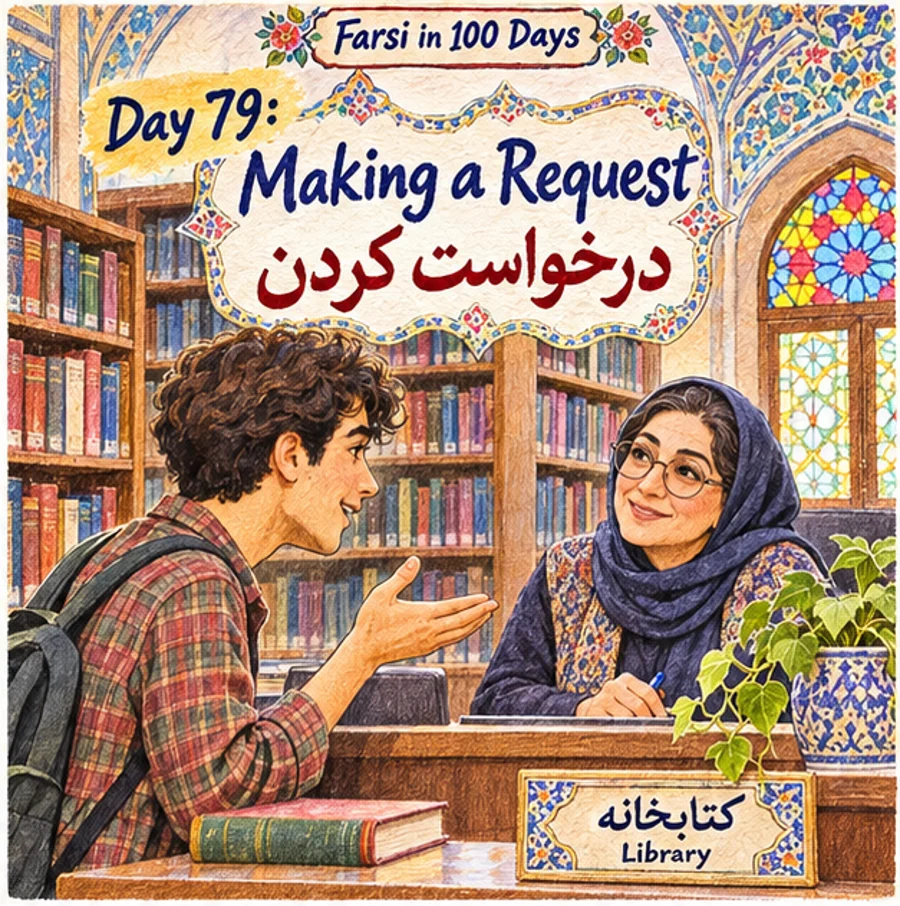
Day 79 of Learn Farsi in 100 Days, our free step-by-step Persian course: Making Requests. The lesson has four parts, with every Persian word in Persian script, pronunciation and English, and each part ends with a quick check.
Part 1Conversation and joke
Day 79, Part 1 has Mehrnaz asking Pouya for favors with ممکن است یک لطفی به من بکنی؟ (momken ast yek lotfi be man bokoni?, could you do me a favor?), mentioning a stool (چهارپایه, chahârpâye), and a joke about a boy who failed while learning to ride a bicycle (دوچرخه, docharkhe).
Conversation: asking for a favor
| Speaker | Persian | English and pronunciation |
|---|---|---|
| Mehrnaz مهرناز | پویا ممکن است یک لطفی به من بکنی؟ | Pouya, could you do me a favor? puyâ, momken ast yek lotfi be man bokoni? |
| Pouya پویا | حتما، چه کمکی میتوانم بکنم؟ | Sure, how can I help? hatman, che komaki mitavânam bokonam? |
| Mehrnaz مهرناز | یک ظرف در کابینت بالا است میخواهم آن را برایم بیاوری؟ | There’s a dish in the top cabinet. Could you get it for me? yek zarf dar kâbinet-e bâlâ ast, mikhâham ân râ barâyam biyâvari? |
| Pouya پویا | بسیار خوب، الان میآورم. | All right, I’ll get it right now. besyâr khub, alân miâvaram. |
| Mehrnaz مهرناز | ممکن است یک لطف دیگری هم بکنی؟ | Could you do me one more favor? momken ast yek lotf-e digari ham bokoni? |
| Pouya پویا | البته. | Of course. albatte. |
| Mehrnaz مهرناز | این دستمال را بگیر و داخل آن کابینت را تمیز کن. | Take this cloth and clean the inside of that cabinet. in dastmâl râ begir va dâkhel-e ân kâbinet râ tamiz kon. |
| Pouya پویا | بسیار خوب. | OK. besyâr khub. |
| Mehrnaz مهرناز | ممنون. ببخشید قد من به آنجا نمیرسد. همیشه باید از چهارپایه استفاده کنم. | Thanks. Sorry, I’m not tall enough to reach up there. I always have to use a stool. mamnun. bebakhshid, ghadd-e man be ânjâ nemiresad. hamishe bâyad az chahârpâye estefâde konam. |
Joke: the promised bicycle
پدر: پسرم! مگر به تو قول نداده بودم که اگر قبول شدی، برایت یک دوچرخه بخرم؟ پس چرا قبول نشدی؟ تو در یک سال گذشته، چه میکردی؟
Father: Son! Didn’t I promise you that if you passed, I would buy you a bicycle? So why didn’t you pass? What were you doing all last year?
پسر: پدرجان! داشتم دوچرخه سواری یاد میگرفتم!
Son: Dad! I was learning to ride a bike!
Quick check
- How do you ask “Could you do me a favor?” in Persian (informal)?
Show answer
ممکن است یک لطفی به من بکنی؟ (momken ast yek lotfi be man bokoni?) - Why does Mehrnaz always need a stool?
Show answer
She isn’t tall enough: قد من به آنجا نمیرسد (ghadd-e man be ânjâ nemiresad). - What does دوچرخه سواری (docharkhe savâri) mean?
Show answer
bicycle riding, cycling
Part 2Common phrases, poetry and word of the day
Day 79, Part 2 gives two phrases about upbringing, من در ناز و نعمت بزرگ شدهام (man dar nâz-o ne’mat bozorg shode-am, I was brought up in the lap of luxury) and من تک فرزند هستم (I am an only child), a Khayyam quatrain, and the word خدمتکار (khedmatkâr, servant).
Common phrases
| Persian | Pronunciation | English |
|---|---|---|
| من در ناز و نعمت بزرگ شدهام. | man dar nâz-o ne’mat bozorg shode-am. | I was brought up in the lap of luxury. |
| من تک فرزند هستم. | man tak farzand hastam. | I am an only child. |
Poetry: Khayyam
A quatrain (robâ’i) by Omar Khayyam. The book gives Edward FitzGerald’s English version: “Alike for those who for TO-DAY prepare, / And those that after a TO-MORROW stare, / A Muezzin from the Tower of Darkness cries / ‘Fools! Your reward is neither Here nor There!'”
| Persian | Pronunciation | English |
|---|---|---|
| قومی متفکرند اندر ره دین | ghowmi motefakkerand andar rah-e din | Some people are lost in thought on the path of faith; |
| قومی به گمان فتاده در راه یقین | ghowmi be gomân fetâde dar râh-e yaghin | others have fallen into doubt on the road to certainty. |
| میترسم از آن که بانگ آید روزی | mitarsam az ân ke bâng âyad ruzi | I fear that one day a voice will cry out: |
| کای بیخبران راه نه آنست و نه این | k-ey bi-khabarân râh na ânast o na in | “O you who know nothing, the way is neither that nor this!” |
Word of the day: خدمتکار (khedmatkâr)
Meaning: servant, maid
He fired all the servants.
Quick check
- How do you say “I am an only child” in Persian?
Show answer
من تک فرزند هستم. (man tak farzand hastam.) - What does در ناز و نعمت بزرگ شدن (dar nâz-o ne’mat bozorg shodan) mean?
Show answer
to be brought up in the lap of luxury - What does خدمتکار (khedmatkâr) mean?
Show answer
servant, maid
Part 3Idiom of the day and conversation
Day 79, Part 3 explains two proverbs, چوب توی آستین کردن (chub tu-ye âstin kardan, to make someone pay) and کلاه گذاشتن (kolâh gozâshtan, to cheat someone), a conversation about moving a heavy table (جابهجا کردن, jâbejâ kardan), and the idiom خود خودش است (that’s just the ticket).
Idiom of the day
چوب توی آستین کردن
chub tu-ye âstin kardan
Word for word: to put a stick in someone’s sleeve
Meaning in Persian: هر زمان کسی با شخصی که قویتر از خود باشد مبارزه کند، به او میگویند: طرف قوی است، چوب توی آستینت میکند.
Meaning: Whenever someone fights a person stronger than himself, people tell him: “The other side is strong; he’ll make you pay (he’ll put a stick up your sleeve).”
English equivalent: to give someone a hard time; to teach someone a lesson
Idiom of the day
کلاه گذاشتن
kolâh gozâshtan
Word for word: to put a hat (on someone’s head)
Meaning in Persian: این اصطلاح برای افرادی که فریب خوردهاند به کار میرود. شخصی که به خاطر عدم توجه ضرر میکند در اصطلاح گفته میشود: کلاه سرش رفته است یا کلاه سرش گذاشتهاند.
Meaning: This expression is used for people who have been tricked. Of someone who loses out because he wasn’t paying attention, people say, “He’s been had” (literally “a hat went on his head” or “they put a hat on his head”).
English equivalent: to cheat someone; to rip someone off
Conversation: moving a table
| Speaker | Persian | English and pronunciation |
|---|---|---|
| Mahnaz مهناز | میشود یک کمکی به من بکنی؟ | Could you give me a hand? mishavad yek komaki be man bokoni? |
| Pegah پگاه | چه کمکی؟ | With what? che komaki? |
| Mahnaz مهناز | میخواهم این میز را جابهجا کنم. | I want to move this table. mikhâham in miz râ jâbejâ konam. |
| Pegah پگاه | باشه، اما به نظرم این میز برای ما خیلی سنگین باشد. | OK, but I think this table may be too heavy for us. bâshe, ammâ be nazaram in miz barâ-ye mâ kheyli sangin bâshad. |
| Mahnaz مهناز | فکر نمیکنم. | I don’t think so. fekr nemikonam. |
| Pegah پگاه | خوب من این طرف را میگیرم تو هم آنطرفش را بگیر. | Well, I’ll take this end and you take the other end. khob, man in taraf râ migiram, to ham ân tarafash râ begir. |
| Mahnaz مهناز | سنگین است. بهتر است از یک نفر دیگر هم کمک بگیریم. | It’s heavy. We’d better get help from someone else too. sangin ast. behtar ast az yek nafar-e digar ham komak begirim. |
Idiom of the day
خود خودش است.
khod-e khodash ast.
Word for word: It is its very self.
Meaning in Persian: همان چیزی است که من دنبالش هستم.
Meaning: It’s exactly what I’m looking for.
English equivalent: Just the ticket.
Quick check
- What does کلاه سرش گذاشتند (kolâh sarash gozâshtand) mean?
Show answer
They cheated him; he was tricked. - How do you say “I want to move this table” in Persian?
Show answer
میخواهم این میز را جابهجا کنم. (mikhâham in miz râ jâbejâ konam.) - What does خود خودش است (khod-e khodash ast) mean?
Show answer
It’s exactly what I’m looking for; just the ticket.
Part 4Reading and new words
Day 79, Part 4 is a reading about Arak (اراک, arâk), a young city founded in the Qajar era (دوران قاجار, dowrân-e ghâjâr) at the foot of the Zagros, followed by a vocabulary list with words like یقین (yaghin, certainty) and لرزهخیزی (larze-khizi, seismicity).
Reading: the city of Arak
اراک یکی از کلانشهرهای ایران و مرکز استان مرکزی است. اراک نسبت به بسیاری از شهرهای ایران، شهر جوانی است. این شهر در دوران قاجار پایهریزی شده است و در حدود دو قرن قدمت دارد. بانی شهر اراک یوسفخان گرجی بود.
Arak is one of Iran’s major cities and the capital of Markazi Province. Compared with many Iranian cities, Arak is young. It was founded in the Qajar period and is about two centuries old. The founder of Arak was Yusef Khan Gorji.
شهر اراک دارای زمستانهای سرد و مرطوب و تابستانهای گرم و خشک است. کوههای اطراف شهر، تالاب میقان و دشت فراهان بر آب و هوای آن تأثیر گذاشتهاند.
Arak has cold, humid winters and hot, dry summers. The mountains around the city, the Meyghan wetland and the Farahan plain have shaped its climate.
شهر در میان پایکوههای رشتهکوه زاگرس قرار دارد. شهر اراک از شهرهای امن از نظر لرزهخیزی است که احتمال وقوع زلزله بالای ۵ ریشتر در آن بسیار کم است.
The city lies among the foothills of the Zagros mountain range. In terms of seismic activity, Arak is a safe city: the chance of an earthquake above magnitude 5 on the Richter scale is very low there.
New words
| Persian | Pronunciation | English |
|---|---|---|
| یقین | yaghin | certainty |
| بیحال شدن | bihâl shodan | to become weak, to feel listless |
| بانگ | bâng | cry, call, shout |
| ترقی | taraghghi | progress, advancement |
| قوم | ghowm | people, tribe, group |
| بیگانه | bigâne | alien, stranger, foreign |
| بوییدن | buyidan | to smell |
| متفکر | motefakker | thinker; thoughtful |
| پاشیدن | pâshidan | to spray, to sprinkle |
| دین | din | religion |
| تحریف | tahrif | distortion |
| بلعیدن | bal’idan | to swallow, to devour |
| آستین | âstin | sleeve |
| پرخوری | porkhori | overeating, gluttony |
| پایهریزی کردن | pâye-rizi kardan | to found, to lay the foundations |
| تالاب | tâlâb | wetland, lagoon, pond |
| تأثیر گذاشتن | ta’sir gozâshtan | to influence, to affect |
| لرزهخیزی | larze-khizi | seismicity, earthquake activity |
| وقوع | voghu’ | occurrence |
| فشار دادن | feshâr dâdan | to press, to push |
| اخراج کردن | ekhrâj kardan | to fire, to expel |
| تبلیغ | tabligh | advertising, propaganda |
| پوست کندن | pust kandan | to peel |
| پاک | pâk | clean, pure |
| ترمیم | tarmim | repair, restoration |
| انبار | anbâr | storehouse, warehouse; stock |
| اندیشه | andishe | thought |
| باز داشتن | bâz dâshtan | to prevent, to hold back |
| براق کردن | barrâgh kardan | to shine, to polish |
| تحت تأثیر | taht-e ta’sir | under the influence of, affected by |
| دکمه | dokme | button |
| دشت | dasht | plain, open field |
Quick check
- Who founded the city of Arak, and in which period?
Show answer
Yusef Khan Gorji (یوسفخان گرجی, yusef-khân-e gorji), in the Qajar period - What is Arak’s climate like?
Show answer
cold, humid winters and hot, dry summers: زمستانهای سرد و مرطوب و تابستانهای گرم و خشک - What does تالاب (tâlâb) mean?
Show answer
wetland, lagoon
Take this lesson further

Study with the book
Learn Farsi in 100 Days: The Ultimate Crash Course to Learning Farsi Fast
This free lesson is part of Learn Farsi in 100 Days. The book puts the whole series in one printable PDF you can study offline.
Serious about Persian? Get all 30 of our Persian learning books for $199.99 (55% less than buying them one by one).
Free Persian Starter Pack: Alphabet + 100 Core Words
Get the 14-page printable Starter Pack (all 32 letters, a 7-day reading plan, 100 core words and 20 survival phrases) and a short 5-email course. Free.
Free. Every morning: that day’s four videos and the full lessons, with every Persian word, its pronunciation and its English meaning. Stop or pause with one click.