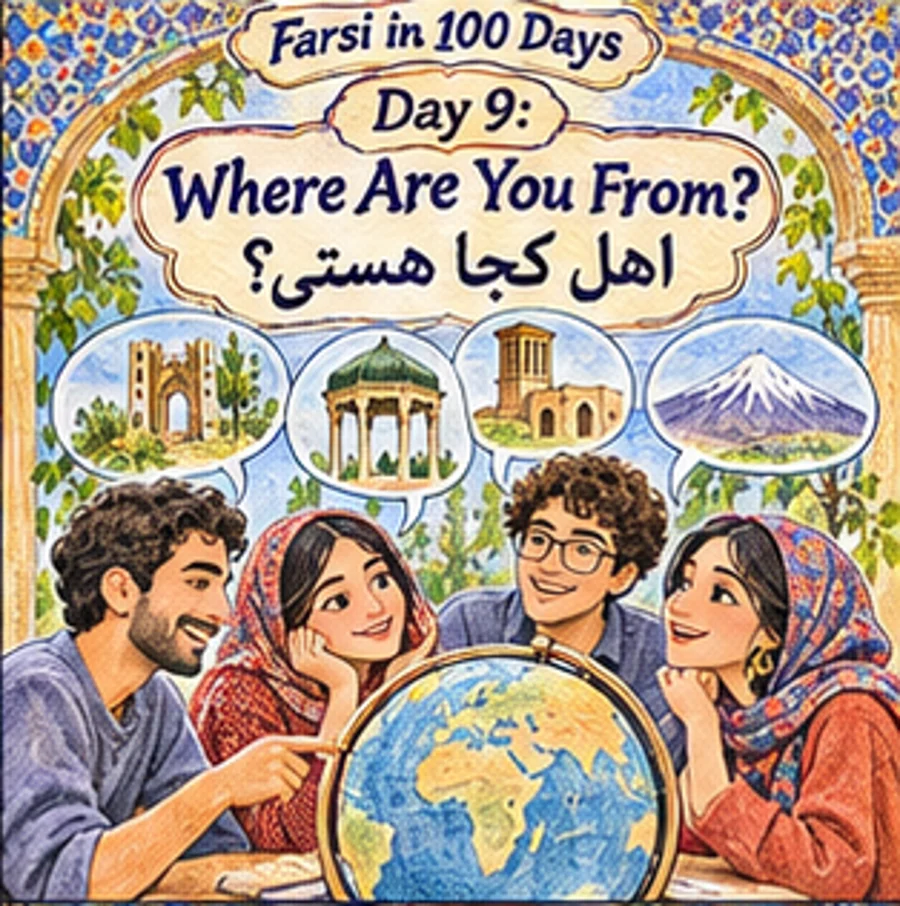
Day 9 of Learn Farsi in 100 Days, our free step-by-step Persian course: Where Are You From?. The lesson has four parts, with every Persian word in Persian script, pronunciation and English, and each part ends with a quick check.
Part 1Grammar and conversation
Day 9, Part 1 teaches کجاست (kojâst, “where is it?”) and its spoken form کو (ku), as in کتاب کجاست؟ (ketâb kojâst?, “Where is the book?”), and a conversation about age, origin and work with اهل کجا هستی؟ (ahl-e kojâ hasti?, “Where are you from?”).
Grammar: کجاست (where is it?)
کجاست (kojâst) is the short form of کجا است (kojâ ast), “where is (it)?”: the question word کجا (kojâ, where) joined to است (ast, is). It comes after the thing you are looking for, as in آن کجاست؟ (ân kojâst?, “Where is it?”). In everyday speech کجاست is often replaced by کو (ku): خودکار کو؟ (khodkâr ku?, “Where’s the pen?”).
Examples
Where is it?
Where is the pen?
Where is the book?
Conversation: Where are you from?
| Speaker | Persian | English and pronunciation |
|---|---|---|
| Radin رادین | تو چند سال داری؟ | How old are you? to chand sâl dâri? |
| Ziba زیبا | من بیست سال دارم، تو چی؟ | I’m twenty. And you? man bist sâl dâram, to chi? |
| Radin رادین | من هجده سال دارم. | I’m 18. man hejdah sâl dâram. |
| Ziba زیبا | اهل کجا هستی؟ | Where are you from? ahl-e kojâ hasti? |
| Radin رادین | اهل ایران هستم. | I am from Iran. ahl-e irân hastam. |
| Ziba زیبا | چه کار میکنی؟ | What do you do? che kâr mikoni? |
| Radin رادین | دانشجو هستم. | I am a student. dâneshju hastam. |
Quick check
- What is the long form of کجاست (kojâst)?
Show answer
کجا است (kojâ ast), “where is it?” - How do you ask “Where are you from?” informally?
Show answer
اهل کجا هستی؟ (ahl-e kojâ hasti?) - What word often replaces کجاست in speech?
Show answer
کو (ku): کتاب کو؟ (ketâb ku?), “Where’s the book?”
Part 2Speech vs. writing, grammar and word of the day
Day 9, Part 2 compares spoken and written forms like اهل کجایی؟ (ahl-e kojâyi?) for اهل کجا هستی؟ (“Where are you from?”), introduces the present stem (ستاک حال, setâk-e hâl), with رو (rav) from رفتن (raftan, to go), and gives the word of the day, شهر (shahr, city).
Speech vs. writing
In speech, هستم and هستی shrink to endings (ایرانم, kojâyi), دارم in ages is replaced by an ending on سال (سالمه, sâlame), آ before m becomes u (اومدم), and -and becomes -an. The spoken form is on the left of each pair, the written form on the right.
| Spoken | Written | English |
|---|---|---|
| بیست سالمه. bist sâlame. | بیست سال دارم. bist sâl dâram. | I am twenty years old. |
| اهل ایرانم. ahl-e irânam. | اهل ایران هستم. ahl-e irân hastam. | I am from Iran. |
| اهل کجایی؟ ahl-e kojâyi? | اهل کجا هستی؟ ahl-e kojâ hasti? | Where are you from? |
| چند سالته؟ chand sâlete? | چند سال داری؟ chand sâl dâri? | How old are you? |
| دستم. dastam. | دست من. dast-e man. | my hand |
| اومدم. umadam. | آمدم. âmadam. | I came. |
| زندگی میکنه. zendegi mikone. | زندگی میکند. zendegi mikonad. | He/She lives. |
| کجان؟ kojân? | کجا هستند؟ kojâ hastand? | Where are they? |
Grammar: the present stem
Every Persian verb has a present stem (ستاک حال, setâk-e hâl) that is used to build the present tense, the present continuous and the imperative, for example میروم (miravam, I go) and برو (borow, go!). The present stem often cannot be predicted from the infinitive, so it has to be learned with each verb: رفتن (raftan, to go) has the stem رو (rav), and آمدن (âmadan, to come) has the stem آ / آی (â / ây).
| Persian | Pronunciation | English |
|---|---|---|
| رفتن ← رو | raftan → rav | to go |
| آمدن ← آی | âmadan → ây | to come |
Word of the day: شهر (shahr)
Meaning: city
Tehran is a big city. My city is small.
Quick check
- What is the written form of the spoken چند سالته؟ (chand sâlete?)
Show answer
چند سال داری؟ (chand sâl dâri?), “How old are you?” - What is the present stem of رفتن (raftan, to go)?
Show answer
رو (rav) - How do you say “Tehran is a big city”?
Show answer
تهران یک شهر بزرگ است (tehrân yek shahr-e bozorg ast).
Part 3Countries, common phrases and idiom of the day
Day 9, Part 3 names ten countries in Persian, from ایران (irân, Iran) to آلمان (âlmân, Germany), gives polite phrases like مواظب خودتان باشید (movâzeb-e khodetân bâshid, “Take care of yourself”), and explains the idiom دستم بند است (dastam band ast, “I’m tied up”).
Countries
| Persian | Pronunciation | English |
|---|---|---|
| افغانستان | afghânestân | Afghanistan |
| ایران | irân | Iran |
| تاجیکستان | tâjikestân | Tajikistan |
| هند | hend | India |
| ترکیه | torkiye | Turkey |
| آمریکا | âmrikâ | United States (America) |
| انگلیس | engelis | England |
| آلمان | âlmân | Germany |
| روسیه | rusiye | Russia |
| فرانسه | farânse | France |
Common phrases
| Persian | Pronunciation | English |
|---|---|---|
| فردا شما را میبینم. | fardâ shomâ râ mibinam. | See you tomorrow. |
| مواظب خودتان باشید. | movâzeb-e khodetân bâshid. | Take care of yourself. |
| این کارت ویزیت من است. | in kârt-e vizit-e man ast. | This is my business card. |
| این شمارهی تلفن من است. | in shomâre-ye telefon-e man ast. | This is my telephone number. |
Idiom of the day
دستم بند است.
dastam band ast.
Word for word: My hand is tied.
Meaning in Persian: مشغول هستم. مثال: ببخشید من دستم بند است.
Meaning: I am busy. Example: ببخشید من دستم بند است (bebakhshid man dastam band ast), “Sorry, I’m tied up.”
English equivalent: I’m tied up.
Quick check
- What is Germany called in Persian?
Show answer
آلمان (âlmân) - How do you say “This is my telephone number”?
Show answer
این شمارهی تلفن من است (in shomâre-ye telefon-e man ast). - What does دستم بند است (dastam band ast) mean?
Show answer
I’m busy / I’m tied up.
Part 4Reading and new words
Day 9, Part 4 is a reading about Soroush, who is from Shiraz (سروش اهل شیراز است, “Soroush is from Shiraz”) but studies in Tehran, and a vocabulary list with travel and city words such as گذرنامه (gozarnâme, passport) and سفارتخانه (sefâratkhâne, embassy).
Reading: Soroush from Shiraz
سروش اهل شیراز است. او بیست سال دارد. سروش مجرد است و در تهران زندگی میکند.
Soroush is from Shiraz. He is twenty years old. Soroush is single and lives in Tehran.
پدر و مادر سروش در شیراز زندگی میکنند. سروش در تهران درس میخواند.
Soroush’s father and mother live in Shiraz. Soroush studies in Tehran.
New words
| Persian | Pronunciation | English |
|---|---|---|
| دست | dast | hand |
| اهل | ahl | from, native of |
| تعطیلات | ta’tilât | holidays |
| کار | kâr | work |
| اقامت | eghâmat | stay, residence |
| شهروند | shahrvand | citizen |
| مشغول | mashghul | busy |
| بند | band | clause; strap, tie |
| بیمارستان | bimârestân | hospital |
| هموطن | hamvatan | compatriot |
| روستا | rustâ | village |
| رئیسجمهور | ra’is-jomhur | president |
| پرچم | parcham | flag |
| سرود | sorud | anthem, song |
| آهنگ | âhang | music, tune |
| وزیر | vazir | minister |
| استان | ostân | province |
| خاطره | khâtere | memory |
| گردشگر | gardeshgar | tourist |
| حرکت کردن | harekat kardan | to move |
| دویدن | davidan | to run |
| اتوبوس | otobus | bus |
| مترو | metro | subway |
| پرده | parde | curtain |
| مسافر | mosâfer | passenger, traveler |
| گذرنامه | gozarnâme | passport |
| دیوار | divâr | wall |
| شناسنامه | shenâsnâme | birth certificate |
| سفارتخانه | sefâratkhâne | embassy |
| نشستن | neshastan | to sit |
| بلیط | belit | ticket |
| خیابان | khiyâbân | street |
| کوچه | kuche | alley |
| آدرس | âdres | address |
| مغازه | maghâze | shop |
| خریدن | kharidan | to buy |
Quick check
- Where is Soroush from?
Show answer
Shiraz: سروش اهل شیراز است (sorush ahl-e shirâz ast). - Where do Soroush’s parents live?
Show answer
In Shiraz: پدر و مادر سروش در شیراز زندگی میکنند. - What does گذرنامه (gozarnâme) mean?
Show answer
passport
Take this lesson further

Study with the book
Learn Farsi in 100 Days: The Ultimate Crash Course to Learning Farsi Fast
This free lesson is part of Learn Farsi in 100 Days. The book puts the whole series in one printable PDF you can study offline.
Serious about Persian? Get all 30 of our Persian learning books for $199.99 (0% less than buying them one by one).
Free Persian Starter Pack: Alphabet + 100 Core Words
Get the 14-page printable Starter Pack (all 32 letters, a 7-day reading plan, 100 core words and 20 survival phrases) and a short 5-email course. Free.
Free. Every morning: that day’s four videos and the full lessons, with every Persian word, its pronunciation and its English meaning. Stop or pause with one click.