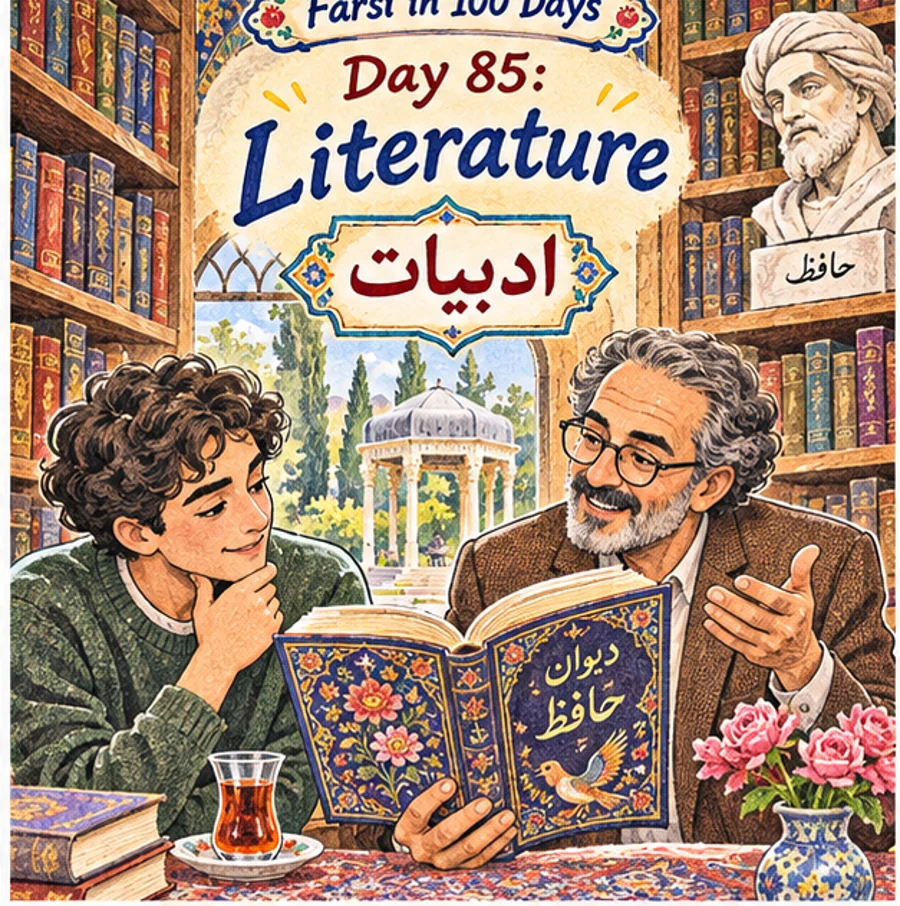
Day 85 of Learn Farsi in 100 Days, our free step-by-step Persian course: Literature. The lesson has four parts, with every Persian word in Persian script, pronunciation and English, and each part ends with a quick check.
Part 1Conversation and joke
Day 85, Part 1 is a conversation between Aynaz and Behshad, a literature student who loves the غزل (ghazal) poems of Hafez and Saadi and Rumi’s مثنوی (masnavi), and recommends Ferdowsi’s شاهنامه (shâhnâme). A Mulla joke about a funeral procession follows.
Conversation: what kind of poetry do you like?
| Speaker | Persian | English and pronunciation |
|---|---|---|
| Aynaz آیناز | در چه رشتهای درس میخوانی؟ | What’s your major? dar che reshte-i dars mikhâni? |
| Behshad بهشاد | من دانشجوی ادبیات هستم. | I’m a literature student. man dâneshju-ye adabiyât hastam. |
| Aynaz آیناز | چه جالب! چه نوع شعرهایی را دوست داری؟ | How interesting! What kind of poetry do you like? che jâleb! che no’ she’r-hâyi râ dust dâri? |
| Behshad بهشاد | من غزل خیلی دوست دارم. مانند شعرهای حافظ و سعدی. اما به مثنوی مولانا هم علاقه دارم. | I really like ghazals, like the poems of Hafez and Saadi. But I’m also interested in Rumi’s Masnavi. man ghazal kheyli dust dâram. mânand-e she’r-hâ-ye hâfez va sa’di. ammâ be masnavi-ye mowlânâ ham alâghe dâram. |
| Aynaz آیناز | تو کتاب مثنوی مولانا را داری؟ | Do you have a copy of Rumi’s Masnavi? to ketâb-e masnavi-ye mowlânâ râ dâri? |
| Behshad بهشاد | نه کتابش را ندارم. من قبلا از کتابخانه گرفتم و مطالعه کردم. | No, I don’t have it. I borrowed it from the library before and read it. na, ketâbash râ nadâram. man ghablan az ketâbkhâne gereftam va motâle’e kardam. |
| Aynaz آیناز | من خیلی دوست دارم مثنوی را بخوانم. | I’d really love to read the Masnavi. man kheyli dust dâram masnavi râ bekhânam. |
| Behshad بهشاد | میتوانی کتابش را بخری. کتاب شاهنامهی فردوسی هم به تو پیشنهاد میکنم بخوانی. آن هم فوقالعاده است. | You can buy it. I also recommend you read Ferdowsi’s Shahnameh. That one is wonderful too. mitavâni ketâbash râ bekhari. ketâb-e shâhnâme-ye ferdowsi ham be to pishnahâd mikonam bekhâni. ân ham fogh-ol-âde ast. |
Joke: Mulla and the funeral
روزی ملا و پسرش دیدند که عدهای جنازهای را با خود میبرند. پسر ملا از پدرش پرسید: پدر این جنازه را کجا میبرند؟
One day Mulla and his son saw some people carrying a coffin. Mulla’s son asked his father, “Father, where are they taking this body?”
ملا گفت او را به جایی میبرند که نه آب هست، نه نان هست و نه چیز دیگری.
Mulla said, “They’re taking him to a place where there is no water, no bread and nothing else.”
پسر ملا گفت: فهمیدم او را به خانهی ما میبرند!
Mulla’s son said, “I get it, they’re taking him to our house!”
Quick check
- How do you ask “What’s your major?” in Persian?
Show answer
در چه رشتهای درس میخوانی؟ (dar che reshte-i dars mikhâni?) - Which two poets’ ghazals does Behshad mention?
Show answer
حافظ (hâfez) and سعدی (sa’di), Hafez and Saadi - Where did Behshad read the Masnavi?
Show answer
از کتابخانه گرفتم (az ketâbkhâne gereftam), he borrowed it from the library
Part 2Common phrases, poetry and word of the day
Day 85, Part 2 gives student phrases such as شهریه چقدر است؟ (shahriye cheghadr ast?, how much is the tuition?) and بورسیه گرفتهام (I’ve won a scholarship), a famous line of Hafez about the tale of love, and the word of the day, کوچ (kuch, migration).
Common phrases
| Persian | Pronunciation | English |
|---|---|---|
| چرا این رشته را انتخاب کردی؟ | cherâ in reshte râ entekhâb kardi? | Why did you choose this major? |
| شهریه چقدر است؟ | shahriye cheghadr ast? | How much is the tuition? |
| برای تحصیل در خارج کشور بورسیه گرفتهام. | barâ-ye tahsil dar khârej-e keshvar bursiye gerefte-am. | I have won a scholarship to study abroad. |
Poetry
A line by Hafez (حافظ, hâfez). The book’s English verse translation: “Love’s pain is but one tale, no more; wonderful this: that from every one whom I hear, the tale is not repeated.”
| Persian | Pronunciation | English |
|---|---|---|
| یک قصه بیش نیست غم عشق وین عجب | yek ghesse bish nist gham-e eshgh, v-in ajab | The sorrow of love is just one single story, and the wonder is |
| کز هر زبان که میشنوم نامکرر است | k-az har zabân ke mishenavam nâmokarrar ast | that from whatever tongue I hear it, it never sounds repeated. |
Word of the day: کوچ (kuch)
Meaning: migration (seasonal move)
Nomadic tribes in Iran migrate from one place to another.
Quick check
- How do you ask “How much is the tuition?” in Persian?
Show answer
شهریه چقدر است؟ (shahriye cheghadr ast?) - What does بورسیه (bursiye) mean?
Show answer
a scholarship - What does کوچ کردن (kuch kardan) mean?
Show answer
to migrate, to move from place to place
Part 3Idiom of the day and conversation
Day 85, Part 3 explains the sayings اگر برای من آب نداشته باشد برای تو نان دارد (one man’s loss is another’s gain) and از آسمان افتاد (az âsemân oftâd, to act superior), a conversation about Saadi’s گلستان (golestân) and the Shahnameh, and the idiom روزهی شکدار نگیر (when in doubt, don’t).
Idiom of the day
اگر برای من آب نداشته باشد برای تو نان دارد.
agar barâ-ye man âb nadâshte bâshad barâ-ye to nân dârad.
Word for word: If it has no water for me, it has bread for you.
Meaning in Persian: این اصطلاح زمانی به کار میرود که کاری برای عدهای ضرر و برای عدهای دیگر سود دارد.
Meaning: This expression is used when something brings a loss to some people and a profit to others.
Idiom of the day
از آسمان افتاد.
az âsemân oftâd.
Word for word: He fell from the sky.
Meaning in Persian: این اصطلاح در مورد کسانی به کار میرود که به زور و قدرت خود میبالند. برای مثال میگویند: مثل اینکه این آقا از آسمان افتاده است!
Meaning: This expression is used about people who boast about their strength and power. For example, people say, “It’s as if this gentleman fell from the sky!”
Conversation: Saadi and Ferdowsi
| Speaker | Persian | English and pronunciation |
|---|---|---|
| Farshad فرشاد | تو کتاب بوستان و گلستان سعدی را خواندهای؟ | Have you read Saadi’s Bustan and Golestan? to ketâb-e bustân va golestân-e sa’di râ khânde-i? |
| Mitra میترا | من فقط کتاب گلستان را خواندهام. | I’ve only read the Golestan. man faghat ketâb-e golestân râ khânde-am. |
| Farshad فرشاد | چطور کتابی است؟ | What kind of book is it? chetor ketâbi ast? |
| Mitra میترا | به صورت داستان و پندهای اخلاقی نوشته شده است. | It’s written as stories and moral lessons. be surat-e dâstân va pand-hâ-ye akhlâghi neveshte shode ast. |
| Farshad فرشاد | در مورد شاهنامهی فردوسی هم چیزی میدانی؟ | Do you know anything about Ferdowsi’s Shahnameh too? dar mored-e shâhnâme-ye ferdowsi ham chizi midâni? |
| Mitra میترا | البته! این کتاب به صورت حماسی نوشته شده است. دربارهی افسانهها و اسطورههای تاریخ ایران است. | Of course! It’s written as an epic. It’s about the legends and myths of Iran’s history. albatte! in ketâb be surat-e hamâsi neveshte shode ast. dar bâre-ye afsâne-hâ va osture-hâ-ye târikh-e irân ast. |
| Farshad فرشاد | من داستان رستم و سهراب آن را خیلی دوست دارم. | I really love its story of Rostam and Sohrab. man dâstân-e rostam va sohrâb-e ân râ kheyli dust dâram. |
Idiom of the day
روزهی شکدار نگیر.
ruze-ye shak-dâr nagir.
Word for word: Don’t keep a doubtful fast.
Meaning in Persian: در امور و یا کارهایی که احتمال شکست و زیان است وارد نشدن.
Meaning: Not getting involved in matters or jobs where there is a chance of failure and loss.
English equivalent: When in doubt, do nowt (nothing).
Quick check
- Which of Saadi’s books has Mitra read?
Show answer
گلستان (golestân), the Golestan - What does از آسمان افتاد (az âsemân oftâd) say about a person?
Show answer
that he boasts of his strength and power and acts superior - Which Persian idiom matches “when in doubt, do nothing”?
Show answer
روزهی شکدار نگیر (ruze-ye shak-dâr nagir)
Part 4Reading and new words
Day 85, Part 4 is a reading about Omar Khayyam (عمر خیام, omar khayyâm), the Seljuk-era mathematician, astronomer and poet whose رباعیات (robâ’iyyât, quatrains) are translated into many languages, followed by a word list including ریاضیدانان (riyâzi-dânân, mathematicians) and مشاهیر (mashâhir, famous people).
Reading: Omar Khayyam
حکیم ابوالفتح عمر بن ابراهیم خیام نیشابوری مشهور به «عمر خیام» از مشاهیر ایران و یکی از مفاخر بزرگ تاریخ است. زمان تولد او در حدود سالهای ۱۰۵۸ میلادی برآورد شده است.
The sage Abolfath Omar ibn Ebrahim Khayyam of Nishapur, known as “Omar Khayyam,” is one of Iran’s famous figures and one of the great luminaries of history. His birth is estimated at around 1058 AD.
خیام از ریاضیدانان، ستارهشناسان و شاعران بنام ایران در دورهی سلجوقی است. وی در ریاضیات، علوم ادبی، دینی و تاریخی استاد بود.
Khayyam was one of Iran’s renowned mathematicians, astronomers and poets of the Seljuk period. He was a master of mathematics and of the literary, religious and historical sciences.
نقش خیام در حل معادلات درجه سوم و مطالعاتاش دربارهی اصل پنجم اقلیدس، نام او را به عنوان ریاضیدانی برجسته در تاریخ علم ثبت کرده است.
Khayyam’s role in solving cubic equations and his studies of Euclid’s fifth postulate have recorded his name in the history of science as an outstanding mathematician.
خیام همچنین شاعری مبتکر بود. رباعیات خیام به اغلب زبانهای زنده از جمله انگلیسی ترجمه شده است.
Khayyam was also an innovative poet. His quatrains (Rubaiyat) have been translated into most living languages, including English.
New words
| Persian | Pronunciation | English |
|---|---|---|
| عشایر | ashâyer | nomads, nomadic tribes |
| دوره | dowre | period, era |
| جانشین | jâneshin | successor |
| مقابل | moghâbel | opposite; other (side) |
| برجستهترین | barjaste-tarin | most prominent |
| حماسه | hamâse | epic, saga |
| صرف کردن | sarf kardan | to spend |
| شاهکار | shâhkâr | masterpiece |
| اسطوره | osture | myth |
| دچار شدن | dochâr shodan | to suffer from, to be afflicted with |
| ریاضیدانان | riyâzi-dânân | mathematicians |
| آشفتگی | âshoftegi | disorder, confusion |
| احیا | ehyâ | revival |
| فانوس | fânus | lantern |
| صوری | suri | nominal, for show (in form only) |
| حیرانی | heyrâni | bewilderment, perplexity |
| بالیدن | bâlidan | to take pride (in); to grow |
| مثل اینکه | mesl-e inke | it seems like |
| مفاخر | mafâkher | notable figures, sources of pride |
| برآورد کردن | barâvord kardan | to estimate |
| نقش | naghsh | role |
| معادلات | mo’âdelât | equations |
| مطالعات | motâle’ât | studies |
| مبتکر | mobtaker | inventive, innovative |
| رباعیات | robâ’iyyât | quatrains, rubaiyat |
| اغلب | aghlab | mostly; most (of) |
| بنام | benâm | renowned, famous |
| مشاهیر | mashâhir | famous people, celebrities |
| مفاخر | mafâkher | sources of pride, great figures |
Quick check
- In which period did Khayyam live?
Show answer
دورهی سلجوقی (dowre-ye saljughi), the Seljuk period - Which mathematical problem is Khayyam known for solving?
Show answer
حل معادلات درجه سوم (hall-e mo’âdelât-e daraje-ye sevvom), solving cubic (third-degree) equations - What does رباعیات (robâ’iyyât) mean?
Show answer
quatrains; Khayyam’s Rubaiyat
Take this lesson further

Study with the book
Learn Farsi in 100 Days: The Ultimate Crash Course to Learning Farsi Fast
This free lesson is part of Learn Farsi in 100 Days. The book puts the whole series in one printable PDF you can study offline.
Serious about Persian? Get all 30 of our Persian learning books for $199.99 (55% less than buying them one by one).
Free Persian Starter Pack: Alphabet + 100 Core Words
Get the 14-page printable Starter Pack (all 32 letters, a 7-day reading plan, 100 core words and 20 survival phrases) and a short 5-email course. Free.
Free. Every morning: that day’s four videos and the full lessons, with every Persian word, its pronunciation and its English meaning. Stop or pause with one click.