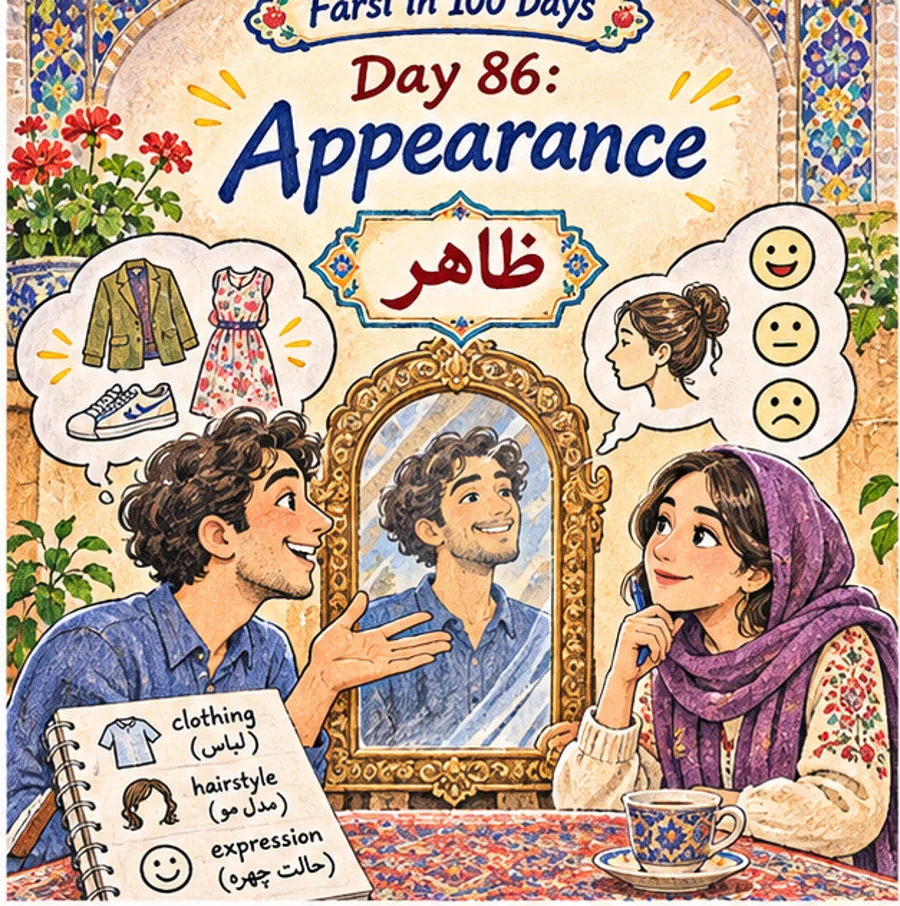
Day 86 of Learn Farsi in 100 Days, our free step-by-step Persian course: Appearance. The lesson has four parts, with every Persian word in Persian script, pronunciation and English, and each part ends with a quick check.
Part 1Conversation and joke
Day 86, Part 1 is a conversation between Nastaran and Parvaneh about a friend’s wedding and what the bride and groom look like, with words like قدبلند (ghadboland, tall), موهای بلوند (muhâ-ye bolond, blond hair) and چشمان آبی (cheshmân-e âbi, blue eyes), plus a Mulla joke.
Conversation: describing a bride and groom
| Speaker | Persian | English and pronunciation |
|---|---|---|
| Nastaran نسترن | فردا شب عروسی دعوت هستم. | I’m invited to a wedding tomorrow night. fardâ shab arusi da’vat hastam. |
| Parvaneh پروانه | چه خوب! عروسی چه کسی است؟ | How nice! Whose wedding is it? che khub! arusi-ye che kasi ast? |
| Nastaran نسترن | عروسی دوستم المیرا. اگر یادت باشد به جشن تولدم آمده بود. | My friend Elmira’s wedding. If you remember, she came to my birthday party. arusi-ye dustam elmirâ. agar yâdat bâshad be jashn-e tavalodam âmade bud. |
| Parvaneh پروانه | همان دختر قدبلند، که موهایش مشکی و فرفری بود؟ | That tall girl whose hair was black and curly? hamân dokhtar-e ghadboland, ke muhâyash meshki va ferferi bud? |
| Nastaran نسترن | نه، همان که موهای بلوند و چشمان آبی داشت. | No, the one who had blond hair and blue eyes. na, hamân ke muhâ-ye bolond va cheshmân-e âbi dâsht. |
| Parvaneh پروانه | یادم آمد. همسرش را دیدهای؟ | Now I remember. Have you seen her husband? yâdam âmad. hamsarash râ dide’i? |
| Nastaran نسترن | بله، دیدهام. او یک پسر قدبلند با موها و چشمان مشکی است. | Yes, I have. He is a tall young man with black hair and black eyes. bale, dide’am. u yek pesar-e ghadboland bâ muhâ va cheshmân-e meshki ast. |
| Parvaneh پروانه | از مراسم عکس بگیر و بعد به من نشان بده. | Take pictures of the ceremony and show them to me afterwards. az marâsem aks begir va ba’d be man neshân bede. |
| Nastaran نسترن | حتما. باید مراسم باشکوهی باشد. | Sure. It should be a magnificent ceremony. hatman. bâyad marâsem-e bâshokuhi bâshad. |
Joke: the Mulla’s dirty clothes
از ملا پرسیدند لباست کثیف شده است، چرا آن را نمیشویی؟ ملا گفت چون دوباره کثیف خواهد شد، چرا زحمت بیهوده بکشم.
They asked the Mulla, “Your clothes have gotten dirty. Why don’t you wash them?” The Mulla said, “Since they will get dirty again, why should I go to useless trouble?”
گفتند: چه اشکال دارد دوباره هم خواهی شست.
They said, “What’s wrong with that? You’ll just wash them again.”
ملا گفت: من که برای لباس شستن خلق نشدهام کارهای دیگری هم دارم.
The Mulla said, “I wasn’t created just to wash clothes. I have other things to do too.”
Quick check
- How do you say “blond hair and blue eyes” in Persian?
Show answer
موهای بلوند و چشمان آبی (muhâ-ye bolond va cheshmân-e âbi) - What does فرفری (ferferi) mean?
Show answer
curly (hair) - In the joke, why does the Mulla not want to wash his clothes?
Show answer
Because they will get dirty again, so washing them would be useless trouble (زحمت بیهوده, zahmat-e bihude).
Part 2Common phrases, poetry and word of the day
Day 86, Part 2 gives phrases for describing faces, such as مژههای بلند (mozhe-hâ-ye boland, long eyelashes) and چال (châl, dimple), a quatrain by Khayyam about fate written on the tablet of eternity, and the word of the day, گدا (gedâ, beggar).
Common phrases: describing faces
| Persian | Pronunciation | English |
|---|---|---|
| او چشمان سیاه و مژههای بلند دارد. | u cheshmân-e siyâh va mozhe-hâ-ye boland dârad. | He has black eyes and long eyelashes. |
| او چشمانی سبز و ابروهایی تیره دارد. | u cheshmâni sabz va abruhâyi tire dârad. | She has green eyes and dark eyebrows. |
| روی گونهاش چال دارد. | ru-ye gune-ash châl dârad. | He has a dimple on his cheek. |
Poetry: Khayyam
A quatrain (rubâ’i) by Omar Khayyam (خیام, khayyâm): whatever was to be was written on the tablet of fate from the first day, so our grief and effort change nothing. The book gives Edward FitzGerald’s famous English verse on the same theme: “The Moving Finger writes; and, having writ, / Moves on: nor all thy Piety nor Wit / Shall lure it back to cancel half a Line, / Nor all thy Tears wash out a Word of it.”
| Persian | Pronunciation | English |
|---|---|---|
| بر لوح، نشان بودنیها بوده است | bar lowh, neshân-e budani-hâ bude ast | On the tablet (of fate) the sign of all that was to be has always been, |
| پیوسته قلم ز نیک و بد فرسوده است | peyvaste ghalam ze nik o bad farsude ast | the pen has always been worn out writing the good and the bad. |
| در روز ازل هر آنچه بایست بداد | dar ruz-e azal har ânche bâyest bedâd | On the first day of eternity it gave whatever had to be; |
| غم خوردن و کوشیدن ما بیهوده است | gham khordan o kushidan-e mâ bihude ast | our grieving and striving are in vain. |
Word of the day: گدا (gedâ)
Meaning: beggar
Mother gave the beggar clothes and food.
Quick check
- How do you say “He has a dimple on his cheek” in Persian?
Show answer
روی گونهاش چال دارد. (ru-ye gune-ash châl dârad.) - What does مژه (mozhe) mean?
Show answer
eyelash - What does گدا (gedâ) mean?
Show answer
beggar
Part 3Idiom of the day and conversation
Day 86, Part 3 has two proverbs, از بیخ عرب شد (az bikh-e arab shod, to stubbornly deny the obvious) and پهلوان پنبه (pahlevân panbe, a would-be hero), a conversation describing a tall volleyball player, and the idiom زیره به کرمان بردن (zire be kermân bordan, carrying coals to Newcastle).
Idiom of the day
از بیخ عرب شد
az bikh-e arab shod
Word for word: he became an Arab from the root
Meaning in Persian: این عبارت درمورد شخصی بهکار میرود که با وجود مدارک و شواهد کافی باز هم حرف دیگران را نپذیرد و لجاجت کند.
Meaning: This expression is used about someone who, despite enough documents and evidence, still refuses to accept what others say and stubbornly insists.
English equivalent: to play dumb; to flatly deny it
Idiom of the day
پهلوان پنبه
pahlevân panbe
Word for word: cotton champion
Meaning in Persian: پهلوان پنبه به فردی میگویند که در کاری مهارت ندارد اما ادعا میکند که در آن کار مهارت زیادی دارد.
Meaning: A “cotton champion” is someone who has no skill at something but claims to be very skilled at it.
English equivalent: a paper tiger; all talk
Conversation: a tall classmate
| Speaker | Persian | English and pronunciation |
|---|---|---|
| Saba صبا | تو کیوان را میشناسی؟ | Do you know Keyvan? to keyvân râ mishenâsi? |
| Homayoun همایون | کیوان؟ همان پسر لاغر با پیشانی بلند که همکلاسی تو است؟ | Keyvan? That thin boy with a high forehead who is your classmate? keyvân? hamân pesar-e lâghar bâ pishâni-ye boland ke hamkelâsi-ye to ast? |
| Saba صبا | بله، شنیدهام بازیکن والیبال است. | Yes. I’ve heard he’s a volleyball player. bale, shenide’am bâzikon-e vâlibâl ast. |
| Homayoun همایون | بله، من بازی او را دیدهام. خیلی خوب بازی میکند. | Yes, I’ve seen him play. He plays very well. bale, man bâzi-ye u râ dide’am. kheyli khub bâzi mikonad. |
| Saba صبا | شنیدهام با یک تیم خارجی قرارداد بسته است. | I’ve heard he has signed a contract with a foreign team. shenide’am bâ yek tim-e khâreji gharârdâd baste ast. |
| Homayoun همایون | چه خوب. قد بلندی داشت. فکر کنم قدش حدود دو متر بود. | How nice. He was tall. I think he was about two meters tall. che khub. ghad-e bolandi dâsht. fekr konam ghaddash hodud-e do metr bud. |
| Saba صبا | بله، قدش دو متر ده سانت است. | Yes, he is two meters ten centimeters tall. bale, ghaddash do metr dah sânt ast. |
Idiom of the day
زیره به کرمان بردن.
zire be kermân bordan.
Word for word: to take cumin to Kerman
Meaning in Persian: بردن چیزی به محلی که در آنجا فراوان باشد، کار بیهوده کردن.
Meaning: Taking something to a place where it is already plentiful; doing something pointless. (Kerman is famous for its cumin.)
English equivalent: To carry coals to Newcastle.
Quick check
- What is a پهلوان پنبه (pahlevân panbe)?
Show answer
Someone who claims great skill at something but actually has none (literally “cotton champion”). - How do you say “He was about two meters tall” in Persian?
Show answer
قدش حدود دو متر بود. (ghaddash hodud-e do metr bud.) - What is the English equivalent of زیره به کرمان بردن (zire be kermân bordan)?
Show answer
To carry coals to Newcastle.
Part 4Reading and new words
Day 86, Part 4 is a reading about weekend trips from Tehran to the green north of Iran and the heavy traffic they cause, followed by 26 new words such as دلپذیر (delpazir, pleasant), آلودگی (âludegi, pollution) and مهارت (mahârat, skill).
Reading: trips to the north of Iran
منطقهی شمال ایران دارای طبیعتی دلپذیر و مناظری منحصربهفرد است. این منطقه در تعطیلات آخر هفته میزبان انبوهی از مسافران است. بسیاری از مردم تهران برای رهایی از زندگی شهری و آلودگی هوا در تعطیلات آخر هفته به شمال میروند تا از آب و هوای مساعد و جاهای دیدنی این منطقه لذت ببرند.
The northern region of Iran has pleasant nature and unique scenery. On weekends this region hosts crowds of travelers. Many people from Tehran go north on weekends to escape city life and air pollution and to enjoy the region’s favorable climate and sights.
همه ساله با آغاز تعطیلات بهار و تابستان، مسافرتهای مردم نیز به مناطق شمال کشور به صورت چشمگیری افزایش پیدا میکند که این خود معضل ترافیکهای بسیار سنگین در مسیرهای منتهی به شمال را به دنبال دارد.
Every year, when the spring and summer holidays begin, people’s trips to the northern parts of the country also rise sharply, and this in turn brings the problem of very heavy traffic on the roads leading north.
New words
| Persian | Pronunciation | English |
|---|---|---|
| لوح | lowh | tablet |
| نیک | nik | good |
| فرسوده | farsude | worn out |
| کوشیدن | kushidan | to endeavor, to strive |
| مدارک | madârek | documents |
| شواهد | shavâhed | evidence |
| لجاجت | lejâjat | obstinacy |
| مهارت | mahârat | skill |
| ادعا کردن | edde’â kardan | to claim |
| مناظر | manâzer | sights, scenery |
| انبوه | anbuh | mass, crowd |
| رهایی | rahâyi | release, escape |
| آلودگی | âludegi | pollution, contamination |
| مساعد | mosâ’ed | favorable |
| چشمگیر | cheshmgir | impressive, considerable |
| معضل | mo’zal | (serious) problem, dilemma |
| منتهی | montahi | leading (to) |
| دلپذیر | delpazir | pleasant |
| شک | shak | doubt |
| شعبده بازی | sho’bade bâzi | magic trick |
| سوراخ | surâkh | hole |
| سوء استفاده | su’-e estefâde | abuse, misuse |
| سمساری | semsâri | secondhand shop |
| سرزنش | sarzanesh | reproach, blame |
| زلال | zolâl | clear (of water) |
| رؤیا | ro’yâ | dream |
Quick check
- Why do many people from Tehran go north on weekends?
Show answer
To escape city life and air pollution (آلودگی هوا, âludegi-ye havâ) and enjoy the favorable climate and sights. - What problem do the spring and summer trips cause?
Show answer
Very heavy traffic (ترافیکهای بسیار سنگین, terâfik-hâ-ye besyâr sangin) on the roads leading north. - What does دلپذیر (delpazir) mean?
Show answer
pleasant
Take this lesson further

Study with the book
Learn Farsi in 100 Days: The Ultimate Crash Course to Learning Farsi Fast
This free lesson is part of Learn Farsi in 100 Days. The book puts the whole series in one printable PDF you can study offline.
Serious about Persian? Get all 30 of our Persian learning books for $199.99 (55% less than buying them one by one).
Free Persian Starter Pack: Alphabet + 100 Core Words
Get the 14-page printable Starter Pack (all 32 letters, a 7-day reading plan, 100 core words and 20 survival phrases) and a short 5-email course. Free.
Free. Every morning: that day’s four videos and the full lessons, with every Persian word, its pronunciation and its English meaning. Stop or pause with one click.