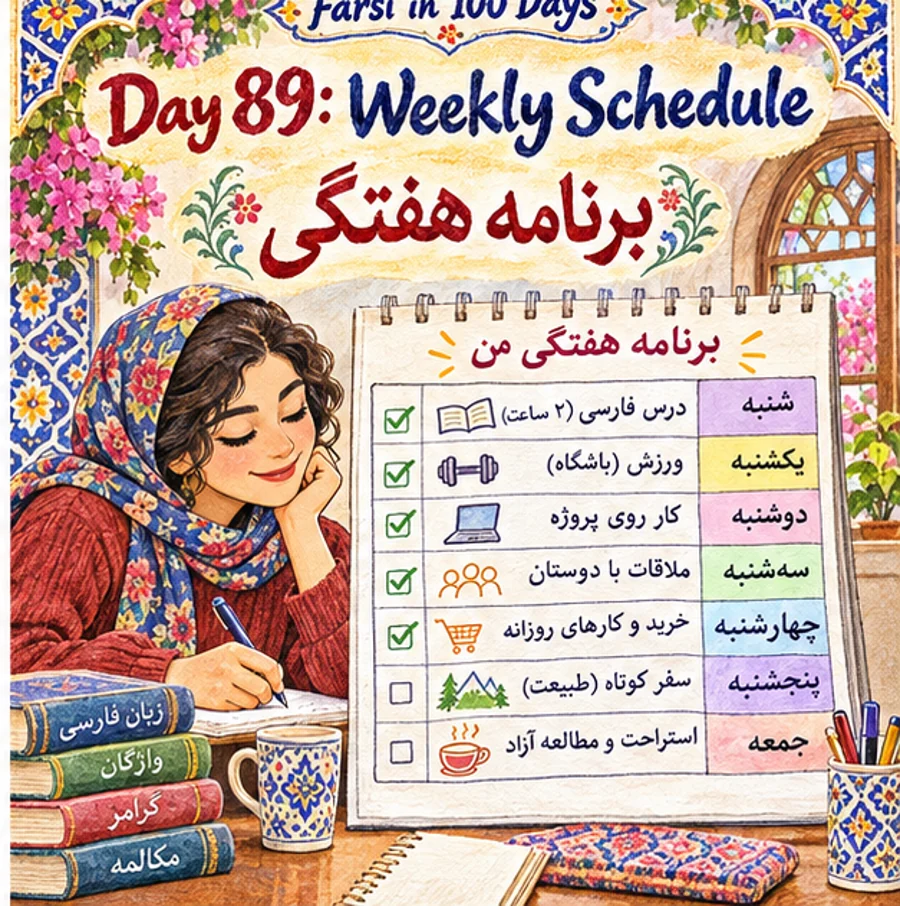
Day 89 of Learn Farsi in 100 Days, our free step-by-step Persian course: The Week’s Schedule. The lesson has four parts, with every Persian word in Persian script, pronunciation and English, and each part ends with a quick check.
Part 1Conversation and joke
Day 89, Part 1 is a conversation between Shayegan and Farnoush about their weekly plans, using days of the week like شنبه (shanbe, Saturday) and سهشنبه (seshanbe, Tuesday) and the phrase آخر هفته (âkhar-e hafte, weekend), plus a joke about the Mulla and some stingy diners.
Conversation: plans for the week
| Speaker | Persian | English and pronunciation |
|---|---|---|
| Shayegan شایگان | این هفته برنامهی تو چیست؟ | What’s your schedule this week? in hafte barnâme-ye to chist? |
| Farnoush فرنوش | من شنبه و دوشنبه کلاس زبان فارسی دارم. سهشنبه هم کلاس گیتار دارم. | I have Persian classes on Saturday and Monday. I also have a guitar class on Tuesday. man shanbe va doshanbe kelâs-e zabân-e fârsi dâram. seshanbe ham kelâs-e gitâr dâram. |
| Shayegan شایگان | آخر هفته چطور؟ | What about the weekend? âkhar-e hafte chetor? |
| Farnoush فرنوش | آخر هفتهها معمولا با دوستانم میرویم پیکنیک یا مهمانی. تو چطور؟ | On weekends my friends and I usually go on a picnic or to a party. What about you? âkhar-e hafte-hâ ma’mulan bâ dustânam miravim piknik yâ mehmâni. to chetor? |
| Shayegan شایگان | من سهشنبه و چهارشنبه کلاس کامپیوتر دارم بقیهی روزها در یک رستوران کار میکنم. | I have computer classes on Tuesday and Wednesday; the rest of the days I work in a restaurant. man seshanbe va chahârshanbe kelâs-e kâmpyuter dâram, baghiye-ye ruzhâ dar yek restorân kâr mikonam. |
| Farnoush فرنوش | آخر هفتهها چطور؟ | And on weekends? âkhar-e hafte-hâ chetor? |
| Shayegan شایگان | آخر هفتهها هم کار میکنم. | I work on weekends too. âkhar-e hafte-hâ ham kâr mikonam. |
Joke: the Mulla takes it back
روزی ملا نصرالدین به عدهای رسید که مشغول غذا خوردن بودند. رفت جلو و گفت: سلام ای انسانهای خسیس.
One day Mulla Nasreddin came upon a group of people who were busy eating. He walked up and said, “Hello, you stingy people!”
یکی از آنها گفت: چرا به ما میگویی خسیس؟ خدا میداند که هیچ یک از ما خسیس نیست.
One of them said, “Why do you call us stingy? God knows none of us is stingy.”
ملا نصرالدین گفت: پس من از حرفی که زدم توبه میکنم. بعد ملا نشست در کنار آنها و شروع کرد به غذا خوردن.
Mulla Nasreddin said, “Then I take back what I said.” Then the Mulla sat down beside them and started eating.
Quick check
- What does Farnoush have on Tuesday?
Show answer
A guitar class: سهشنبه هم کلاس گیتار دارم (seshanbe ham kelâs-e gitâr dâram). - How do you say “weekend” in Persian?
Show answer
آخر هفته (âkhar-e hafte) - What does خسیس (khasis) mean?
Show answer
stingy
Part 2Common phrases, poetry and word of the day
Day 89, Part 2 gives phrases about free time such as شطرنج بازی میکنیم (shatranj bâzi mikonim, we play chess) and سرگرمی (sargarmi, hobby), two couplets by Hafez about the season of roses, and the word of the day, خسارت (khesârat, damage).
Common phrases: free time
| Persian | Pronunciation | English |
|---|---|---|
| من و دوستان نزدیکم دور هم جمع میشویم و معمولا شطرنج بازی میکنیم. | man va dustân-e nazdikam dor-e ham jam’ mishavim va ma’mulan shatranj bâzi mikonim. | My close friends and I get together and usually play chess. |
| من هیچ سرگرمی ندارم. آنقدر گرفتارم که نمیتوانم سرگرمی داشته باشم. | man hich sargarmi nadâram. ânghadr gereftâram ke nemitavânam sargarmi dâshte bâsham. | I don’t have a hobby. I’m too busy to have a hobby. |
Poetry: Hafez
Two couplets from a ghazal by Hafez (حافظ, hâfez). The poet tells his friends not to report his faults to the muhtaseb (the moral police officer), since he too is always chasing pleasure, and reminds himself not to miss the season of roses. The book gives this English verse: “To the Muhtaseb, utter not my crime; for he also / Is ever like me in desire of the drinkers of wine. / Hafez! sit not a moment without wine, and the Beloved: / ‘Tis the season of the rose, and of the Jasmine, and of the celebration of the Feast!”
| Persian | Pronunciation | English |
|---|---|---|
| با محتسبم عیب مگویید که او نیز | bâ mohtasebam eyb maguyid ke u niz | Do not tell the muhtaseb my faults, for he too |
| پیوسته چو ما در طلب عیش مدام است | peyvaste cho mâ dar talab-e eysh-e modâm ast | is always, like us, in search of endless pleasure (and wine). |
| حافظ منشین بی می و معشوق زمانی | hâfez, maneshin bi mey o ma’shugh zamâni | Hafez, do not sit a moment without wine and the beloved, |
| کایام گل و یاسمن و عید صیام است | k-ayyâm-e gol o yâsaman o eyd-e siyâm ast | for it is the season of the rose and jasmine, and the feast at the end of the fast. |
Word of the day: خسارت (khesârat)
Meaning: damage
The houses in the city have been badly damaged by the flood.
Quick check
- What does سرگرمی (sargarmi) mean?
Show answer
hobby, pastime - How do you say “I’m too busy to have a hobby” in Persian?
Show answer
آنقدر گرفتارم که نمیتوانم سرگرمی داشته باشم. (ânghadr gereftâram ke nemitavânam sargarmi dâshte bâsham.) - What does خسارت دیدن (khesârat didan) mean?
Show answer
to be damaged, to suffer damage
Part 3Idiom of the day and conversation
Day 89, Part 3 explains the expression صفحه گذاشتن (safhe gozâshtan, to gossip about someone behind their back), has a conversation about a busy week from Saturday to Wednesday (از شنبه تا چهارشنبه, az shanbe tâ chahârshanbe), and the idiom شبانه روز کار کردن (shabâne ruz kâr kardan, to work day and night).
Idiom of the day
صفحه گذاشتن
safhe gozâshtan
Word for word: to put on a record (to play a record)
Meaning in Persian: عبارت بالا از اصطلاحات بسیار معمول است که در شوخی و جدی استفاده میشود. صفحه گذاشتن به معنی غیبت کردن و در مورد شخص غایب صحبت کردن است. که معمولا کاری را به او نسبت میدهند که ممکن است حقیقت نداشته باشد. در این مواقع میگویند: پشت سرش صفحه گذاشتهاند. یعنی حرفی که در مورد او گفته میشود صحت ندارد.
Meaning: This is a very common expression, used both jokingly and seriously. صفحه گذاشتن means to gossip, to talk about someone who is not present, usually attributing to them something that may not be true. In such cases people say: پشت سرش صفحه گذاشتهاند (posht-e sarash safhe gozâshte’and), “They’ve been talking behind his back,” meaning what is said about him is not true.
English equivalent: to talk behind someone’s back; to spread rumors
Conversation: a busy week
| Speaker | Persian | English and pronunciation |
|---|---|---|
| Fereydoun فریدون | خیلی وقت است تو را ندیدهام. چه کار میکنی این روزها؟ | I haven’t seen you for a long time. What are you up to these days? kheyli vaght ast to râ nadide’am. che kâr mikoni in ruzhâ? |
| Kamran کامران | راستش کارهایم زیاد است. از شنبه تا چهارشنبه در دانشگاه کلاس دارم. آخر هفتهها هم معمولا با دوستانم میروم خارج از شهر. | To be honest, I have a lot to do. I have classes at the university from Saturday to Wednesday. On weekends I usually go out of town with my friends. râstash kârhâyam ziyâd ast. az shanbe tâ chahârshanbe dar dâneshgâh kelâs dâram. âkhar-e hafte-hâ ham ma’mulan bâ dustânam miravam khârej az shahr. |
| Fereydoun فریدون | آخر هفتهها کجا میروید؟ | Where do you go on weekends? âkhar-e hafte-hâ kojâ miravid? |
| Kamran کامران | ساحل، جنگل، کوه … اگر بخواهی میتوانی این هفته با ما بیایی. | The beach, the forest, the mountains… If you like, you can come with us this week. sâhel, jangal, kuh… agar bekhâhi mitavâni in hafte bâ mâ biyâyi. |
| Fereydoun فریدون | حتما. | Sure, definitely. hatman. |
Idiom of the day
شبانه روز کار کردن.
shabâne ruz kâr kardan.
Word for word: to work night and day
Meaning in Persian: بسیار تلاش کردن. زیاد کار کردن.
Meaning: To try very hard; to work a lot.
English equivalent: Work all the hours God sends.
Quick check
- What does پشت سرش صفحه گذاشتهاند (posht-e sarash safhe gozâshte’and) mean?
Show answer
They’ve been gossiping about him behind his back (saying things that aren’t true). - How do you say “from Saturday to Wednesday” in Persian?
Show answer
از شنبه تا چهارشنبه (az shanbe tâ chahârshanbe) - What is the English equivalent of شبانه روز کار کردن (shabâne ruz kâr kardan)?
Show answer
Work all the hours God sends (work day and night).
Part 4Reading and new words
Day 89, Part 4 is a reading about Naqsh-e Jahan Square in Isfahan (میدان نقش جهان, meydân-e naghsh-e jahân) and its historic buildings such as Ali Qapu, followed by 28 new words including درازا (derâzâ, length), پهنا (pahnâ, width) and غیبت کردن (gheybat kardan, to gossip).
Reading: Naqsh-e Jahan Square
نقشجهان در مرکز شهر اصفهان، مجموعهای تاریخی است که شامل میدان نقشجهان (با نام قدیمی میدان شاه) و بناهای تاریخی شامل عالیقاپو، مسجد شاه (اصفهان) و سردر قیصریه است.
Naqsh-e Jahan, in the center of the city of Isfahan, is a historic complex that includes Naqsh-e Jahan Square (formerly called Shah Square) and historic buildings including Ali Qapu, the Shah Mosque (of Isfahan) and the Qeysarieh Gate.
علاوه بر این، بر روی این بناها ۲۰۰ حجره دو طبقهای پیرامون میدان نقش جهان واقع شده است که عموما جایگاه عرضهی صنایع دستی اصفهان است.
In addition, 200 two-story shops stand around Naqsh-e Jahan Square, and they are generally where Isfahan’s handicrafts are sold.
میدان نقشجهان، میدانی به شکل مستطیل به درازای ۵۰۷ متر و پهنای ۱۵۸ متر در مرکز شهر اصفهان، یکی از بزرگترین میدانهای جهان است.
Naqsh-e Jahan Square, a rectangular square 507 meters long and 158 meters wide in the center of Isfahan, is one of the largest squares in the world.
New words
| Persian | Pronunciation | English |
|---|---|---|
| زهره | zohre | Venus (the evening star) |
| مه | mah | moon |
| پدید آمدن | padid âmadan | to emerge, to appear |
| می فروش | mey forush | wine seller |
| معمول | ma’mul | usual, common |
| جدی | jeddi | serious |
| غیبت کردن | gheybat kardan | to backbite, to gossip |
| غایب | ghâyeb | absent |
| حجره | hojre | small shop (in a bazaar), chamber |
| جایگاه | jâygâh | place, position |
| درازا | derâzâ | length |
| پهنا | pahnâ | width |
| مجموعه | majmu’e | collection, complex |
| پیرامون | pirâmun | around; about |
| عموما | omuman | generally |
| صحت | sehhat | truth, accuracy |
| دور هم | dor-e ham | together |
| خسیس | khasis | stingy; miser |
| حسود | hasud | jealous |
| تیغ | tigh | blade |
| تعلیم | ta’lim | teaching |
| تقاضا کردن | taghâzâ kardan | to request |
| تصویر | tasvir | image |
| ترقی | taraghghi | progress |
| بلافاصله | belâfâsele | immediately |
| برنده | barande | winner |
| باطل | bâtel | void, null |
| بقیه | baghiye | the rest, the others |
Quick check
- What was the old name of میدان نقش جهان (meydân-e naghsh-e jahân)?
Show answer
میدان شاه (meydân-e shâh), Shah Square - How long and how wide is Naqsh-e Jahan Square?
Show answer
507 meters long (درازا, derâzâ) and 158 meters wide (پهنا, pahnâ). - What does حجره (hojre) mean in the reading?
Show answer
a small shop or chamber in a bazaar
Take this lesson further

Study with the book
Learn Farsi in 100 Days: The Ultimate Crash Course to Learning Farsi Fast
This free lesson is part of Learn Farsi in 100 Days. The book puts the whole series in one printable PDF you can study offline.
Serious about Persian? Get all 30 of our Persian learning books for $199.99 (55% less than buying them one by one).
Free Persian Starter Pack: Alphabet + 100 Core Words
Get the 14-page printable Starter Pack (all 32 letters, a 7-day reading plan, 100 core words and 20 survival phrases) and a short 5-email course. Free.
Free. Every morning: that day’s four videos and the full lessons, with every Persian word, its pronunciation and its English meaning. Stop or pause with one click.