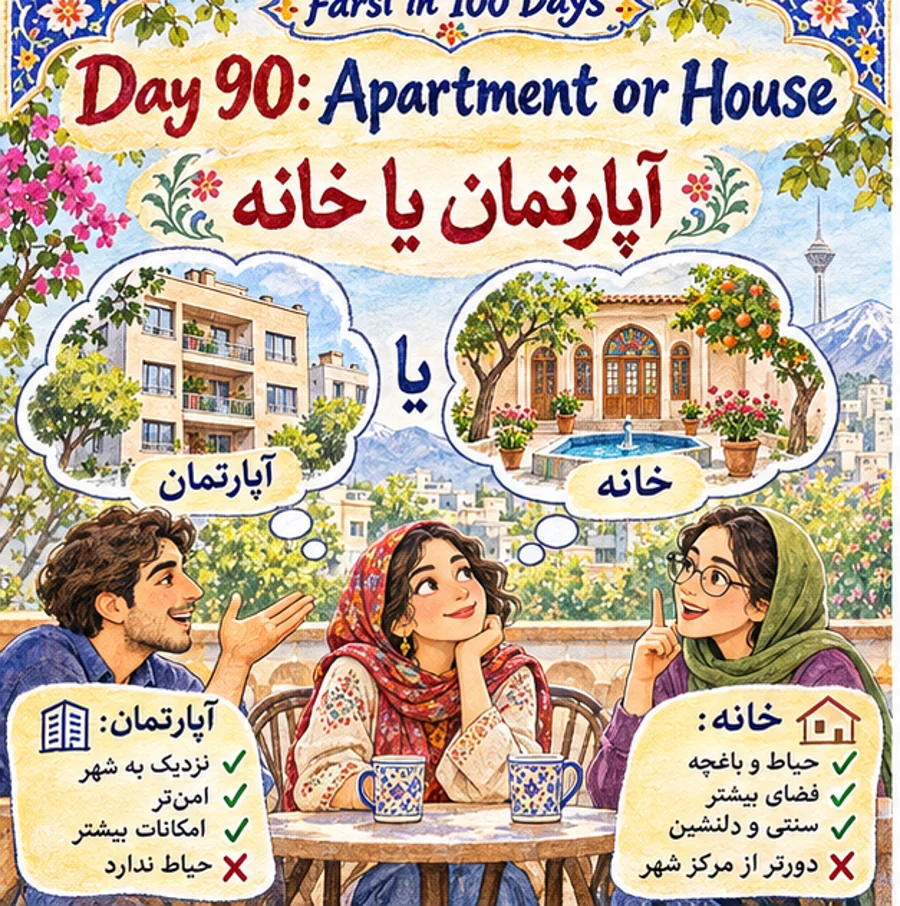
Day 90 of Learn Farsi in 100 Days, our free step-by-step Persian course: Apartment or House. The lesson has four parts, with every Persian word in Persian script, pronunciation and English, and each part ends with a quick check.
Part 1Conversation and joke
Day 90, Part 1 is a conversation between Shahyad and Gisoo comparing a house with an apartment, with phrases like خانهی ویلایی (khâne-ye vilâyi, a detached house) and مزیت و معایب (maziyyat va ma’âyeb, advantages and disadvantages), plus a joke about a crow that steals the Mulla’s soap.
Conversation: house or apartment?
| Speaker | Persian | English and pronunciation |
|---|---|---|
| Shahyad شهیاد | شما آپارتمان دارید یا خانه؟ | Do you have an apartment or a house? shomâ âpârtemân dârid yâ khâne? |
| Gisoo گیسو | ما یک خانهی ویلایی داریم. | We have a house with a yard. mâ yek khâne-ye vilâyi dârim. |
| Shahyad شهیاد | چه خوب، من قبلا یک خانهی ویلایی داشتم اما برای من خیلی بزرگ بود. | How nice. I used to have a house, but it was too big for me. che khub, man ghablan yek khâne-ye vilâyi dâshtam ammâ barâ-ye man kheyli bozorg bud. |
| Gisoo گیسو | ما چهار نفر هستیم. قبلا که در آپارتمان زندگی میکردیم برایمان کوچک بود، اما اینجا به اندازهی کافی بزرگ است و هر کدام یک اتاق داریم. | There are four of us. When we lived in an apartment before, it was too small for us, but here is big enough and each of us has a room. mâ chahâr nafar hastim. ghablan ke dar âpârtemân zendegi mikardim barâyemân kuchak bud, ammâ injâ be andâze-ye kâfi bozorg ast va har kodâm yek otâgh dârim. |
| Shahyad شهیاد | خانهی بزرگ تمیز کردنش خیلی سخت است. | A big house is very hard to clean. khâne-ye bozorg tamiz kardanash kheyli sakht ast. |
| Gisoo گیسو | آپارتمان کوچک هم جا به اندازهی کافی برای وسیلهها ندارد. | And a small apartment doesn’t have enough room for your things. âpârtemân-e kuchak ham jâ be andâze-ye kâfi barâ-ye vasile-hâ nadârad. |
| Shahyad شهیاد | خوب هر کدام مزیت و معایب خود را دارند. | Well, each has its own advantages and disadvantages. khob, har kodâm maziyyat va ma’âyeb-e khod râ dârand. |
Joke: the crow and the soap
روزی زن ملا در حال شستن لباس بود که ناگهان کلاغی صابون را برداشت و بالای درخت برد.
One day the Mulla’s wife was washing clothes when suddenly a crow grabbed the soap and carried it up a tree.
زن ملا، ملا را صدا زد و گفت: کلاغ صابون را برد.
The Mulla’s wife called the Mulla and said, “The crow took the soap!”
ملا گفت: میبینی که لباس بچه کلاغ از ما سیاهتر است، پس او بیشتر به این صابون نیاز دارد.
The Mulla said, “You can see the little crow’s clothes are blacker than ours, so he needs the soap more than we do.”
Quick check
- What is a خانهی ویلایی (khâne-ye vilâyi)?
Show answer
a detached house (with a yard), as opposed to an apartment - How do you say “each has its own advantages and disadvantages” in Persian?
Show answer
هر کدام مزیت و معایب خود را دارند. (har kodâm maziyyat va ma’âyeb-e khod râ dârand.) - In the joke, why does the Mulla say the crow needs the soap more?
Show answer
Because the crow’s clothes are blacker than theirs (سیاهتر, siyâh-tar).
Part 2Common phrases, poetry and word of the day
Day 90, Part 2 gives practical questions such as اینجا سطل زباله است؟ (injâ satl-e zobâle ast?, is there a trash bin here?) and پریز برق (periz-e bargh, electrical outlet), the opening lines of Rumi’s Masnavi about the reed, and the word of the day, بلا (balâ, disaster).
Common phrases: around the house
| Persian | Pronunciation | English |
|---|---|---|
| از چی ساخته شده است؟ | az chi sâkhte shode ast? | What is it made of? |
| اینجا سطل زباله است؟ | injâ satl-e zobâle ast? | Is there a trash bin here? |
| اینجا پریز برق است؟ | injâ periz-e bargh ast? | Is there an electrical outlet here? |
Poetry: Rumi (Mowlana)
The famous opening of the Masnavi by Rumi, known in Iran as Mowlana (مولانا, mowlânâ). The reed flute, cut from its reed bed, laments its separation, a symbol of the soul longing for its origin. The book gives this English: “Listen to this reed how it complains, telling a tale of separations, / Saying, ‘Ever since I was parted from the reed-bed, man and woman have moaned in (unison with) my lament.'”
| Persian | Pronunciation | English |
|---|---|---|
| بشنو از نی چون حکایت میکند | beshno az ney chon hekâyat mikonad | Listen to the reed, how it tells a tale; |
| از جداییها شکایت میکند | az jodâyi-hâ shekâyat mikonad | it complains of separations. |
| کز نیستان تا مرا ببریدهاند | k-az neyestân tâ marâ bobride’and | “Ever since they cut me from the reed bed, |
| از نفیرم مرد و زن نالیدهاند | az nafiram mard o zan nâlide’and | men and women have wept at my cry.” |
Word of the day: بلا (balâ)
Meaning: disaster, calamity
Floods and earthquakes are natural disasters.
Quick check
- How do you ask “Is there an electrical outlet here?” in Persian?
Show answer
اینجا پریز برق است؟ (injâ periz-e bargh ast?) - In Rumi’s poem, what does the reed complain about?
Show answer
Separations: از جداییها شکایت میکند (az jodâyi-hâ shekâyat mikonad). - What does بلایای طبیعی (balâyâ-ye tabi’i) mean?
Show answer
natural disasters
Part 3Idiom of the day and conversation
Day 90, Part 3 has two proverbs about secrets, شتر دیدی، ندیدی (shotor didi, nadidi, keep it to yourself) and پتهاش روی آب افتاد (pate-ash ru-ye âb oftâd, his secret came out), a conversation about a new apartment with کاغذ دیواری (kâghaz divâri, wallpaper), and the idiom کنگر خوردن و لنگر انداختن.
Idiom of the day
شتر دیدی، ندیدی
shotor didi, nadidi
Word for word: You saw a camel? You didn’t see one.
Meaning in Persian: هنگامی که شخصی مطلبی را بداند و نخواهند که به دیگران خبر بدهد، به او میگویند: شتر دیدی، ندیدی. به این معنی که این راز را برای کسی نگو.
Meaning: When someone knows something and others don’t want him to tell anyone, they say to him: “You saw a camel? You didn’t see one,” meaning: don’t tell this secret to anyone.
English equivalent: Mum’s the word; you didn’t see anything.
Idiom of the day
پتهاش روی آب افتاد
pate-ash ru-ye âb oftâd
Word for word: his patch (of cloth) fell on the water
Meaning in Persian: هرگاه راز کسی فاش شود میگویند: پتهاش روی آب افتاد. یعنی اسرارش فاش شد.
Meaning: Whenever someone’s secret comes out, people say: “His patch fell on the water,” meaning his secrets were revealed.
English equivalent: The cat is out of the bag; his cover was blown.
Conversation: a new apartment
| Speaker | Persian | English and pronunciation |
|---|---|---|
| Golbarg گلبرگ | شنیدهام دنبال آپارتمان میگردی؟ | I’ve heard you’re looking for an apartment? shenide’am donbâl-e âpârtemân migardi? |
| Siamak سیامک | بله، اما دیروز پیدا کردم. | Yes, but I found one yesterday. bale, ammâ diruz peydâ kardam. |
| Golbarg گلبرگ | آپارتمانت چطور است؟ | What’s your apartment like? âpârtemânat chetor ast? |
| Siamak سیامک | دو تا اتاق خواب دارد. آشپزخانه کابینت و ظرفشویی دارد. دیوارها کاغذ دیواری دارند. | It has two bedrooms. The kitchen has cabinets and a sink. The walls have wallpaper. do tâ otâgh khâb dârad. âshpazkhâne kâbinet va zarfshuyi dârad. divârhâ kâghaz divâri dârand. |
| Golbarg گلبرگ | طبقهی چندم است؟ | Which floor is it on? tabaghe-ye chandom ast? |
| Siamak سیامک | طبقهی چهارم. | The fourth floor. tabaghe-ye chahârom. |
Idiom of the day
کنگر خوردن و لنگر انداختن.
kangar khordan va langar andâkhtan.
Word for word: to eat artichoke thistle and drop anchor
Meaning in Persian: به طنز در مورد کسی که زمان زیادی در جایی یا منزل شخصی بماند، میگویند.
Meaning: Said humorously about someone who stays a long time somewhere or at someone’s home.
English equivalent: Outstay one’s welcome.
Quick check
- What does شتر دیدی، ندیدی (shotor didi, nadidi) mean?
Show answer
Don’t tell anyone this secret (literally “You saw a camel? You didn’t see one”). - How do you ask “Which floor is it on?” in Persian?
Show answer
طبقهی چندم است؟ (tabaghe-ye chandom ast?) - What does کاغذ دیواری (kâghaz divâri) mean?
Show answer
wallpaper
Part 4Reading and new words
Day 90, Part 4 is a reading about Rudkhan Castle (قلعهرودخان, ghal’e-rudkhân) near Fuman in Gilan province, followed by 30 new words, many for the home, such as شومینه (shumine, fireplace), نشیمن (neshiman, living room) and پادری (pâdari, doormat).
Reading: Rudkhan Castle
قلعهرودخان در جنوب غربی شهر فومن در استان گیلان قرار دارد. برخی از کارشناسان، تاریخ ساخت قلعه را در دوران ساسانیان میدانند. دیوار قلعه ۱۵۰۰ متر طول دارد و در آن ۶۵ برج قرار گرفته است.
Rudkhan Castle is located southwest of the city of Fuman in Gilan province. Some experts date the castle’s construction to the Sasanian era. The castle wall is 1,500 meters long, with 65 towers along it.
این قلعه در دورانی دیگر تجدید بنا شده و از پایگاههای مهم مبارزاتی بوده است.
The castle was rebuilt in a later period and served as an important base for resistance fighters.
قلعهرودخان از دو بخش ارگ (محل زندگی حاکم و حرمسرای وی) و قورخانه (محل فعالیتهای نظامی و زندگی سربازان) تشکیل شده است. ارگ در قسمت غربی این بنا قرار دارد و جنس آن از آجر است.
Rudkhan Castle consists of two parts: the citadel (where the ruler and his household lived) and the arsenal (the place of military activities and the soldiers’ quarters). The citadel is in the western part of the building and is made of brick.
New words
| Persian | Pronunciation | English |
|---|---|---|
| سطل | satl | bucket, bin |
| مزایا | mazâyâ | advantages |
| زباله | zobâle | garbage |
| پریز | periz | (electrical) outlet |
| نیمکت | nimkat | bench |
| جدایی | jodâyi | separation |
| نیستان | neyestân | reed bed, canebrake |
| بریدن | boridan | to cut |
| قفسهی کتاب | ghafase-ye ketâb | bookcase |
| نفیر | nafir | cry, lament; horn blast |
| طول | tul | length |
| جارو | jâru | broom |
| ویلا | vilâ | villa, house with a yard |
| وسیله | vasile | device; (plural) belongings |
| مزیت | maziyyat | advantage |
| پایگاه | pâygâh | base |
| دودکش | dudkesh | chimney |
| مبارزاتی | mobârezâti | related to struggle or resistance, militant |
| جنس | jens | material; gender |
| کاناپه | kânâpe | sofa |
| شومینه | shumine | fireplace |
| آجر | âjor | brick |
| کلبه | kolbe | hut, cottage |
| کارشناسان | kârshenâsân | experts |
| اتاق خواب | otâgh khâb | bedroom |
| نشیمن | neshiman | living room |
| آشپزخانه | âshpazkhâne | kitchen |
| پادری | pâdari | doormat |
| حمام | hammâm | bathroom |
| نفوذ کردن | nofuz kardan | to permeate, to penetrate |
Quick check
- Where is قلعهرودخان (ghal’e-rudkhân)?
Show answer
Southwest of the city of Fuman in Gilan province. - How long is the castle wall, and how many towers does it have?
Show answer
1,500 meters long, with 65 towers (۶۵ برج, shast-o panj borj). - What does آجر (âjor) mean?
Show answer
brick
Take this lesson further

Study with the book
Learn Farsi in 100 Days: The Ultimate Crash Course to Learning Farsi Fast
This free lesson is part of Learn Farsi in 100 Days. The book puts the whole series in one printable PDF you can study offline.
Serious about Persian? Get all 30 of our Persian learning books for $199.99 (55% less than buying them one by one).
Free Persian Starter Pack: Alphabet + 100 Core Words
Get the 14-page printable Starter Pack (all 32 letters, a 7-day reading plan, 100 core words and 20 survival phrases) and a short 5-email course. Free.
Free. Every morning: that day’s four videos and the full lessons, with every Persian word, its pronunciation and its English meaning. Stop or pause with one click.