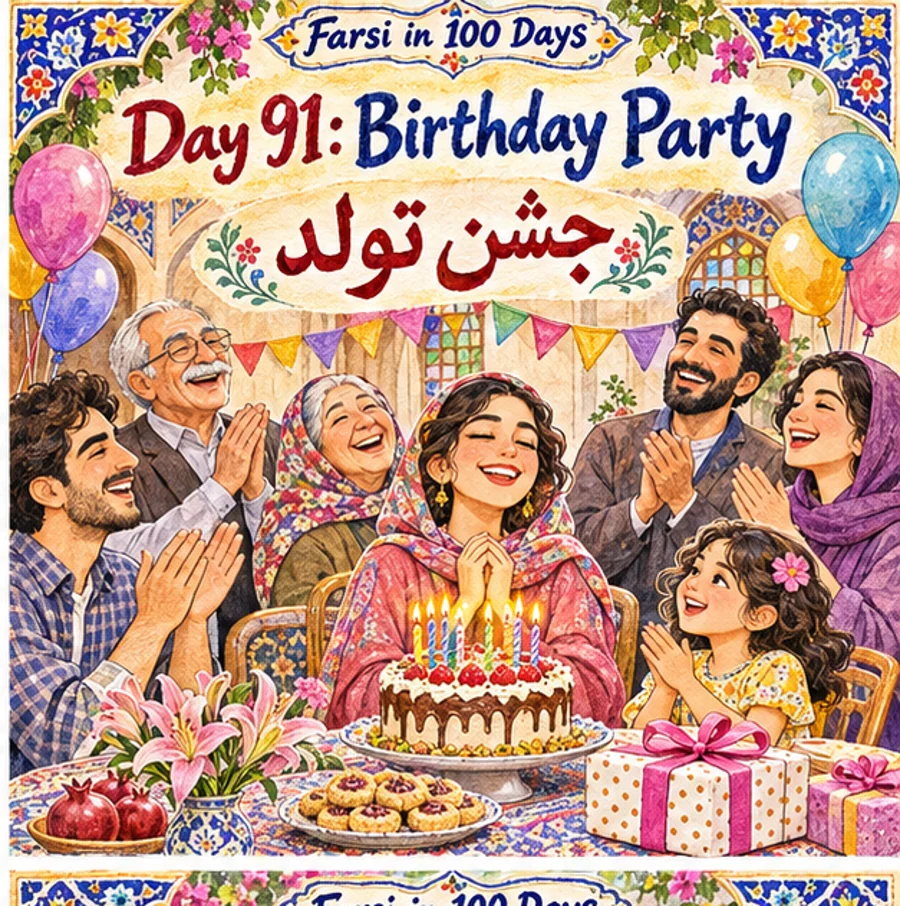
Day 91 of Learn Farsi in 100 Days, our free step-by-step Persian course: Birthday Party. The lesson has four parts, with every Persian word in Persian script, pronunciation and English, and each part ends with a quick check.
Part 1Conversation and joke
Day 91, Part 1 has a conversation between Ardeshir and Barbad, who met at Negar’s birthday party (جشن تولد, jashn-e tavallod), with phrases like چهرهی شما آشنا است (your face looks familiar) and به خاطر نمیآورم (I don’t remember), plus a Mulla joke about resting.
Conversation: a familiar face
| Speaker | Persian | English and pronunciation |
|---|---|---|
| Ardeshir اردشیر | ببخشید، میتوانم اسم شما را بپرسم؟ | Excuse me, may I ask your name? bebakhshid, mitavânam esm-e shomâ râ beporsam? |
| Barbad باربد | برای چی؟ اسم من باربد است. | What for? My name is Barbad. barâye chi? esm-e man bârbad ast. |
| Ardeshir اردشیر | چهرهی شما برای من خیلی آشنا است، فکر میکنم قبلا شما را دیدهام. | Your face looks very familiar to me. I think I’ve seen you before. chehre-ye shomâ barâye man kheyli âshnâ ast, fekr mikonam ghablan shomâ râ dide-am. |
| Barbad باربد | فکر نمیکنم، چون من اهل این اطراف نیستم. | I don’t think so, because I’m not from around here. fekr nemikonam, chon man ahl-e in atrâf nistam. |
| Ardeshir اردشیر | شما با نگار دوست نیستید؟ | Aren’t you friends with Negar? shomâ bâ negâr dust nistid? |
| Barbad باربد | بله هستم، شما هم دوست نگار هستید؟ | Yes, I am. Are you a friend of Negar’s too? bale hastam, shomâ ham dust-e negâr hastid? |
| Ardeshir اردشیر | البته، من شما را در جشن تولد نگار دیدهام. | Of course. I saw you at Negar’s birthday party. albatte, man shomâ râ dar jashn-e tavallod-e negâr dide-am. |
| Barbad باربد | اما من شما را بهخاطر نمیآورم. | But I don’t remember you. ammâ man shomâ râ be-khâter nemiâvaram. |
| Ardeshir اردشیر | من اردشیر هستم. من شما را به خوبی به یاد میآورم. شما همانی هستید که در مهمانی پانتومیم بازی کرد. | I’m Ardeshir. I remember you well. You’re the one who did the pantomime at the party. man ardeshir hastam. man shomâ râ be khubi be yâd miâvaram. shomâ hamâni hastid ke dar mehmâni pântomim bâzi kard. |
| Barbad باربد | بله، به هر حال از دیدن شما خوشبختم. | Yes. Anyway, nice to meet you. bale, be har hâl az didan-e shomâ khoshbakhtam. |
Joke: the Mulla’s rest
شخصی از ملا پرسید: چند ساعت در روز استراحت میکنی؟ ملا گفت: چند ساعت در شب و دو ساعت در روز که او میخوابد.
Someone asked the Mulla, “How many hours a day do you rest?” The Mulla said, “A few hours at night, and two hours during the day when she sleeps.”
آن شخص پرسید: منظورت از او چه کسی است؟ ملا گفت: همسرم.
The man asked, “Who do you mean by ‘she’?” The Mulla said, “My wife.”
شخص گفت: نادان پرسیدم خودت چقدر استراحت میکنی. ملا جواب داد: نادان خودت هستی. ساعتهایی که همسرم در خواب است من میتوانم استراحت کنم.
The man said, “You fool, I asked how much you yourself rest.” The Mulla answered, “You’re the fool. The hours my wife is asleep are when I get to rest.”
Quick check
- How do you say “Your face looks very familiar to me” in Persian?
Show answer
چهرهی شما برای من خیلی آشنا است. (chehre-ye shomâ barâye man kheyli âshnâ ast.) - What does بهخاطر نمیآورم (be-khâter nemiâvaram) mean?
Show answer
I don’t remember. - Where did Ardeshir see Barbad before?
Show answer
At Negar’s birthday party: در جشن تولد نگار (dar jashn-e tavallod-e negâr).
Part 2Common phrases, poetry and word of the day
Day 91, Part 2 gives two phrases for asking about maps, such as نقشهی شهر (naghshe-ye shahr, town map), a quatrain by Khayyam (خیام) about friends lost to death, and the word of the day, اخم کردن (akhm kardan, to frown).
Common phrases
| Persian | Pronunciation | English |
|---|---|---|
| من یک نقشه از مسیرهای پیادهروی این منطقه میخواهم. | man yek naghshe az masir-hâ-ye piyâde-ravi-ye in mantaghe mikhâham. | I would like a map of the walking trails in this region. |
| از کجا میتوانم نقشهی شهر را بخرم؟ | az kojâ mitavânam naghshe-ye shahr râ bekharam? | Where can I buy a map of the town? |
Poetry: a quatrain by Khayyam
A quatrain (rubâ’i) by Omar Khayyam (خیام, khayyâm). The book gives Edward FitzGerald’s English verse: “Lo! some we loved, the loveliest and the best, / That Time and Fate of all their Vintage prest, / Have drunk their Cup a Round or two before, / And one by one crept silently to Rest.”
| Persian | Pronunciation | English |
|---|---|---|
| یاران موافق همه از دست شدند | yârân-e movâfegh hame az dast shodand | The friends who were in tune with us are all gone; |
| در پای اجل یکان یکان پست شدند | dar pâ-ye ajal yekân yekân past shodand | one by one they fell at the feet of death. |
| بودیم به یک شراب در مجلس عمر | budim be yek sharâb dar majles-e omr | We all shared one wine at the banquet of life; |
| یک دور ز ما پیشترک مست شدند | yek dor ze mâ pishtarak mast shodand | they just got drunk a round before us. |
Word of the day: اخم کردن (akhm kardan)
Meaning: to frown, scowl, glower
Mother was upset by his bad behavior and frowned.
Quick check
- How do you ask “Where can I buy a map of the town?” in Persian?
Show answer
از کجا میتوانم نقشهی شهر را بخرم؟ (az kojâ mitavânam naghshe-ye shahr râ bekharam?) - What does اخم کردن (akhm kardan) mean?
Show answer
to frown or scowl - Who wrote the quatrain on this page?
Show answer
Omar Khayyam, خیام (khayyâm)
Part 3Idiom of the day and conversation
Day 91, Part 3 explains the proverb شاهنامه آخرش خوش است (shâhnâme âkharash khosh ast, the Shahnameh ends well), has Haleh and Kian talking about Parichehr’s birthday party (جشن تولد, jashn-e tavallod), and gives the idiom اجل برگشته میمیرد؛ نه بیمار سخت.
Idiom of the day
شاهنامه آخرش خوش است.
shâhnâme âkharash khosh ast.
Word for word: The Shahnameh, its end is pleasant.
Meaning in Persian: در گذشته هر کسی که «شاهنامه» میخواند و به ستایش سلطان محمود غزنوی میرسید، تصور میکرد سلطان انسان بخشنده و بزرگی است؛ اما با پایان یافتن «شاهنامه» و فهمیدن رفتار بد سلطان محمود با فردوسی و کتابش، متوجه اشتباه خود میشد. این داستان بعدا به ضرب المثل تبدیل شد و به هر کس که دست به کاری که عاقلانه نیست میزد و اصرار به ادامهی آن داشت، میگفتند: شاهنامه آخرش خوش است.
Meaning: In the past, anyone reading the Shahnameh who reached its praise of Sultan Mahmud of Ghazni imagined that the Sultan was a great and generous man; but on finishing the Shahnameh and learning how badly Sultan Mahmud had treated Ferdowsi and his book, they realized their mistake. The story later became a proverb: to anyone who started something unwise and insisted on carrying on with it, people would say, “The Shahnameh ends well” (ironically: wait and see how this turns out).
Conversation: Parichehr’s birthday party
| Speaker | Persian | English and pronunciation |
|---|---|---|
| Haleh هاله | تو درمورد جشن تولد پریچهر چیزی شنیدهای؟ | Have you heard anything about Parichehr’s birthday party? to dar mored-e jashn-e tavallod-e parichehr chizi shenide-i? |
| Kian کیان | بله، ولی هنوز من را دعوت نکرده است. منتظر هستم من را دعوت کند. | Yes, but she hasn’t invited me yet. I’m waiting for her to invite me. bale, vali hanuz man râ da’vat nakarde ast. montazer hastam man râ da’vat konad. |
| Haleh هاله | من را امروز صبح دعوت کرد. | She invited me this morning. man râ emruz sobh da’vat kard. |
| Kian کیان | شاید من را هم تا آخر شب دعوت کند. | Maybe she’ll invite me too by tonight. shâyad man râ ham tâ âkhar-e shab da’vat konad. |
| Haleh هاله | فکر میکنی مهمانی چطوری باشد؟ | What do you think the party will be like? fekr mikoni mehmâni chetori bâshad? |
| Kian کیان | به نظرم که باید خیلی هیجان انگیز باشد. | I think it should be really exciting. be nazaram ke bâyad kheyli hayajân-angiz bâshad. |
Idiom of the day
اجل برگشته میمیرد؛ نه بیمار سخت.
ajal bargashte mimirad; na bimâr-e sakht.
Word for word: The one whose fate has turned dies, not the gravely ill.
Meaning in Persian: تصورات و نتیجهگیریهای ما از مسائل زندگی نمیتواند قطعی باشد.
Meaning: Our assumptions and conclusions about life cannot be certain; things often turn out differently from what we expect.
English equivalent: A creaking door hangs longest.
Quick check
- Who was invited to Parichehr’s party this morning?
Show answer
Haleh: من را امروز صبح دعوت کرد (man râ emruz sobh da’vat kard), “She invited me this morning.” - When do people say شاهنامه آخرش خوش است (shâhnâme âkharash khosh ast)?
Show answer
To someone who has started something unwise and insists on continuing it: wait and see how it ends. - What is the English equivalent of اجل برگشته میمیرد؛ نه بیمار سخت?
Show answer
A creaking door hangs longest.
Part 4Reading and new words
Day 91, Part 4 is a reading about Hafezieh (حافظیه, hâfeziye), the tomb of the poet Hafez in Shiraz, and a word list with items such as مقبره (maghbare, tomb), دلقک (dalghak, clown) and آتش بازی (âtash-bâzi, fireworks).
Reading: Hafezieh, the tomb of Hafez
حافظیه نام مجموعهای است که آرامگاه حافظ شاعر معروف ایرانی در آن قرار دارد. این آرامگاه در شهر شیراز واقع شده است. تالار حافظیهی این مجموعه مربوط به دوران زندیه است. سبک معماری آن نیز متعلق به دوران هخامنشی و زندیه است.
Hafezieh is the name of the complex where the tomb of Hafez, the famous Iranian poet, is located. The tomb is in the city of Shiraz. The complex’s Hafezieh hall dates from the Zand era, and its architectural style also belongs to the Achaemenid and Zand periods.
برای اولین بار بعد از وفات حافظ، حاکم فارس بر روی مقبرهی او بنایی احداث کرد. در قسمت جلوی بنا نیز حوض بزرگی را ساختند که آب چشمهی رکناباد به درون آن راه مییابد.
The first time a building was put up over his grave was after Hafez’s death, when the governor of Fars built one. In front of the building they also made a large pool, into which the water of the Roknabad spring flows.
بنای آرامگاه در دوران صفویه و افشاریه تعمیر شد. در دوران زندیه نیز کریمخان زند بارگاهی بر روی مقبره بنا کرد.
The tomb building was repaired in the Safavid and Afsharid periods. In the Zand period, Karim Khan Zand also built a shrine over the tomb.
New words
| Persian | Pronunciation | English |
|---|---|---|
| منظور | manzur | meaning, intention |
| مسیر | masir | route, direction |
| تصورات | tasavvorât | ideas, assumptions |
| ابراز کردن | ebrâz kardan | to express |
| تحویل گرفتن | tahvil gereftan | to receive |
| پایان یافتن | pâyân yâftan | to end |
| مسائل | masâ’el | issues, matters |
| آسایش | âsâyesh | comfort, ease |
| قاطعیت | ghâte’iyyat | decisiveness, firmness |
| متعلق | mota’allegh | belonging (to) |
| اخلاق | akhlâgh | morality, manners |
| بعدا | ba’dan | afterwards, later |
| احداث | ehdâs | construction |
| عاقلانه | âghelâne | wise; wisely |
| راه یافتن | râh yâftan | to find a way in, get into |
| بارگاه | bârgâh | royal court; shrine |
| قطعی بودن | ghat’i budan | to be certain |
| شیوه | shive | style, manner |
| تعمیرات | ta’mirât | repairs |
| فراز | farâz | top, height; above |
| مقصود | maghsud | meaning, purpose |
| قاطع | ghâte’ | decisive |
| مقبره | maghbare | tomb |
| مرمر | marmar | marble |
| تخیلات | takhayyolât | imagination, fantasies |
| خط نستعلیق | khatt-e nasta’ligh | Nastaliq script |
| پانتومیم | pântomim | pantomime |
| بهخاطر آوردن | be-khâter âvardan | to remember |
| آتش بازی | âtash-bâzi | fireworks |
| دلقک | dalghak | clown |
| شمع | sham’ | candle |
Quick check
- In which city is Hafez’s tomb?
Show answer
In Shiraz: در شهر شیراز (dar shahr-e shirâz). - Who built a shrine over the tomb in the Zand period?
Show answer
Karim Khan Zand, کریمخان زند (karim-khân-e zand). - What does مقبره (maghbare) mean?
Show answer
tomb
Take this lesson further

Study with the book
Learn Farsi in 100 Days: The Ultimate Crash Course to Learning Farsi Fast
This free lesson is part of Learn Farsi in 100 Days. The book puts the whole series in one printable PDF you can study offline.
Serious about Persian? Get all 30 of our Persian learning books for $199.99 (55% less than buying them one by one).
Free Persian Starter Pack: Alphabet + 100 Core Words
Get the 14-page printable Starter Pack (all 32 letters, a 7-day reading plan, 100 core words and 20 survival phrases) and a short 5-email course. Free.
Free. Every morning: that day’s four videos and the full lessons, with every Persian word, its pronunciation and its English meaning. Stop or pause with one click.