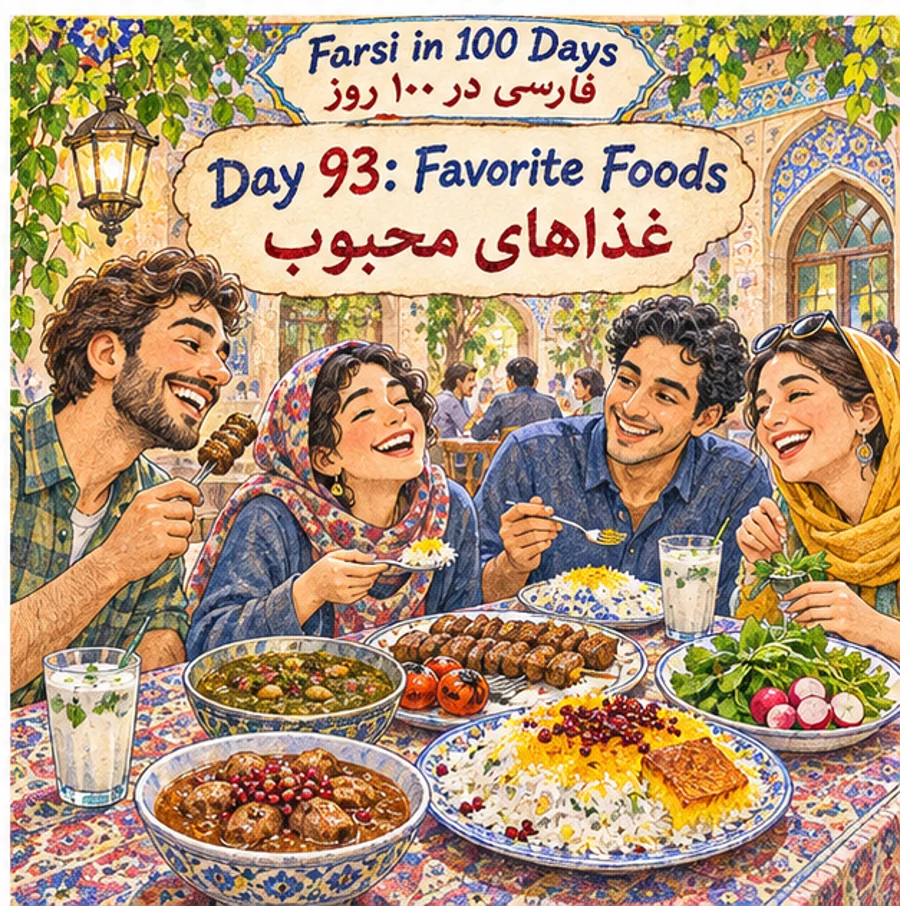
Day 93 of Learn Farsi in 100 Days, our free step-by-step Persian course: What Food Do You Like?. The lesson has four parts, with every Persian word in Persian script, pronunciation and English, and each part ends with a quick check.
Part 1Conversation and joke
Day 93, Part 1 has Sepideh and Shahdad talking about food they like, from spicy Indian dishes (غذاهای تند, ghazâ-hâ-ye tond) to قورمه سبزی (ghorme sabzi, herb stew) and کباب (kabâb, kebab), plus a Mulla joke at the donkey market.
Conversation: favorite foods
| Speaker | Persian | English and pronunciation |
|---|---|---|
| Sepideh سپیده | چه نوع غذاهایی را دوست داری؟ | What kinds of food do you like? che no’ ghazâ-hâyi râ dust dâri? |
| Shahdad شهداد | من عاشق غذاهای تند هستم، مثل غذاهای هندی. | I love spicy food, like Indian food. man âshegh-e ghazâ-hâ-ye tond hastam, mesl-e ghazâ-hâ-ye hendi. |
| Sepideh سپیده | من اصلا غذای تند نمیتوانم بخورم. | I can’t eat spicy food at all. man aslan ghazâ-ye tond nemitavânam bokhoram. |
| Shahdad شهداد | تا حالا غذاهای هندی را امتحان کردی؟ | Have you ever tried Indian food? tâ hâlâ ghazâ-hâ-ye hendi râ emtehân kardi? |
| Sepideh سپیده | یکبار امتحان کردم اما دوست نداشتم. | I tried it once, but I didn’t like it. yek bâr emtehân kardam ammâ dust nadâshtam. |
| Shahdad شهداد | تو چه غذاهایی را دوست داری؟ | What foods do you like? to che ghazâ-hâyi râ dust dâri? |
| Sepideh سپیده | من غذاهای ایرانی را خیلی دوست دارم. | I really like Iranian food. man ghazâ-hâ-ye irâni râ kheyli dust dâram. |
| Shahdad شهداد | کدام غذای ایرانی را بیشتر دوست داری؟ | Which Iranian dish do you like most? kodâm ghazâ-ye irâni râ bishtar dust dâri? |
| Sepideh سپیده | قورمه سبزی، مادر من قورمه سبزی را خیلی خوب درست میکند. | Ghormeh sabzi. My mother makes ghormeh sabzi really well. ghorme sabzi. mâdar-e man ghorme sabzi râ kheyli khub dorost mikonad. |
| Shahdad شهداد | من هم قورمه سبزی دوست دارم اما از بین غذاهای ایرانی کباب را بیشتر دوست دارم. | I like ghormeh sabzi too, but of all Iranian dishes I like kebab best. man ham ghorme sabzi dust dâram ammâ az beyn-e ghazâ-hâ-ye irâni kabâb râ bishtar dust dâram. |
Joke: the Mulla at the market
یک روز ملا به بازار رفته بود تا یک خر بخرد. عدهی زیادی از روستاییها در آنجا بودند.
One day the Mulla had gone to the market to buy a donkey. A lot of villagers were there.
در همین هنگام مردی که از آنجا عبور میکرد به سمت ملا رفت تا او را اذیت کند. مرد به ملا گفت: در این بازار جز روستاییها و خر چیز دیگری پیدا نمیشود.
Just then a man passing by went up to the Mulla to tease him. The man said to the Mulla, “There’s nothing in this market but villagers and donkeys.”
ملا پرسید: شما روستایی هستید؟ مرد پاسخ داد: نه! ملا گفت: پس مشخص شد که چه چیزی هستید.
The Mulla asked, “Are you a villager?” The man answered, “No!” The Mulla said, “Then it’s clear what you are.”
Quick check
- How do you ask “What kinds of food do you like?” in Persian?
Show answer
چه نوع غذاهایی را دوست داری؟ (che no’ ghazâ-hâyi râ dust dâri?) - What does غذای تند (ghazâ-ye tond) mean?
Show answer
spicy food - Which Iranian dish does Shahdad like best?
Show answer
کباب (kabâb), kebab
Part 2Common phrases, poetry and word of the day
Day 93, Part 2 gives six everyday questions for finding your way, such as اسم این خیابان چیه؟ (esm-e in khiyâbân chiye?, what’s this street called?), two couplets by Hafez (حافظ) about staying in your own home, and the word of the day, تفتیش کردن (taftish kardan, to inspect).
Common phrases
| Persian | Pronunciation | English |
|---|---|---|
| اسم این خیابان چیه؟ | esm-e in khiyâbân chiye? | What is the name of this street? |
| اسم این ناحیه چیه؟ | esm-e in nâhiye chiye? | What is the name of this district? |
| از اینجا خیلی دور است؟ | az injâ kheyli dur ast? | Is it far from here? |
| اسم این شهر چیه؟ | esm-e in shahr chiye? | What is the name of this town? |
| حالا کجا هستیم؟ | hâlâ kojâ hastim? | Where are we now? |
| لطفا یک نقشه اینجا بکشید. | lotfan yek naghshe injâ bekeshid. | Please draw a map here. |
Poetry: two couplets by Hafez
Two couplets from a ghazal by Hafez (حافظ, hâfez). The book gives this English translation (H. Wilberforce Clarke): “Go not to the house of the Lords void of liberality of the age; For the corner of ease in the dwelling of one’s self is. Hafez consumed; and in the condition of love and of life staking, Yet, at the head of covenant and of fidelity of himself is.”
| Persian | Pronunciation | English |
|---|---|---|
| مرو به خانهی ارباب بیمروت دهر | maro be khâne-ye arbâb-e bi-morovvat-e dahr | Do not go to the houses of this world’s ungenerous lords, |
| که گنج عافیتت در سرای خویشتن است | ke ganj-e âfiyatat dar sarâ-ye khishtan ast | for your treasure of peace and well-being is in your own home. |
| بسوخت حافظ و در شرط عشقبازی او | besukht hâfez va dar shart-e eshgh-bâzi-ye u | Hafez burned with love, and in the pledge of his love |
| هنوز بر سر عهد و وفای خویشتن است | hanuz bar sar-e ahd o vafâ-ye khishtan ast | he still keeps his promise and stays faithful. |
Word of the day: تفتیش کردن (taftish kardan)
Meaning: to inspect, search
The airport officers searched the suitcases.
Quick check
- How do you ask “Is it far from here?” in Persian?
Show answer
از اینجا خیلی دور است؟ (az injâ kheyli dur ast?) - What is the written form of the spoken question word چیه (chiye)?
Show answer
چیست (chist) or چه است, “what is it?” - What does تفتیش کردن (taftish kardan) mean?
Show answer
to inspect or search
Part 3Idiom of the day and conversation
Day 93, Part 3 explains the proverb آب زیر کاه (âb-e zir-e kâh, water under straw: a sly person), has Soren and Kiana deciding what to cook, from کباب (kabâb, kebab) to ماکارانی (mâkârâni, pasta), and gives an idiom about a willow that doesn’t shake in the wind.
Idiom of the day
آب زیر کاه
âb-e zir-e kâh
Word for word: water under the straw
Meaning in Persian: این اصطلاح برای کسانی به کار میرود که در زندگی مکار و حیلهگرند و با چهرهای خوب، به عنوان یک دوست برنامههای شوم خود را اجرا میکنند. داستان ضرب المثل: در گذشته افرادی که به خاطر ضعف و ناتوانی، توانایی جنگیدن و مبارزه کردن نداشتند از این حیله استفاده میکردند. به این صورت که در مسیر دشمن یک چاه حفر میکردند و روی آن را با کاه میپوشاندند. وقتی دشمن از آنجا عبور میکرد متوجه نمیشد و به داخل آن گودال یا چاه میافتاد.
Meaning: This expression is used for people who are sly and cunning, who wear a friendly face and, posing as a friend, carry out their evil plans. The story behind it: in the past, people who were too weak to fight used this trick. They dug a pit in the enemy’s path and covered it with straw. When the enemy passed by, he didn’t notice it and fell into the hole.
English equivalent: A snake in the grass.
Conversation: what shall I cook?
| Speaker | Persian | English and pronunciation |
|---|---|---|
| Soren سورن | امروز میخواهم آشپزی کنم. چه غذایی دوست داری درست کنم؟ | I want to cook today. What would you like me to make? emruz mikhâham âshpazi konam. che ghazâyi dust dâri dorost konam? |
| Kiana کیانا | من کباب خیلی دوست دارم، کباب بلد هستی درست کنی؟ | I really like kebab. Do you know how to make kebab? man kabâb kheyli dust dâram, kabâb balad hasti dorost koni? |
| Soren سورن | البته، اجازه بده ببینم موادش را در خانه داریم. اوه! گوشت به اندازهی کافی نداریم. | Of course. Let me see if we have the ingredients at home. Oh! We don’t have enough meat. albatte, ejâze bede bebinam mavâddash râ dar khâne dârim. oh! gusht be andâze-ye kâfi nadârim. |
| Kiana کیانا | خوب ماکارانی درست کن! من عاشق ماکارانی هستم. | Well, make pasta! I love pasta. khob mâkârâni dorost kon! man âshegh-e mâkârâni hastam. |
| Soren سورن | ماکارانی هم نداریم! | We don’t have pasta either! mâkârâni ham nadârim! |
| Kiana کیانا | به نظرم بهتر است اول برویم خرید. | I think we’d better go shopping first. be nazaram behtar ast avval beravim kharid. |
| Soren سورن | آره باید برویم خرید. | Yeah, we have to go shopping. âre bâyad beravim kharid. |
Idiom of the day
از آن بیدها نیست که با این بادها بلرزد.
az ân bid-hâ nist ke bâ in bâd-hâ belarzad.
Word for word: He is not one of those willows that shake in these winds.
Meaning in Persian: انسانی قوی است و در برابر سختیها مقاوم است.
Meaning: He is a strong person who holds up against hardship.
English equivalent: The anvil fears no blows.
Quick check
- What kind of person is called آب زیر کاه (âb-e zir-e kâh)?
Show answer
A sly, two-faced person who acts friendly while secretly planning harm. - How do you ask “Do you know how to make kebab?” in Persian?
Show answer
کباب بلد هستی درست کنی؟ (kabâb balad hasti dorost koni?) - What does مواد (mavâdd) mean in the conversation?
Show answer
ingredients
Part 4Reading and new words
Day 93, Part 4 is a reading about Saray-e Moshir (سرای مشیر, sarâ-ye moshir), an old Qajar-era bazaar in Shiraz, and a word list with items such as میراث فرهنگی (mirâs-e farhangi, cultural heritage), سوء تغذیه (su’-e taghziye, malnutrition) and گیاه خواری (giyâh-khâri, vegetarianism).
Reading: Saray-e Moshir bazaar in Shiraz
سرای مشیر یا سرای گلشن یک بازار قدیمی در شهر شیراز است. تاریخ ساخت این بازار به دوران قاجاریه بازمیگردد. این بازار در مجاورت بازار وکیل واقع شده است.
Saray-e Moshir, or Saray-e Golshan, is an old bazaar in the city of Shiraz. It was built in the Qajar era. The bazaar stands next to the Vakil Bazaar.
یکی از زیباترین قسمتهای این بازار حیاط بزرگی است که در وسط ساختمانهای آن قرار گرفته است. این حیاط زیبا دارای درختان تنومند نارنج و یک حوض بزرگ در وسط آن است.
One of the most beautiful parts of the bazaar is a large courtyard in the middle of its buildings. This lovely courtyard has sturdy bitter-orange trees and a large pool in its center.
این بازار زیبا در سال ۱۳۴۷ خورشیدی در میراث فرهنگی ایران به ثبت رسیده است. به علت اینکه کاشیکاریهای زیبا و شیشههای الوان آن درحال فرسایش بود، در سال ۱۳۴۸ تعمیراتی در این بازار انجام شد.
This beautiful bazaar was registered as part of Iran’s cultural heritage in 1347 of the solar calendar (1968). Because its beautiful tilework and colored glass were wearing away, repairs were carried out in 1348 (1969).
اتاقهای اطراف حیاط بازار برای عرضهی صنایعدستی استان فارس اختصاص یافته است. هم اکنون این بازار به خاطر موقعیتی که دارد یکی از مکانهای گردشگری شهر شیراز است.
The rooms around the courtyard are set aside for displaying and selling the handicrafts of Fars province. Today, thanks to its location, the bazaar is one of the tourist sites of Shiraz.
New words
| Persian | Pronunciation | English |
|---|---|---|
| انهدام | enhedâm | destruction |
| شوم | shum | ominous, evil |
| حیله | hile | trick |
| حفر کردن | hafr kardan | to dig |
| کاه | kâh | straw |
| پوشاندن | pushândan | to cover |
| گودال | gudâl | pit, hole |
| الوان | alvân | colorful, of many colors |
| به علت اینکه | be ellat-e inke | because |
| مجاورت | mojâverat | proximity, vicinity |
| تنومند | tanumand | sturdy, thick-trunked |
| وعدهی غذایی | va’de-ye ghazâyi | meal |
| نارنج | nârenj | bitter orange (tree) |
| میراث فرهنگی | mirâs-e farhangi | cultural heritage |
| عرضه | arze | supply, offering (for sale) |
| خوش طعم | khosh-ta’m | tasty |
| اختصاص یافتن | ekhtesâs yâftan | to be allocated, set aside |
| گیاه خواری | giyâh-khâri | vegetarianism |
| مجاور | mojâver | adjacent |
| غیرقابل خوردن | gheyr-e ghâbel-e khordan | inedible |
| سوء تغذیه | su’-e taghziye | malnutrition |
| عدهای | eddei | some (people), a group |
| روستایی | rustâyi | rural; villager |
| در همین هنگام | dar hamin hengâm | at that very moment, just then |
| اذیت کردن | aziyyat kardan | to bother, tease |
| جز | joz | except |
| قورمه سبزی | ghorme sabzi | ghormeh sabzi, a Persian herb stew |
Quick check
- In which era was Saray-e Moshir built?
Show answer
In the Qajar era: دوران قاجاریه (dorân-e ghâjâriye). - What grows in the courtyard of the bazaar?
Show answer
Sturdy bitter-orange trees: درختان تنومند نارنج (derakhtân-e tanumand-e nârenj). - What does میراث فرهنگی (mirâs-e farhangi) mean?
Show answer
cultural heritage
Take this lesson further

Study with the book
Learn Farsi in 100 Days: The Ultimate Crash Course to Learning Farsi Fast
This free lesson is part of Learn Farsi in 100 Days. The book puts the whole series in one printable PDF you can study offline.
Serious about Persian? Get all 30 of our Persian learning books for $199.99 (55% less than buying them one by one).
Free Persian Starter Pack: Alphabet + 100 Core Words
Get the 14-page printable Starter Pack (all 32 letters, a 7-day reading plan, 100 core words and 20 survival phrases) and a short 5-email course. Free.
Free. Every morning: that day’s four videos and the full lessons, with every Persian word, its pronunciation and its English meaning. Stop or pause with one click.