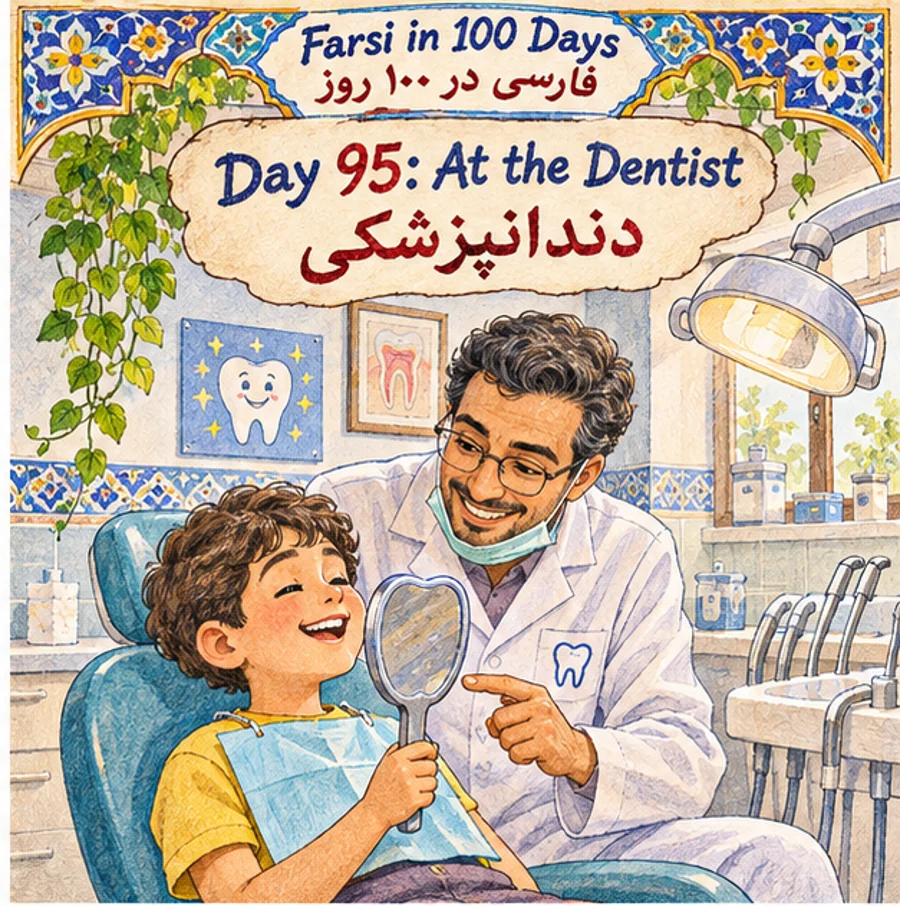
Day 95 of Learn Farsi in 100 Days, our free step-by-step Persian course: At the Dentist. The lesson has four parts, with every Persian word in Persian script, pronunciation and English, and each part ends with a quick check.
Part 1Conversation and joke
Day 95, Part 1 has a patient at the dentist (دندانپزشک, dandânpezeshk) with a decayed tooth (دندان پوسیده, dandân-e puside), who needs an X-ray and asks for an appointment for a cleaning (جرمگیری, jerm-giri), plus a Mulla joke about a house with nothing in it.
Conversation: at the dentist
| Speaker | Persian | English and pronunciation |
|---|---|---|
| Dentist دندانپزشک | مشکل شما چیست؟ | What’s the problem? moshkel-e shomâ chist? |
| Patient بیمار | یکی از دندانهایم که قبلا پر کرده بودم، درد دارد. | One of my teeth that I had filled before is hurting. yeki az dandân-hâyam ke ghablan por karde budam, dard dârad. |
| Dentist دندانپزشک | اجازه بدهید نگاه کنم. … این دندان پوسیده است. | Let me take a look. … This tooth is decayed. ejâze bedahid negâh konam. … in dandân puside ast. |
| Patient بیمار | خوب باید چه کار کنم؟ | Well, what should I do? khob bâyad che kâr konam? |
| Dentist دندانپزشک | باید اول از دندان عکسبرداری کنیم تا مطمئن شویم مشکل چیست. | First we have to X-ray the tooth to be sure what the problem is. bâyad avval az dandân aksbardâri konim tâ motma’en shavim moshkel chist. |
| Patient بیمار | بسیار خوب. ممکن است دیگر دندانهایم را هم معاینه کنید. | All right. Could you examine my other teeth too? besyâr khub. momken ast digar dandân-hâyam râ ham mo’âyene konid. |
| Dentist دندانپزشک | بله حتما. خوب دندانهایتان نیاز به جرمگیری دارد. | Yes, of course. Well, your teeth need scaling (a cleaning). bale hatman. khob dandân-hâyetân niyâz be jerm-giri dârad. |
| Patient بیمار | ممکن است یک وقت برای جرمگیری به من بدهید؟ | Could you give me an appointment for a cleaning? momken ast yek vaght barâye jerm-giri be man bedahid? |
| Dentist دندانپزشک | حتما. با منشی هماهنگ کنید تا به شما یک وقت بدهد. | Certainly. Arrange it with the receptionist and she’ll give you an appointment. hatman. bâ monshi hamâhang konid tâ be shomâ yek vaght bedahad. |
Joke: the empty house
روزی ملا در خانهای رفت و از صاحبخانه مقداری نان خواست. دختری که در خانه بود، جواب داد: نداریم! ملا گفت: یک لیوان آب بده! دختر پاسخ داد: نداریم!
One day the Mulla went to a house and asked the owner for some bread. A girl who was at home answered, “We don’t have any!” The Mulla said, “Give me a glass of water!” The girl replied, “We don’t have any!”
ملا پرسید: مادرت کجاست؟ دختر پاسخ داد: به عزاداری رفته است!
The Mulla asked, “Where is your mother?” The girl replied, “She’s gone to a mourning ceremony!”
ملا گفت: با این خانهای که شما دارید دیگران باید برای عزاداری به خانه شما بیایند.
The Mulla said, “With a house like yours, other people should be coming to your house to mourn.”
Quick check
- How do you say “This tooth is decayed” in Persian?
Show answer
این دندان پوسیده است. (in dandân puside ast.) - What does جرمگیری (jerm-giri) mean?
Show answer
scaling, a dental cleaning (removing tartar) - Who will give the patient an appointment?
Show answer
The receptionist: منشی (monshi).
Part 2Common phrases, poetry and word of the day
Day 95, Part 2 gives two polite requests, such as میتوانم آدرس شما را داشته باشم؟ (mitavânam âdres-e shomâ râ dâshte bâsham?, could I have your address?), two couplets from Rumi (مولانا, mowlânâ) about longing for one’s origin, and the word of the day, ناله کردن (nâle kardan, to moan).
Common phrases
| Persian | Pronunciation | English |
|---|---|---|
| میتوانم آدرس شما را داشته باشم؟ | mitavânam âdres-e shomâ râ dâshte bâsham? | Could I have your address? |
| میتوانم شماره تلفن شما را داشته باشم؟ | mitavânam shomâre telefon-e shomâ râ dâshte bâsham? | May I have your telephone number? |
Poetry: from Rumi’s Masnavi
Two couplets from the opening of the Masnavi by Rumi (مولانا, mowlânâ), the “Song of the Reed.” The book gives this English translation (R. A. Nicholson): “Every one who is left far from his source wishes back the time when he was united with it. In every company I uttered my wailful notes, I consorted with the unhappy and with them that rejoice.” The book also explains two words: کو (ku) = که او (ke u, who/that he), and باز جوید (bâz juyad) = دوباره جستجو کند (dobâre jostoju konad, seeks again).
| Persian | Pronunciation | English |
|---|---|---|
| هر کسی کو دور ماند از اصل خویش | har kasi ku dur mând az asl-e khish | Everyone who is left far from his origin |
| باز جوید روزگار وصل خویش | bâz juyad ruzgâr-e vasl-e khish | seeks again the time when he was united with it. |
| من به هر جمعیتی نالان شدم | man be har jam’iyyati nâlân shodam | In every gathering I poured out my lament; |
| جفت بدحالان و خوشحالان شدم | joft-e bad-hâlân o khosh-hâlân shodam | I kept company with the unhappy and the happy alike. |
Word of the day: ناله کردن (nâle kardan)
Meaning: to moan, groan; to whine
The patient was moaning because of his toothache.
Quick check
- How do you ask “May I have your telephone number?” in Persian?
Show answer
میتوانم شماره تلفن شما را داشته باشم؟ (mitavânam shomâre telefon-e shomâ râ dâshte bâsham?) - In the poem, what does کو (ku) stand for?
Show answer
که او (ke u), “who (he)” - What does ناله کردن (nâle kardan) mean?
Show answer
to moan or groan
Part 3Idiom of the day and conversation
Day 95, Part 3 explains the proverb دو قورت و نیمش باقی است (do ghort o nimash bâghi ast, said of someone who expects too much), has a patient booking a tooth extraction (کشیدن دندان, keshidan-e dandân) and a crown (روکش دندان, rukesh-e dandân), and gives the idiom آش کشک خالهات است.
Idiom of the day
دو قورت و نیمش باقی است.
do ghort o nimash bâghi ast.
Word for word: Two and a half gulps of it are still left.
Meaning in Persian: این ضربالمثل درمورد شخصی به کار میرود که حرص و طمع زیاد داشته باشد، و بیشتر از میزان شایستگی خود، انتظار لطف و محبت از طرف دیگران داشته باشد. همچنین شخصی، که از کار بد و نادرست خود نه تنها احساس پشیمانی نکند بلکه انتظار لطف و محبت هم داشته باشد. در این مواقع میگویند: «دو قورت و نیمش باقی است.»
Meaning: This proverb is used about a greedy person who expects more kindness and favor from others than he deserves; also about someone who not only feels no regret for his bad, wrong actions but even expects kindness. In such cases people say, “He still has two and a half gulps to go” (he is never satisfied and still wants more).
Conversation: booking an appointment
| Speaker | Persian | English and pronunciation |
|---|---|---|
| Patient بیمار | ممکن است برای کشیدن دندان به من یک وقت بدهید. | Could you give me an appointment to have a tooth pulled? momken ast barâye keshidan-e dandân be man yek vaght bedahid. |
| Receptionist منشی | بله، قبلا پزشک شما را معاینه کرده است؟ | Yes. Has the doctor examined you before? bale, ghablan pezeshk shomâ râ mo’âyene karde ast? |
| Patient بیمار | بله، پزشک اینجا روکش دندان هم انجام میدهد؟ | Yes. Does the doctor here do crowns too? bale, pezeshk-e injâ rukesh-e dandân ham anjâm midahad? |
| Receptionist منشی | بله انجام میدهند. برای روکش دندان هم وقت میخواهید؟ | Yes, he does. Would you like an appointment for a crown too? bale anjâm midahand. barâye rukesh-e dandân ham vaght mikhâhid? |
| Patient بیمار | بله، اگر ممکن است یک وقت هم برای آن بدهید. | Yes, if possible, give me an appointment for that too. bale, agar momken ast yek vaght ham barâye ân bedahid. |
| Receptionist منشی | روز نهم شهریور میتوانید بیایید؟ | Can you come on the 9th of Shahrivar? ruz-e nohom-e shahrivar mitavânid biyâyid? |
| Patient بیمار | بله میتوانم. | Yes, I can. bale mitavânam. |
Idiom of the day
آش کشک خالهات است، بخوری پایت است نخوری پایت است.
âsh-e kashk-e khâle-at ast, bokhori pâyat ast, nakhori pâyat ast.
Word for word: It’s your aunt’s kashk soup: if you eat it, it’s on you; if you don’t eat it, it’s still on you.
Meaning in Persian: تکلیف و وظیفهای که برعهدهی کسی باشد. این کار را باید انجام دهی.
Meaning: A duty or obligation that falls on someone: you have to do this, like it or not.
English equivalent: As you make your bed, so you must lie in it.
Quick check
- How do you ask for an appointment to have a tooth pulled?
Show answer
ممکن است برای کشیدن دندان به من یک وقت بدهید؟ (momken ast barâye keshidan-e dandân be man yek vaght bedahid?) - What does روکش دندان (rukesh-e dandân) mean?
Show answer
a dental crown - When is دو قورت و نیمش باقی است (do ghort o nimash bâghi ast) said?
Show answer
About a greedy or shameless person who expects more than he deserves, even after doing wrong.
Part 4Reading and new words
Day 95, Part 4 is a reading about the Mongol-era poet Khwaju Kermani (خواجوی کرمانی, khâju-ye kermâni), buried in Shiraz, and a dental word list with items such as دندان عقل (dandân-e aghl, wisdom tooth), عصب کشی (asab-keshi, root canal) and نخ دندان (nakh-e dandân, dental floss).
Reading: the poet Khwaju Kermani
خواجوی کرمانی در سال ۶۸۹ هجری قمری در کرمان به دنیا آمده و در سال ۷۵۲ هجری قمری در شیراز درگذشته است. خواجوی کرمانی که از شاعران دوران مغول است، شعرهای زیادی را برای ستایش حاکمان استان فارس سروده است. از این شاعر آثار زیادی باقی مانده است.
Khwaju Kermani was born in Kerman in 689 AH (lunar calendar) and died in Shiraz in 752 AH. Khwaju Kermani, one of the poets of the Mongol era, wrote many poems in praise of the rulers of Fars province. Many of his works have survived.
اشعار خواجوی کرمانی بیشتر اشعار عرفانی است. برخی از تاریخنگاران او را در ریاضیات و پزشکی نیز صاحبنظر میدانند. آرامگاه این شاعر در شمال شهر شیراز قرار دارد.
Khwaju Kermani’s poems are mostly mystical. Some historians also consider him an expert in mathematics and medicine. The poet’s tomb is in the north of Shiraz.
New words
| Persian | Pronunciation | English |
|---|---|---|
| ستایش | setâyesh | praise |
| باقیمانده | bâghi-mânde | remaining; remainder |
| عرفانی | erfâni | mystical |
| تاریخنگاران | târikh-negârân | historians |
| عصب کشی | asab-keshi | root canal (treatment) |
| صاحبنظر | sâheb-nazar | expert, authority |
| کشک | kashk | kashk (dried whey), curd |
| خمیر دندان | khamir-e dandân | toothpaste |
| تکلیف | taklif | task, duty, assignment |
| وظیفه | vazife | duty |
| پانسمان کردن | pânsemân kardan | to dress (a wound) |
| جرمگیری | jerm-giri | scaling, tartar removal |
| دندان آسیاب | dandân-e âsiyâb | molar |
| دندان عقل | dandân-e aghl | wisdom tooth |
| کشیدن | keshidan | to pull out, extract (a tooth) |
| نخ دندان | nakh-e dandân | dental floss |
| لثه | lase | gum |
| فک | fak | jaw |
| نالیدن | nâlidan | to moan, groan, whimper |
| تب | tab | fever |
| مطمئن بودن | motma’en budan | to be sure |
| مراقبت کردن | morâghebat kardan | to take care (of) |
| مسواک | mesvâk | toothbrush |
| هماهنگ کردن | hamâhang kardan | to coordinate, arrange |
| پذیرش | paziresh | reception (desk) |
| عزاداری | azâdâri | mourning |
| تأخیر | ta’khir | delay |
Quick check
- Where was Khwaju Kermani born, and where is his tomb?
Show answer
He was born in Kerman (کرمان, kermân); his tomb is in the north of Shiraz (شیراز, shirâz). - What does دندان عقل (dandân-e aghl) mean?
Show answer
wisdom tooth - How do you say “dental floss” in Persian?
Show answer
نخ دندان (nakh-e dandân)
Take this lesson further

Study with the book
Learn Farsi in 100 Days: The Ultimate Crash Course to Learning Farsi Fast
This free lesson is part of Learn Farsi in 100 Days. The book puts the whole series in one printable PDF you can study offline.
Serious about Persian? Get all 30 of our Persian learning books for $199.99 (55% less than buying them one by one).
Free Persian Starter Pack: Alphabet + 100 Core Words
Get the 14-page printable Starter Pack (all 32 letters, a 7-day reading plan, 100 core words and 20 survival phrases) and a short 5-email course. Free.
Free. Every morning: that day’s four videos and the full lessons, with every Persian word, its pronunciation and its English meaning. Stop or pause with one click.