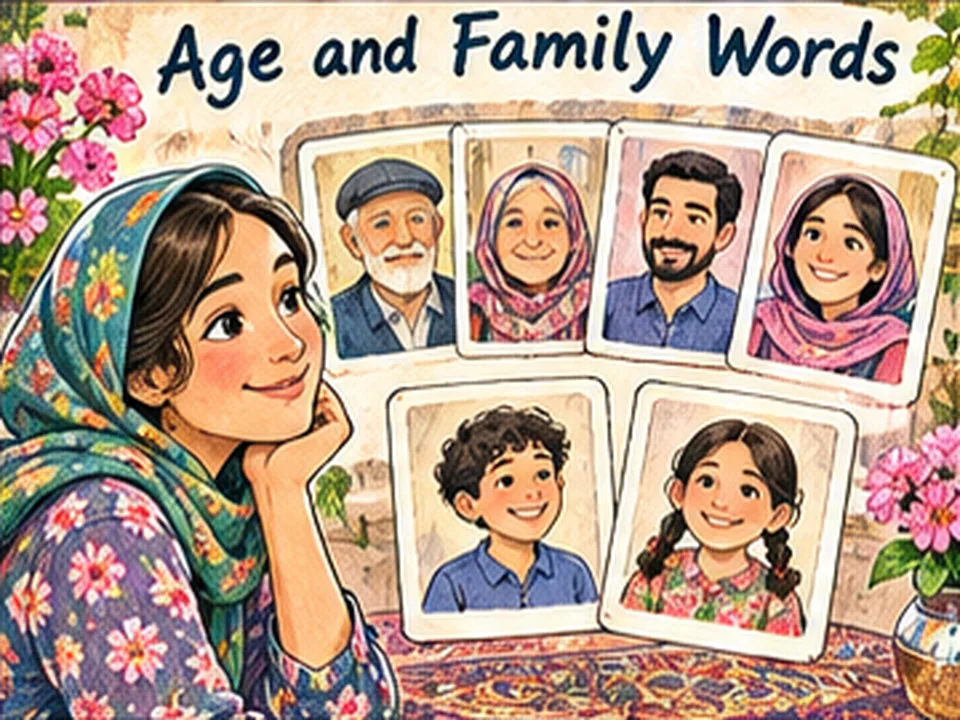
Lesson 8 of Learn to Speak Persian Fast, our free video course: How Old Are You?. Watch the video for each part, then read the notes, with every Persian word in Persian script, pronunciation and English, and try the practice questions at the end of each part.
New words: Persian words for age and family
Learn Persian words for age, family members and the numbers you need to say how old you are, with examples and a short quiz.
Study notes for this lesson. To ask and answer "How old are you?" you need a few words about age, the members of your family and the numbers. This page lists the core vocabulary, the most useful numbers and some example sentences about Maryam and her family, who appear again in the reading and speaking parts of this lesson.
Vocabulary: age and family
| Persian | Pronunciation | English |
|---|---|---|
| سن | /sen/ | age |
| سال | /sâl/ | year |
| چند | /chand/ | how many |
| ساله | /sâle/ | … years old |
| تولد | /tavallod/ | birthday, birth |
| خانواده | /khânevâde/ | family |
| نفر | /nafar/ | person (used when counting people) |
| بچه | /bache/ | child |
| پسر | /pesar/ | boy, son |
| دختر | /dokhtar/ | girl, daughter |
| برادر | /barâdar/ | brother |
| خواهر | /khâhar/ | sister |
| پدربزرگ | /pedarbozorg/ | grandfather |
| مادربزرگ | /mâdarbozorg/ | grandmother |
| جوان | /javân/ | young |
| پیر | /pir/ | old (for people) |
| بزرگتر | /bozorgtar/ | older, bigger |
| کوچکتر | /kuchaktar/ | younger, smaller |
Numbers you need for ages
Compound numbers are joined with و, pronounced -o: بیست و پنج (bist-o panj), 25; چهل و هشت (chehel-o hasht), 48.
| Persian | Pronunciation | Number |
|---|---|---|
| ده | /dah/ | 10 |
| دوازده | /davâzdah/ | 12 |
| سیزده | /sizdah/ | 13 |
| بیست | /bist/ | 20 |
| بیست و دو | /bist-o do/ | 22 |
| سی | /si/ | 30 |
| چهل | /chehel/ | 40 |
| پنجاه | /panjâh/ | 50 |
| شصت | /shast/ | 60 |
| هفتاد | /haftâd/ | 70 |
| هشتاد | /hashtâd/ | 80 |
| صد | /sad/ | 100 |
Example sentences
| Persian | Pronunciation | English |
|---|---|---|
| شما چند سال دارید؟ | /shomâ chand sâl dârid?/ | How old are you? (polite, literally "how many years do you have?") |
| چند سالته؟ | /chand sâlete?/ | How old are you? (spoken, informal) |
| من بیست و دو سال دارم. | /man bist-o do sâl dâram./ | I am twenty-two years old. |
| مریم بیست و دو ساله است. | /maryam bist-o do sâle ast./ | Maryam is twenty-two years old. |
| برادر مریم از او بزرگتر است. | /barâdar-e maryam az u bozorgtar ast./ | Maryam's brother is older than her. |
| خواهرش دوازده سال دارد. | /khâharash davâzdah sâl dârad./ | Her sister is twelve. |
| خانوادهی ما شش نفر است. | /khânevâde-ye mâ shesh nafar ast./ | There are six people in our family. |
| فردا تولد سحر است. | /fardâ tavallod-e sahar ast./ | Tomorrow is Sahar's birthday. |
Three ways to give your age
You will meet three patterns, and all of them are correct. The written and polite pattern uses داشتن (dâshtan, "to have"): من بیست سال دارم (man bist sâl dâram). The second uses ساله (sâle) as an adjective with "to be": من بیست ساله هستم (man bist sâle hastam). The third is the everyday spoken form, بیست سالمه (bist sâlame), which you will practice on the Speaking page. To ask the question, use چند (chand, "how many") with سال: چند سال دارید؟ or, among friends, چند سالته؟. The word سن (sen, "age") appears mostly in forms and in writing: سن شما چقدر است؟ (sen-e shomâ cheghadr ast?), "What is your age?".
Notes on the words
- Persian usually says you "have" years: بیست سال دارم (bist sâl dâram). You can also use ساله (sâle) with "to be": بیست ساله هستم (bist sâle hastam).
- After a number, the noun stays singular: سه برادر (se barâdar), "three brothers", not سه برادرها.
- پیر (pir) is only for people and animals. For old things, use قدیمی (ghadimi) or کهنه (kohne).
- بزرگتر and کوچکتر are comparatives of بزرگ (bozorg, "big") and کوچک (kuchak, "small"). With people they mean "older" and "younger". In speech you will hear کوچیکتر (kuchiktar).
- بچه (bache) means "child" and also "kid" in a friendly way; بچهها (bache-hâ) is "children" or "guys".
Other parts of Lesson 8
Practice
How do you say "forty-eight" in Persian?
Show answer
chehel-o hasht چهل و هشت
Ask a friend how old they are in spoken Persian.
Show answer
chand sâlete? چند سالته؟
Translate: "I am thirty years old."
Show answer
man si sâl dâram. (or: man si sâle hastam.) من سی سال دارم.
What is the difference between pir and ghadimi? پیر / قدیمی
Show answer
pir is "old" for people; ghadimi is "old" for things.
Translate: "my older brother"
Show answer
barâdar-e bozorgtaram (or barâdar-e bozorgam) برادر بزرگترم
Grammar: The Persian present indicative tense
Learn how to form the Persian present indicative with mi-, present stems and personal endings, with tables, examples and a quiz.
Study notes for this lesson. The present indicative is the tense you use most in Persian. One form covers "I live", "I am living" and often "I will go" too. It is built from three parts: the prefix می (mi-), the present stem of the verb, and a personal ending.
Personal endings
| Ending | Pronunciation | Person |
|---|---|---|
| ـم | /-am/ | I |
| ـی | /-i/ | you (singular) |
| ـد | /-ad (spoken: -e)/ | he, she |
| ـیم | /-im/ | we |
| ـید | /-id (spoken: -in)/ | you (plural or polite) |
| ـند | /-and (spoken: -an)/ | they |
Full example: رفتن (raftan), to go
The present stem of رفتن is رو (rav). Written and spoken forms are both shown, because everyday Tehran speech shortens this verb a lot.
| Persian | Pronunciation | English |
|---|---|---|
| من میروم | /man miravam (spoken: miram)/ | I go / I am going |
| تو میروی | /to miravi (spoken: miri)/ | you go |
| او میرود | /u miravad (spoken: mire)/ | he / she goes |
| ما میرویم | /mâ miravim (spoken: mirim)/ | we go |
| شما میروید | /shomâ miravid (spoken: mirin)/ | you go (plural or polite) |
| آنها میروند | /ânhâ miravand (spoken: miran)/ | they go |
Present stems you must learn
The present stem cannot always be guessed from the infinitive, so learn it with each new verb. Removing ـن (-an) from the infinitive gives the past stem, not the present stem.
| Infinitive and stem | Pronunciation | Meaning and “I” form |
|---|---|---|
| کردن ← کن | /kardan → kon/ | to do, make → mikonam |
| خواندن ← خوان | /khândan → khân/ | to read, study → mikhânam |
| دیدن ← بین | /didan → bin/ | to see → mibinam |
| آمدن ← آ | /âmadan → â/ | to come → miâyam (spoken: miyâm) |
| شدن ← شو | /shodan → shav/ | to become → mishavam (spoken: misham) |
| گفتن ← گو | /goftan → gu/ | to say → miguyam (spoken: migam) |
| داشتن ← دار | /dâshtan → dâr/ | to have → dâram (no mi-) |
What the present indicative is used for
- Habits and facts: هر روز به مدرسه میرود (har ruz be madrese miravad), "she goes to school every day".
- Actions happening now: چه کار میکنی؟ (che kâr mikoni?), "what are you doing?".
- Plans in the near future, usually with a time word: فردا میروم (fardâ miravam), "I'm going tomorrow".
Negative
Replace می with نمی (nemi-): نمیروم (nemiravam), "I don't go". With compound verbs the prefix goes on the verb part: زندگی نمیکنم (zendegi nemikonam), "I don't live". The verb داشتن takes ن (na-) only: ندارم (nadâram), "I don't have".
Examples
| Persian | Pronunciation | English |
|---|---|---|
| من در تهران زندگی میکنم. | /man dar tehrân zendegi mikonam./ | I live in Tehran. |
| سحر به مدرسه میرود. | /sahar be madrese miravad./ | Sahar goes to school. |
| برادرم بیست و پنج سال دارد. | /barâdaram bist-o panj sâl dârad./ | My brother is twenty-five. |
| مادربزرگم هر روز پیادهروی میکند. | /mâdarbozorgam har ruz piyâde-ravi mikonad./ | My grandmother walks every day. |
| فردا سحر سیزده ساله میشود. | /fardâ sahar sizdah sâle mishavad./ | Tomorrow Sahar turns thirteen. |
| ما فارسی میخوانیم. | /mâ fârsi mikhânim./ | We study Persian. |
| آنها در تهران زندگی نمیکنند. | /ânhâ dar tehrân zendegi nemikonand./ | They don't live in Tehran. |
Common mistakes
- Adding می to داشتن: "I have" is دارم (dâram), not میدارم.
- Using the past stem: "I go" is میروم (miravam), not میرفتم, which means "I was going" or "I used to go".
- Forgetting the zero-width space: write میروم, not میروم or می روم. Many Iranians type میروم informally, but the standard spelling keeps می separate.
- Mixing written and spoken forms in one sentence, such as من میرم مدرسه with a written ending elsewhere. Pick one style and stay with it.
Other parts of Lesson 8
Practice
Conjugate khândan for "we". خواندن
Show answer
mikhânim میخوانیم
What is the present stem of didan (to see)? دیدن
Show answer
bin: mibinam, "I see" بین
Make negative: man dar tehrân zendegi mikonam. من در تهران زندگی میکنم.
Show answer
man dar tehrân zendegi nemikonam. من در تهران زندگی نمیکنم.
Why is mi-dâram wrong for "I have"?
Show answer
dâshtan does not take mi- in the simple present: dâram. دارم
Give the spoken form of miravad. میرود
Show answer
mire میره
Speaking: How old are you? A Persian conversation
Practice asking and telling ages in spoken Persian with a family-photo dialogue, useful phrases, a role-play idea and a quiz.
Study notes for this lesson. Leila visits her friend Maryam and they look at a family photo. Maryam tells her who everyone is and how old they are. The dialogue uses spoken Tehran Persian, so many verbs and endings are shortened. Read it aloud and pay attention to the short form سالمه (sâlame).
Dialogue: Leila and Maryam
| Speaker | Persian | Pronunciation | English |
|---|---|---|---|
| Leila | این عکس خانوادهته؟ | /in aks-e khânevâdate?/ | Is this a photo of your family? |
| Maryam | آره. اینا پدر و مادرمن. | /âre. inâ pedar-o mâdaraman./ | Yes. These are my father and mother. |
| Leila | پدرت چند سالشه؟ | /pedaret chand sâleshe?/ | How old is your father? |
| Maryam | پنجاه سالشه. | /panjâh sâleshe./ | He's fifty. |
| Leila | این پسر کیه؟ | /in pesar kiye?/ | Who is this boy? |
| Maryam | برادرم نیماست. بیست و پنج سالشه. | /barâdaram nimâst. bist-o panj sâleshe./ | That's my brother Nima. He's twenty-five. |
| Leila | پس تو از نیما کوچیکتری؟ | /pas to az nimâ kuchiktari?/ | So you're younger than Nima? |
| Maryam | آره، من بیست و دو سالمه. تو چند سالته؟ | /âre, man bist-o do sâlame. to chand sâlete?/ | Yes, I'm twenty-two. How old are you? |
| Leila | من بیست و سه سالمه. | /man bist-o se sâlame./ | I'm twenty-three. |
| Maryam | این دختر کوچولو هم خواهرمه، سحر. فردا تولدشه. | /in dokhtar kuchulu ham khâharame, sahar. fardâ tavallodeshe./ | And this little girl is my sister, Sahar. Tomorrow is her birthday. |
| Leila | چه خوب! تولدش مبارک. | /che khub! tavallodesh mobârak./ | How nice. Happy birthday to her. |
How the spoken age phrase works
سالمه (sâlame) is short for سالم است (sâlam ast), literally "it is my year(s)". It is the most common way to give your age in conversation. The same pattern works for every person: سالمه (sâlame), "I am"; سالته (sâlete), "you are"; سالشه (sâleshe), "he or she is". In writing or formal speech, use سال دارم (sâl dâram): من بیست و دو سال دارم.
Useful phrases
| Persian | Pronunciation | English |
|---|---|---|
| چند سالته؟ | /chand sâlete?/ | How old are you? (informal) |
| شما چند سالتونه؟ | /shomâ chand sâletune?/ | How old are you? (polite, spoken) |
| … سالمه. | /… sâlame./ | I'm … (years old). |
| … سالشه. | /… sâleshe./ | He / she is … (years old). |
| از … بزرگترم. | /az … bozorgtaram./ | I'm older than … |
| از … کوچیکترم. | /az … kuchiktaram./ | I'm younger than … |
| این کیه؟ | /in kiye?/ | Who is this? |
| تولدت مبارک! | /tavallodet mobârak!/ | Happy birthday. |
Asking an adult's age directly can feel personal in Iran, as in many places, so with older people or new acquaintances it is safer to talk about the ages of children and younger family members.
Two more spoken features appear in the dialogue. اینا (inâ) is the spoken form of اینها (inhâ), "these", and کیه؟ (kiye?) is short for کی است؟ (ki ast?), "who is it?". Notice also how Leila uses پس (pas, "so, then") to draw a conclusion from what Maryam has just said.
Role-play
- Bring a real or imagined family photo and show it to a partner.
- Your partner points and asks این کیه؟ and چند سالشه؟.
- Answer with the family words from the New Words page and a number.
- Compare ages with بزرگتر and کوچیکتر.
- Finish by asking your partner تو چند سالته؟.
Other parts of Lesson 8
Practice
How old is Maryam's father?
Show answer
Fifty: panjâh sâleshe. پنجاه سالشه.
Who is older, Maryam or Nima?
Show answer
Nima. He is 25; Maryam is 22. نیما
Say "I'm twenty-three" in spoken Persian.
Show answer
bist-o se sâlame. بیست و سه سالمه.
What does tavallodesh mobârak mean? تولدش مبارک
Show answer
Happy birthday to her (him).
Give the written equivalent of man bist-o do sâlame. من بیست و دو سالمه.
Show answer
man bist-o do sâl dâram. من بیست و دو سال دارم.
Reading: Maryam's family
Read a short beginner Persian text about a family and their ages, sentence by sentence, with key words, grammar notes and a quiz.
Study notes for this lesson. Maryam introduces her family and says how old everyone is. The text is in standard written Persian and uses the present indicative from the Grammar page. Before you read, review the numbers and family words on the New Words page.
Reading text
| Persian | Pronunciation | English |
|---|---|---|
| سلام، من مریم هستم و بیست و دو سال دارم. | /salâm, man maryam hastam va bist-o do sâl dâram./ | Hello, I am Maryam and I am twenty-two years old. |
| من با خانوادهام در تهران زندگی میکنم. | /man bâ khânevâde-am dar tehrân zendegi mikonam./ | I live in Tehran with my family. |
| ما شش نفر هستیم. | /mâ shesh nafar hastim./ | There are six of us. |
| پدرم پنجاه سال دارد و مادرم چهل و هشت سال دارد. | /pedaram panjâh sâl dârad va mâdaram chehel-o hasht sâl dârad./ | My father is fifty and my mother is forty-eight. |
| برادرم نیما بیست و پنج سال دارد. | /barâdaram nimâ bist-o panj sâl dârad./ | My brother Nima is twenty-five. |
| او مهندس است و در یک شرکت کار میکند. | /u mohandes ast va dar yek sherkat kâr mikonad./ | He is an engineer and works at a company. |
| خواهر کوچکم سحر دوازده سال دارد و به مدرسه میرود. | /khâhar-e kuchakam sahar davâzdah sâl dârad va be madrese miravad./ | My little sister Sahar is twelve and goes to school. |
| مادربزرگم هم با ما زندگی میکند. | /mâdarbozorgam ham bâ mâ zendegi mikonad./ | My grandmother also lives with us. |
| او هفتاد و پنج سال دارد، اما هنوز هر روز پیادهروی میکند. | /u haftâd-o panj sâl dârad, ammâ hanuz har ruz piyâde-ravi mikonad./ | She is seventy-five, but she still goes for a walk every day. |
| فردا تولد سحر است. | /fardâ tavallod-e sahar ast./ | Tomorrow is Sahar's birthday. |
| او سیزده ساله میشود. | /u sizdah sâle mishavad./ | She is turning thirteen. |
Key words
- خانواده (khânevâde): family; با خانوادهام (bâ khânevâde-am), "with my family"
- نفر (nafar): person, used for counting people
- زندگی کردن (zendegi kardan): to live
- خواهر کوچک (khâhar-e kuchak): little sister
- مادربزرگ (mâdarbozorg): grandmother
- هنوز (hanuz): still
- پیادهروی کردن (piyâde-ravi kardan): to walk, go for a walk
- تولد (tavallod): birthday
- ساله شدن (sâle shodan): to turn (an age)
In spoken Persian the first sentences would sound like this: سلام، من مریمم و بیست و دو سالمه. با خانوادهم تو تهران زندگی میکنم. (salâm, man maryamam va bist-o do sâlame. bâ khânevâdam tu tehrân zendegi mikonam.) Compare the two versions to see how endings shorten in speech.
Grammar in the text
- Age is given with داشتن: دوازده سال دارد (davâzdah sâl dârad), "she is twelve". There is no می on دارد.
- ما شش نفر هستیم, literally "we are six persons", is the natural way to say how many people are in a family.
- سیزده ساله میشود uses شدن (shodan), "to become", to talk about a birthday that is coming. The present tense often refers to the near future.
- خانوادهام (khânevâde-am) shows the possessive suffix after silent ه, from Lesson 7.
Writing task: write five sentences about your own family. Give each person's name, age and one activity, for example برادرم سی سال دارد و در یک بیمارستان کار میکند (barâdaram si sâl dârad va dar yek bimârestân kâr mikonad), "My brother is thirty and works at a hospital".
Other parts of Lesson 8
Practice
How many people are in Maryam's family home?
Show answer
Six: mâ shesh nafar hastim. شش نفر
How old is Maryam's mother?
Show answer
Forty-eight. چهل و هشت سال
What does Nima do?
Show answer
He is an engineer at a company. مهندس است.
What does the grandmother do every day?
Show answer
She goes for a walk. پیادهروی میکند.
How old will Sahar be tomorrow?
Show answer
Thirteen. سیزده ساله
Take this lesson further

Study with the book
Learn to Speak Persian Fast: For Beginners
This free lesson is part of Learn to Speak Persian Fast. The book puts the whole series in one printable PDF you can study offline.
Serious about Persian? Get all 30 of our Persian learning books for $199.99 (55% less than buying them one by one).
Free Persian Starter Kit (PDF)
The Persian alphabet chart and the 101 most common Persian words with pronunciation, in one printable PDF. You also get a one-time 15% code for any of our books.
We will email you new lessons and book news from Learn Persian Online. Unsubscribe any time.Free Persian Starter Pack: Alphabet + 100 Core Words
Get the 14-page printable Starter Pack (all 32 letters, a 7-day reading plan, 100 core words and 20 survival phrases) and a short 5-email course. Free.