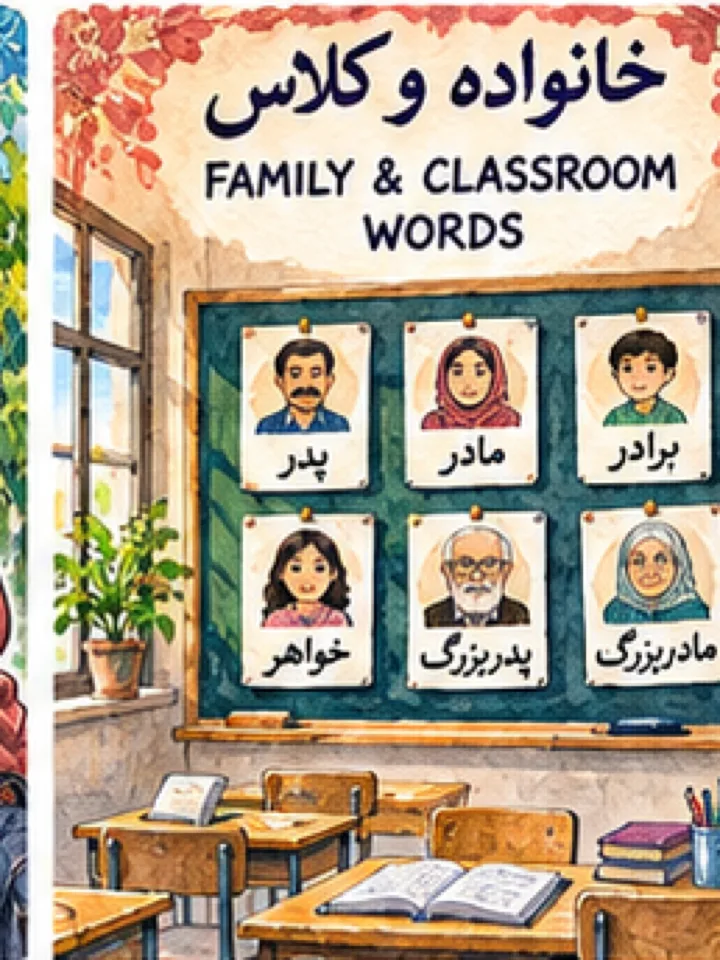
Lesson 3 of Learn to Speak Persian Fast, our free video course: Family and Classroom. Watch the video for each part, then read the notes, with every Persian word in Persian script, pronunciation and English, and try the practice questions at the end of each part.
New words for lesson 3: family and classroom
Study notes for lesson 3: 18 Persian words for family members and the classroom, with pronunciation, example sentences and a short quiz.
Study notes for this lesson. The lesson 3 video introduces words for the family, and the rest of the lesson puts them to work in a classroom setting with the present tense of "to be" (هستم, "I am"). On these pages you follow Leila, a student who shows her class a photo of her family, her classmate Nima, and their teacher, Mr. Rezaei.
Word list
| Persian | Pronunciation | English |
|---|---|---|
| خانواده | /khânevâde/ | family |
| پدر | /pedar/ | father |
| مادر | /mâdar/ | mother |
| برادر | /barâdar/ | brother |
| خواهر | /khâhar/ | sister |
| پسر | /pesar/ | boy; son |
| دختر | /dokhtar/ | girl; daughter |
| بچه | /bachche/ | child |
| معلم | /mo'allem/ | teacher |
| دانشجو | /dâneshju/ | (university) student |
| کلاس | /kelâs/ | class, classroom |
| دوست | /dust/ | friend |
| عکس | /aks/ | photo |
| این | /in/ | this |
| آن | /ân/ | that |
| بزرگ | /bozorg/ | big; older |
| کوچک | /kuchek/ | small; young |
| خوشحال | /khoshhâl/ | happy |
Notes on the words
- خواهر and خواندن are spelled with خوا, but the و is silent: say khâhar, not khvâhar.
- پسر and دختر mean both "boy, girl" and "son, daughter". پسر من (pesar-e man) is "my son".
- دانشجو is a university student. A school pupil is دانشآموز (dânesh-âmuz).
- In speech, کوچک usually sounds like کوچیک (kuchik), and آن like اون (un).
Example sentences
| Persian | Pronunciation | English |
|---|---|---|
| این خانوادهی من است. | /in khânevâde-ye man ast./ | This is my family. |
| این پدر من است و آن مادر من است. | /in pedar-e man ast va ân mâdar-e man ast./ | This is my father and that is my mother. |
| برادر من کوچک است. | /barâdar-e man kuchek ast./ | My brother is young. |
| خواهر من دانشجو است. | /khâhar-e man dâneshju ast./ | My sister is a university student. |
| آقای رضایی معلم ماست. | /âghâ-ye rezâyi mo'allem-e mâst./ | Mr. Rezaei is our teacher. |
| ما در کلاس خوشحال هستیم. | /mâ dar kelâs khoshhâl hastim./ | We are happy in class. |
Notice the ezâfe again: پدر من is pedar-e man. After a word ending in a vowel, the ezâfe becomes -ye, and after a silent ه it is often written with ی: خانوادهی من (khânevâde-ye man).
How to learn these words
Find a family photo and point to each person while you say the word aloud: این پدر من است, این خواهر من است. Then describe the people in your class or office with معلم, دانشجو and دوست. Lesson 5 adds the wider family: grandparents, aunts, uncles and cousins.
Word families
Several words in this list pair up, which makes them easier to remember. پدر and مادر rhyme, and so do برادر and مادر in their endings. این (this) and آن (that) point to people or things near you and further away: این پسر is "this boy", آن دختر is "that girl". بزرگ and کوچک are opposites; with family members they often mean older and younger rather than physical size, so خواهر بزرگ is an older sister.
Other pages in this lesson
Practice
What is the Persian word for "sister"?
Show answer
khâhar خواهر
What does this word mean? خانواده
Show answer
family (khânevâde)
How do you say "my father"?
Show answer
pedar-e man پدر من
Translate: My brother is young.
Show answer
barâdar-e man kuchek ast. برادر من کوچک است.
Which word means a university student?
Show answer
dâneshju دانشجو
Grammar: The present tense of "to be" in Persian
Study notes for lesson 3 grammar: the present tense of 'to be' in Persian, full forms like hastam and short endings like -am, with examples.
Study notes for this lesson. The grammar video for lesson 3 introduces the simple present of the verb "to be" (بودن, budan). This is the verb in sentences like "I am a student" or "She is my sister". Persian has two ways to say it: a full form (هستم, hastam) and a short ending that attaches to the word before it (ـم, -am). Both mean the same thing. This page covers the positive forms; lesson 4 adds the negative "I am not".
Full forms
| Form | Pronunciation | Meaning |
|---|---|---|
| من هستم | /man hastam/ | I am |
| تو هستی | /to hasti/ | you are (informal) |
| او است | /u ast/ | he, she is |
| ما هستیم | /mâ hastim/ | we are |
| شما هستید | /shomâ hastid/ | you are (plural or polite) |
| آنها هستند | /ânhâ hastand/ | they are |
The verb comes at the end of the sentence: من دانشجو هستم (man dâneshju hastam) is literally "I student am". The third person singular is usually است (ast), not هست; هست means "there is" or adds emphasis.
Short endings
In speech and in much writing, the verb shrinks to an ending on the noun or adjective. With a word ending in a consonant, such as خوشحال (khoshhâl), "happy":
| Form | Pronunciation | Meaning |
|---|---|---|
| خوشحالم | /khoshhâlam/ | I am happy |
| خوشحالی | /khoshhâli/ | you are happy |
| خوشحال است | /khoshhâl ast/ | he, she is happy (spoken: khoshhâle) |
| خوشحالیم | /khoshhâlim/ | we are happy |
| خوشحالید | /khoshhâlid/ | you are happy (plural or polite) |
| خوشحالند | /khoshhâland/ | they are happy |
After a vowel the endings change slightly. With دانشجو you can say دانشجو هستم or دانشجویم (dâneshjuyam); for "he is" both دانشجو است and دانشجوست (dâneshjust) are correct. After a silent ه, as in بچه, the ending is written separately: بچهام (bachche-am), "I am a child". When in doubt, the full form with هستم is always correct.
Examples
| Persian | Pronunciation | English |
|---|---|---|
| من معلم هستم. / من معلمم. | /man mo'allem hastam. / man mo'allemam./ | I am a teacher. |
| تو دانشجو هستی؟ | /to dâneshju hasti?/ | Are you a student? |
| او برادر من است. | /u barâdar-e man ast./ | He is my brother. |
| ما خوشحالیم. | /mâ khoshhâlim./ | We are happy. |
| شما معلم هستید؟ | /shomâ mo'allem hastid?/ | Are you a teacher? (polite) |
| آنها خواهر و برادر هستند. | /ânhâ khâhar va barâdar hastand./ | They are sister and brother. |
| لیلا دوست من است. | /leylâ dust-e man ast./ | Leila is my friend. |
| خانوادهی من کوچک است. | /khânevâde-ye man kuchek ast./ | My family is small. |
A yes/no question has the same word order as a statement; only the voice rises at the end. The answer is بله or نه.
Common mistakes
- Using است for every person. It is only for "he, she, it": say من دانشجو هستم, not من دانشجو است.
- Putting the verb in the middle as in English. It goes last: او معلم است.
- Doubling the verb, as in خوشحالم هستم. Use either the ending or the full form, not both.
- Joining the ending straight onto a silent ه: write بچهام, not بچهم.
Putting it together: talking about yourself
With this one verb you can already introduce yourself and the people around you. Start with your name, add what you do, and then introduce one person: من سارا هستم. من دانشجو هستم. این دوست من است. (man sârâ hastam. man dâneshju hastam. in dust-e man ast.) "I am Sara. I am a student. This is my friend." Practice by writing five such sentences about yourself, first with the full forms and then again with the short endings, and read both versions aloud.
Other pages in this lesson
Practice
Complete: I am a student. من دانشجو …
Show answer
hastam من دانشجو هستم.
Which form means "they are"?
Show answer
hastand هستند
Say "we are happy" with a short ending.
Show answer
khoshhâlim خوشحالیم
Correct the sentence. من معلم است.
Show answer
man mo'allem hastam (or man mo'allemam). من معلم هستم.
Translate: She is my sister.
Show answer
u khâhar-e man ast. او خواهر من است.
Speaking practice: in the classroom
Study notes for lesson 3 speaking: a Persian classroom dialogue about a family photo using hastam and ast, useful phrases and a role-play.
Study notes for this lesson. The lesson 3 speaking video is set in a classroom. Below is an original practice dialogue for the same setting: Mr. Rezaei, the teacher, welcomes a new student, Nima, and asks Leila about a photo of her family. The dialogue uses the family words and the present tense of "to be" from this lesson, in standard Persian that is fine to use in class.
Dialogue
| Speaker | Persian | Pronunciation | English |
|---|---|---|---|
| Mr. Rezaei | سلام، صبح بخیر. | /salâm, sobh bekheyr./ | Hello, good morning. |
| Nima and Leila | سلام آقای رضایی. | /salâm âghâ-ye rezâyi./ | Hello, Mr. Rezaei. |
| Mr. Rezaei | شما دانشجوی جدید هستید؟ | /shomâ dâneshju-ye jadid hastid?/ | Are you the new student? |
| Nima | بله، من نیما هستم. | /bale, man nimâ hastam./ | Yes, I am Nima. |
| Mr. Rezaei | خوش آمدید. لیلا، این عکس خانوادهی شماست؟ | /khosh âmadid. leylâ, in aks-e khânevâde-ye shomâst?/ | Welcome. Leila, is this a photo of your family? |
| Leila | بله. این پدر من است و این مادر من. | /bale. in pedar-e man ast va in mâdar-e man./ | Yes. This is my father, and this is my mother. |
| Nima | این پسر کوچک کیست؟ | /in pesar-e kuchek kist?/ | Who is this little boy? |
| Leila | او برادر من است. اسم او امید است. | /u barâdar-e man ast. esm-e u omid ast./ | He is my brother. His name is Omid. |
| Mr. Rezaei | و این دختر خواهر شماست؟ | /va in dokhtar khâhar-e shomâst?/ | And is this girl your sister? |
| Leila | بله، او نسرین است. او هم دانشجوست. | /bale, u nasrin ast. u ham dâneshjust./ | Yes, she is Nasrin. She is a student too. |
| Mr. Rezaei | خیلی خوب. شما یک خانوادهی خوشحال هستید. | /kheyli khub. shomâ yek khânevâde-ye khoshhâl hastid./ | Very good. You are a happy family. |
Useful phrases
The dialogue uses standard forms. In everyday speech many of them are shortened; the spoken version is given in the English column.
| Persian | Pronunciation | English |
|---|---|---|
| این کیست؟ | /in kist?/ | Who is this? Spoken: in kiye? |
| این پدر من است. | /in pedar-e man ast./ | This is my father. Spoken: in pedar-e mane. |
| من دانشجو هستم. | /man dâneshju hastam./ | I am a student. Spoken: man dâneshjuam. |
| او هم دانشجوست. | /u ham dâneshjust./ | He/she is a student too. Spoken: un ham dâneshjue. |
| خوش آمدید. | /khosh âmadid./ | Welcome. Spoken: khosh umadin. |
| ببخشید، اسم شما چیست؟ | /bebakhshid, esm-e shomâ chist?/ | Excuse me, what is your name? |
Pronunciation tips
- کیست (kist) is کی (ki), "who", plus است. In the same way شماست is شما + است.
- Stress usually falls on the last syllable of a noun: pe-DAR, mâ-DAR, khâ-HAR. The verb ending does not take the stress: khoshHÂL-am.
Role-play
Bring a real or imagined family photo. One person plays the teacher and asks این کیست؟ about each person; the other answers with او … من است and adds one detail, such as او دانشجوست or او کوچک است. Then swap roles. If you practice alone, record yourself describing five people in the photo.
Other pages in this lesson
Practice
Who is the new student?
Show answer
Nima نیما
Who is Omid?
Show answer
Leila's little brother برادر لیلا
What does Leila say about Nasrin?
Show answer
She is a student too. او هم دانشجوست.
How do you ask "Who is this?"
Show answer
in kist? این کیست؟
Reading: Leila introduces her family
Study notes for lesson 3 reading: a short Persian text in which Leila introduces her family, using hastam and ast, with key words and a quiz.
Study notes for this lesson. This original reading text practices the present tense of "to be" with the family words from lesson 3. Leila is speaking to her Persian class about a family photo. Every sentence uses a form of هستم or است, so look for them as you read.
Reading text
| Persian | Pronunciation | English |
|---|---|---|
| سلام، من لیلا هستم. | /salâm, man leylâ hastam./ | Hello, I am Leila. |
| من دانشجو هستم. | /man dâneshju hastam./ | I am a university student. |
| این عکس خانوادهی من است. | /in aks-e khânevâde-ye man ast./ | This is a photo of my family. |
| این پدر من است. او معلم است. | /in pedar-e man ast. u mo'allem ast./ | This is my father. He is a teacher. |
| این مادر من است. او دکتر است. | /in mâdar-e man ast. u doktor ast./ | This is my mother. She is a doctor. |
| این پسر کوچک برادر من است. | /in pesar-e kuchek barâdar-e man ast./ | This little boy is my brother. |
| اسم او امید است. او بچه است. | /esm-e u omid ast. u bachche ast./ | His name is Omid. He is a child. |
| این دختر خواهر من، نسرین، است. | /in dokhtar khâhar-e man, nasrin, ast./ | This girl is my sister, Nasrin. |
| او هم دانشجوست. | /u ham dâneshjust./ | She is a student too. |
| ما یک خانوادهی کوچک و خوشحال هستیم. | /mâ yek khânevâde-ye kuchek va khoshhâl hastim./ | We are a small and happy family. |
| آقای رضایی معلم ماست و نیما دوست من است. | /âghâ-ye rezâyi mo'allem-e mâst va nimâ dust-e man ast./ | Mr. Rezaei is our teacher and Nima is my friend. |
Key words
- عکس (aks): photo
- خانواده (khânevâde): family
- دکتر (doktor): doctor
- بچه (bachche): child
- هم (ham): also, too
- و (va): and
- هستیم (hastim): we are
- ماست (mâst): is ours; ما + است
Grammar in the text
Leila uses هستم when she talks about herself and است for each person in the photo. For the whole family she uses هستیم, "we are". Two words show the short form of است after a vowel: دانشجوست (dâneshju + ast) and ماست (mâ + ast).
Write your own version
Use Leila's text as a model and write six to eight sentences about your own family or a family you know. Keep her pattern: این … من است to introduce each person, then one sentence about them with است. End with a sentence about the whole family using هستیم. If you do not know a word for a job, describe the person with بزرگ, کوچک or خوشحال instead.
Reading tip: read the text aloud twice. The first time, follow the transliteration; the second time, read only the Persian column and check yourself afterwards. Then cover the Persian and try to say each sentence from the English.
Other pages in this lesson
Practice
What does Leila's father do?
Show answer
He is a teacher. او معلم است.
What is her mother's job?
Show answer
She is a doctor. او دکتر است.
What is her brother's name?
Show answer
Omid امید
Who else is a student in Leila's family?
Show answer
her sister Nasrin نسرین
How does Leila describe her family?
Show answer
small and happy کوچک و خوشحال
Take this lesson further

Study with the book
Learn to Speak Persian Fast: For Beginners
This free lesson is part of Learn to Speak Persian Fast. The book puts the whole series in one printable PDF you can study offline.
Serious about Persian? Get all 30 of our Persian learning books for $199.99 (55% less than buying them one by one).
Free Persian Starter Kit (PDF)
The Persian alphabet chart and the 101 most common Persian words with pronunciation, in one printable PDF. You also get a one-time 15% code for any of our books.
We will email you new lessons and book news from Learn Persian Online. Unsubscribe any time.Free Persian Starter Pack: Alphabet + 100 Core Words
Get the 14-page printable Starter Pack (all 32 letters, a 7-day reading plan, 100 core words and 20 survival phrases) and a short 5-email course. Free.