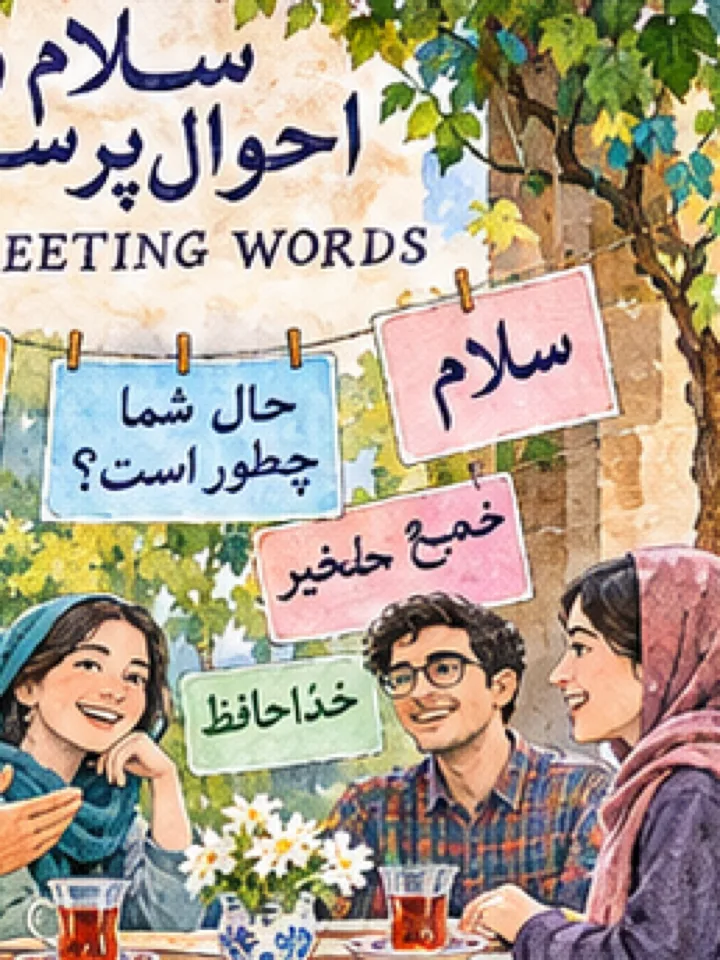
Lesson 2 of Learn to Speak Persian Fast, our free video course: Greetings. Watch the video for each part, then read the notes, with every Persian word in Persian script, pronunciation and English, and try the practice questions at the end of each part.
New words: Persian greetings: new words for lesson 2
Study notes for lesson 2: 20 Persian greeting words such as salâm, khodâhâfez and khoshbakhtam, with pronunciation, examples and a quiz.
Study notes for this lesson. Lesson 2 of the course is about greeting people: saying hello and goodbye, asking how someone is, giving your name and saying thank you. The table below collects the key words for this theme. The same words appear in the grammar, speaking and reading pages of lesson 2, where Ali and Maryam meet in their Persian class and their teacher, Mrs. Karimi, greets them.
Word list
| Persian | Pronunciation | English |
|---|---|---|
| سلام | /salâm/ | hello, hi |
| خداحافظ | /khodâhâfez/ | goodbye |
| صبح بخیر | /sobh bekheyr/ | good morning |
| شب بخیر | /shab bekheyr/ | good night |
| حال | /hâl/ | state, how someone is |
| چطور | /chetor/ | how |
| خوب | /khub/ | good, well, fine |
| خیلی | /kheyli/ | very |
| ممنون | /mamnun/ | thanks |
| مرسی | /mersi/ | thanks (everyday) |
| متشکرم | /moteshakkeram/ | thank you (polite) |
| اسم | /esm/ | name |
| من | /man/ | I |
| تو | /to/ | you (one friend, family member or child) |
| شما | /shomâ/ | you (polite, or more than one person) |
| بله | /bale/ | yes |
| نه | /na/ | no |
| خوشبختم | /khoshbakhtam/ | nice to meet you |
| آقا | /âghâ/ | Mr.; sir |
| خانم | /khânom/ | Mrs., Ms.; lady |
Notes on the words
- سلام works at any time of day and with anyone. Iranians often answer a greeting with the same word.
- ممنون, مرسی and متشکرم all mean thanks. مرسی comes from French and is very common in speech; متشکرم sounds a little more formal.
- خوشبختم literally means "I am fortunate". You say it when you meet someone for the first time.
- آقا and خانم come before a family name with ezâfe: آقای کریمی (âghâ-ye karimi), خانم کریمی (khânom-e karimi).
Example sentences
| Persian | Pronunciation | English |
|---|---|---|
| سلام، حال شما چطور است؟ | /salâm, hâl-e shomâ chetor ast?/ | Hello, how are you? (polite) |
| خیلی خوبم، ممنون. | /kheyli khubam, mamnun./ | I'm very well, thanks. |
| اسم من مریم است. | /esm-e man maryam ast./ | My name is Maryam. |
| خوشبختم، آقای کریمی. | /khoshbakhtam, âghâ-ye karimi./ | Nice to meet you, Mr. Karimi. |
| صبح بخیر، خانم کریمی. | /sobh bekheyr, khânom-e karimi./ | Good morning, Mrs. Karimi. |
| شب بخیر، خداحافظ. | /shab bekheyr, khodâhâfez./ | Good night, goodbye. |
In everyday speech the polite question often sounds like حالتون چطوره؟ (hâletun chetore?), and among friends حالت چطوره؟ (hâlet chetore?). The written form حال شما چطور است؟ is what you see in books and formal letters. The grammar page of this lesson explains when to use تو and when to use شما.
How to learn these words
Learn the greetings as whole phrases, not word by word. صبح بخیر and شب بخیر share the word بخیر (bekheyr), "with good", so they are easy to remember as a pair. Say each phrase aloud with the right situation in mind: صبح بخیر when you arrive in the morning, شب بخیر when you leave late in the evening or go to bed. Then practice short exchanges such as سلام and سلام، حالت چطوره؟, so the answer خوبم، ممنون comes without thinking.
Other pages in this lesson
Practice
How do you say "goodbye" in Persian?
Show answer
khodâhâfez خداحافظ
What does this phrase mean? صبح بخیر
Show answer
good morning (sobh bekheyr)
Which word for "you" do you use with a teacher you have just met?
Show answer
shomâ شما
What do you say when you meet someone for the first time?
Show answer
khoshbakhtam خوشبختم
Translate: My name is Ali.
Show answer
esm-e man ali ast. اسم من علی است.
Grammar: Personal pronouns and polite "you" in Persian greetings
Study notes for lesson 2 grammar: Persian personal pronouns, when to use to or shomâ in greetings, and how ezâfe forms 'my name'.
Study notes for this lesson. Greetings are the first place where Persian grammar matters socially: the word you choose for "you" shows how close you are to the other person. This page covers the six personal pronouns, the difference between تو (to) and شما (shomâ), and the small linking sound ezâfe that you need to say "my name" or "your name".
The personal pronouns
| Pronoun | Pronunciation | Meaning |
|---|---|---|
| من | /man/ | I |
| تو | /to/ | you (singular, informal) |
| او | /u/ | he, she |
| ما | /mâ/ | we |
| شما | /shomâ/ | you (plural, or one person politely) |
| آنها | /ânhâ/ | they |
Two points surprise English speakers. First, او (u) means both "he" and "she": Persian pronouns have no gender. Second, شما is used for one person when you want to be polite, much like French vous. In speech, او often sounds like اون (un) and آنها like اونا (unâ).
Informal and polite greetings
Use تو with close friends, family members, children and people your own age who use تو with you. Use شما with teachers, older people, strangers, shop staff and anyone you have just met. If you are unsure, choose شما; nobody is offended by politeness.
| Persian | Pronunciation | Use |
|---|---|---|
| حالت چطوره؟ | /hâlet chetore?/ | How are you? (to a friend, spoken) |
| حالتون چطوره؟ | /hâletun chetore?/ | How are you? (polite, spoken) |
| حال شما چطور است؟ | /hâl-e shomâ chetor ast?/ | How are you? (polite, written) |
| تو چطوری؟ | /to chetori?/ | How are you doing? (informal) |
| شما چطورید؟ | /shomâ chetorid?/ | How are you doing? (polite) |
Notice that the polite form also changes the ending: چطوری (chetori) goes with تو, چطورید (chetorid) goes with شما. The verb always agrees with the pronoun, and lesson 3 shows these endings in full.
Ezâfe: "my name", "your name"
To say "my name", Persian puts the noun first and joins the pronoun with a short -e sound called ezâfe: اسم من (esm-e man), literally "name of me". The -e is spoken but normally not written.
| Persian | Pronunciation | English |
|---|---|---|
| اسم من | /esm-e man/ | my name |
| اسم تو | /esm-e to/ | your name (informal) |
| اسم او | /esm-e u/ | his or her name |
| اسم شما | /esm-e shomâ/ | your name (polite) |
| حال شما | /hâl-e shomâ/ | your health, how you are |
More examples
| Persian | Pronunciation | English |
|---|---|---|
| من خوبم. | /man khubam./ | I am fine. |
| تو چطوری، علی؟ | /to chetori, ali?/ | How are you, Ali? |
| شما چطورید، خانم کریمی؟ | /shomâ chetorid, khânom-e karimi?/ | How are you, Mrs. Karimi? |
| اسم او مریم است. | /esm-e u maryam ast./ | Her name is Maryam. |
| ما خوبیم، ممنون. | /mâ khubim, mamnun./ | We are fine, thanks. |
| اسم شما چیست؟ | /esm-e shomâ chist?/ | What is your name? (polite) |
Persian often drops the pronoun because the ending already shows the person: خوبم (khubam) alone means "I am fine".
Common mistakes
- Using تو with a teacher or an older stranger. It can sound rude; use شما.
- Choosing "he" or "she" from او. Persian does not mark it, so in English you decide from context.
- Leaving out the ezâfe: say esm-e man, not esm man.
- Mixing forms, as in شما چطوری. Keep the pronoun and the ending in agreement: شما چطورید.
Other pages in this lesson
Practice
What is the Persian word for "we"?
Show answer
mâ ما
Does this pronoun mean "he" or "she"? او
Show answer
both; Persian pronouns have no gender
Which question would you ask your teacher?
Show answer
hâletun chetore? or hâl-e shomâ chetor ast? حالتون چطوره؟
How do you say "your name" politely?
Show answer
esm-e shomâ اسم شما
Correct the mistake. شما چطوری؟
Show answer
shomâ chetorid? شما چطورید؟
Speaking practice: meeting someone in Persian
Study notes for lesson 2 speaking: a short Persian dialogue where Ali and Maryam meet, useful greeting phrases, a role-play and a quiz.
Study notes for this lesson. On this page you practice greetings out loud. The dialogue is an original example in everyday spoken Persian, the way people talk in Tehran: Ali and Maryam meet on the first day of their Persian class, and then their teacher, Mrs. Karimi, arrives. Read each line aloud, first slowly and then at normal speed.
Dialogue
| Speaker | Persian | Pronunciation | English |
|---|---|---|---|
| Ali | سلام، صبح بخیر. | /salâm, sobh bekheyr./ | Hello, good morning. |
| Maryam | سلام، صبح شما هم بخیر. | /salâm, sobh-e shomâ ham bekheyr./ | Hello, good morning to you too. |
| Ali | اسم من علیه. اسم شما چیه؟ | /esm-e man aliye. esm-e shomâ chiye?/ | My name is Ali. What's your name? |
| Maryam | اسم من مریمه. | /esm-e man maryame./ | My name is Maryam. |
| Ali | خوشبختم. | /khoshbakhtam./ | Nice to meet you. |
| Maryam | منم خوشبختم. حالتون چطوره؟ | /manam khoshbakhtam. hâletun chetore?/ | Nice to meet you too. How are you? |
| Ali | خوبم، ممنون. شما چطورید؟ | /khubam, mamnun. shomâ chetorid?/ | I'm fine, thanks. How are you? |
| Maryam | مرسی، منم خوبم. | /mersi, manam khubam./ | Thanks, I'm fine too. |
| Mrs. Karimi | سلام، صبح بخیر. | /salâm, sobh bekheyr./ | Hello, good morning. |
| Ali and Maryam | سلام خانم کریمی. | /salâm khânom-e karimi./ | Hello, Mrs. Karimi. |
| Mrs. Karimi | حالتون چطوره؟ | /hâletun chetore?/ | How are you all? |
| Ali | خیلی خوبیم، مرسی. | /kheyli khubim, mersi./ | We're very well, thanks. |
Ali and Maryam use شما with each other because they have just met. Mrs. Karimi uses the same polite form to the whole class, since شما is also the plural "you".
Useful phrases
The left column shows the spoken form used in the dialogue. Where the written form is different, it is given in the English column so you can recognize it in texts.
| Persian | Pronunciation | English |
|---|---|---|
| اسم من علیه. | /esm-e man aliye./ | My name is Ali. Written: esm-e man ali ast. |
| اسمتون چیه؟ | /esmetun chiye?/ | What's your name? (polite) Written: esm-e shomâ chist? |
| حالت چطوره؟ | /hâlet chetore?/ | How are you? (to a friend) |
| خوبم، مرسی. | /khubam, mersi./ | I'm fine, thanks. |
| بد نیستم. | /bad nistam./ | I'm not bad. |
| منم همینطور. | /manam hamintor./ | Me too. Same here. |
| خداحافظ. | /khodâhâfez./ | Goodbye. |
| فعلاً. | /fe'lan./ | Bye for now. (casual) |
Pronunciation tips
- In خوشبختم the kh sound comes twice: kho-sh-bakh-tam. Keep it rough at the back of the throat.
- In spoken Persian, "is" after a name ending in a consonant becomes -e: مریمه (maryame). After a vowel it becomes -ye: علیه (aliye).
- Questions with چطوره and چیه rise slightly at the end.
Role-play
Work with a partner, or play both parts yourself. First, greet a new classmate: say hello, give your name, ask theirs, say nice to meet you and ask how they are, using شما. Then repeat the scene as two old friends, switching to تو: حالت چطوره؟, خوبم، مرسی. Finish both scenes with خداحافظ.
Other pages in this lesson
Practice
How does Maryam answer "good morning"?
Show answer
sobh-e shomâ ham bekheyr (good morning to you too) صبح شما هم بخیر.
What does Ali say after he learns Maryam's name?
Show answer
khoshbakhtam, nice to meet you خوشبختم.
What does this mean? منم خوبم.
Show answer
I'm fine too. (manam khubam)
Ask a friend how they are, in spoken Persian.
Show answer
hâlet chetore? حالت چطوره؟
Reading: the first day of Persian class
Study notes for lesson 2 reading: a short beginner Persian text about the first day of class, with translation, key words and a quiz.
Study notes for this lesson. This short original text uses the greetings from lesson 2 in standard written Persian. Ali and Maryam meet on the first day of class, and their teacher, Mrs. Karimi, greets them. Try reading the Persian column first, then check the pronunciation and the translation sentence by sentence.
Reading text
| Persian | Pronunciation | English |
|---|---|---|
| امروز اولین روز کلاس فارسی است. | /emruz avvalin ruz-e kelâs-e fârsi ast./ | Today is the first day of Persian class. |
| علی ساعت هشت صبح به کلاس میآید. | /ali sâ'at-e hasht-e sobh be kelâs miâyad./ | Ali comes to class at eight in the morning. |
| در کلاس یک دختر هست. | /dar kelâs yek dokhtar hast./ | There is a girl in the class. |
| علی میگوید: «سلام، صبح بخیر.» | /ali miguyad: "salâm, sobh bekheyr."/ | Ali says, "Hello, good morning." |
| دختر میگوید: «سلام. اسم من مریم است.» | /dokhtar miguyad: "salâm. esm-e man maryam ast."/ | The girl says, "Hello. My name is Maryam." |
| علی میگوید: «خوشبختم. اسم من علی است.» | /ali miguyad: "khoshbakhtam. esm-e man ali ast."/ | Ali says, "Nice to meet you. My name is Ali." |
| بعد معلم وارد کلاس میشود. | /ba'd mo'allem vâred-e kelâs mishavad./ | Then the teacher enters the classroom. |
| اسم معلم خانم کریمی است. | /esm-e mo'allem khânom-e karimi ast./ | The teacher's name is Mrs. Karimi. |
| خانم کریمی میپرسد: «حال شما چطور است؟» | /khânom-e karimi miporsad: "hâl-e shomâ chetor ast?"/ | Mrs. Karimi asks, "How are you?" |
| علی و مریم میگویند: «خوب هستیم، متشکریم.» | /ali va maryam miguyand: "khub hastim, moteshakkerim."/ | Ali and Maryam say, "We are fine, thank you." |
| در پایان کلاس، همه میگویند: «خداحافظ.» | /dar pâyân-e kelâs, hame miguyand: "khodâhâfez."/ | At the end of the class, everyone says, "Goodbye." |
Key words
- امروز (emruz): today
- اولین (avvalin): first
- کلاس (kelâs): class, classroom
- معلم (mo'allem): teacher
- میگوید (miguyad): he or she says
- میپرسد (miporsad): he or she asks
- متشکریم (moteshakkerim): we thank you, thank you (from us)
- همه (hame): everyone
Notes on the text
- The text is in written Persian. In speech, میآید (miâyad) sounds like میاد (miyâd) and میگوید (miguyad) like میگه (mige).
- Persian uses the guillemets « » as quotation marks.
- هست in sentence 3 means "there is". You will meet it again in lesson 3 together with هستم, "I am".
- Mrs. Karimi uses شما because she is speaking to two students. It would also be polite to one.
Reading strategy
Before you read, look for the words you already know from the new words page: سلام, صبح بخیر, اسم, خوشبختم, خداحافظ. They give you the outline of the story. Then read one sentence at a time and guess the meaning of new words from context before checking the key words below.
After reading, cover the English column and translate each sentence yourself. Then read the whole text aloud once without stopping.
Other pages in this lesson
Practice
What time does Ali come to class?
Show answer
at eight in the morning ساعت هشت صبح
What is the girl's name?
Show answer
Maryam مریم
Who is Mrs. Karimi?
Show answer
the teacher معلم
What does Mrs. Karimi ask?
Show answer
How are you? حال شما چطور است؟
What does everyone say at the end of the class?
Show answer
goodbye خداحافظ
Take this lesson further

Study with the book
Learn to Speak Persian Fast: For Beginners
This free lesson is part of Learn to Speak Persian Fast. The book puts the whole series in one printable PDF you can study offline.
Serious about Persian? Get all 30 of our Persian learning books for $199.99 (55% less than buying them one by one).
Free Persian Starter Kit (PDF)
The Persian alphabet chart and the 101 most common Persian words with pronunciation, in one printable PDF. You also get a one-time 15% code for any of our books.
We will email you new lessons and book news from Learn Persian Online. Unsubscribe any time.Free Persian Starter Pack: Alphabet + 100 Core Words
Get the 14-page printable Starter Pack (all 32 letters, a 7-day reading plan, 100 core words and 20 survival phrases) and a short 5-email course. Free.