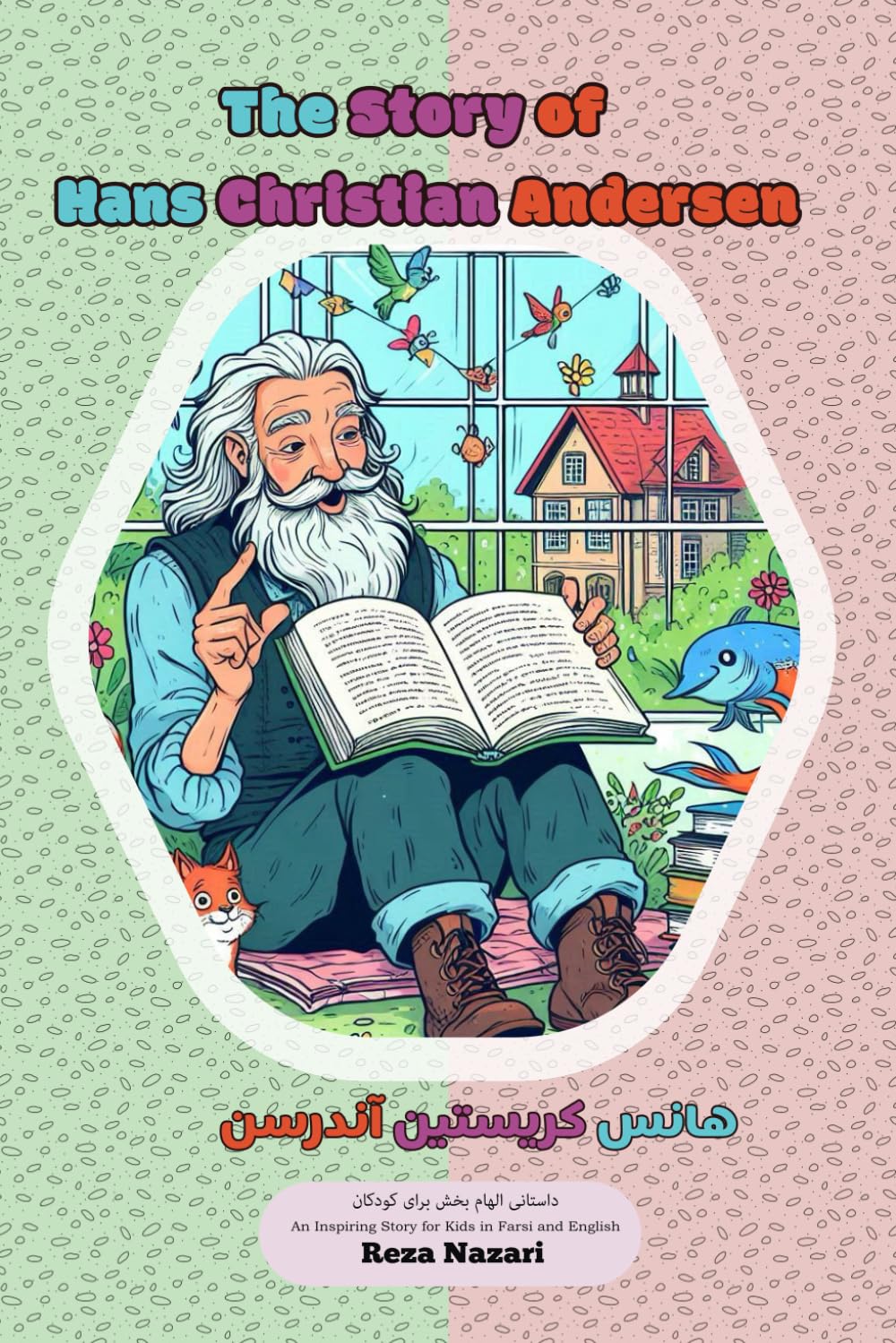
47 pages · Printable PDF · Instant download
- Instant downloadYours right after checkout
- Secure checkoutCard (Stripe) or PayPal
- Read anywherePhone, tablet or computer, or print it

Paperback sold separately. As an Amazon Associate I earn from qualifying purchases.
Buy 2 or more books and save up to 25% at checkout.
The Story of Hans Christian Andersen
The Story of Hans Christian Andersen tells how a poor boy from Odense, Denmark, went to Copenhagen at 14 to act, lost his singing voice and became a writer instead. Children read how his first fairy tales came out between 1835 and 1837, why Danish critics disliked them, how he met Charles Dickens in England, and which of his 156 tales are still read today. English and Persian throughout. 47-page PDF.
The boy who wanted to sing on stage and wrote The Little Mermaid instead
Andersen’s father read him the Arabian Nights; his mother washed clothes for a living. After his father died in 1816, Hans worked for a weaver and a tailor, then left for Copenhagen at 14 to go on the stage. The Story of Hans Christian Andersen shows how a friend at the Royal Danish Theatre noticed his poems, and how its director, Jonas Collin, sent him back to school.
Then come the fairy tales. Children learn that Thumbelina, The Little Mermaid and The Emperor’s New Clothes first came out in small booklets, that critics called his chatty style wrong for children, and that he kept going anyway. The book ends with a wish he shared with a composer before he died: most mourners would be children, so the music should keep time with little steps.
At a glance
What your child will read
The book covers his life from 2 April 1805 in Odense to 4 August 1875.
His childhood
A stepsister named Karen, a school for poor children, work with a weaver and a tailor, and a soprano voice that changed as he grew up.
His fairy tales
The first collection of nine tales, a short story with a talking cat, an American magazine’s offer of $500 for 12 new stories in 1868, and a list of favorites from The Snow Queen to The Princess and the Pea.
What children learn
That other people’s doubts do not have to stop you. Andersen took a break after bad reviews, then went back to fairy tales and wrote 156 of them.
How the Persian is written
The Persian has no vowel marks. Story titles appear in Persian quotation marks, such as «شبهای عربی» (Arabian Nights).
From his early years
Three sentences about work and a new idea, as the book prints them:
| Persian | English |
|---|---|
| هانس برای کمک به خانواده مجبور بود کار کند. | To help out, Hans had to work. |
| او ابتدا بهعنوان یک بافنده مشغول به کار شد و نحوهی ساخت پارچه را یاد گرفت. | First, he helped a weaver, learning how to make cloth. |
| یکی از دوستانش در تئاتر به هانس گفت که فکر میکند هانس واقعاً در نوشتن شعر مهارت دارد. | One of his friends at the theatre told Hans that he thought Hans was really good at writing poems. |
Reading it together
- Before you start, ask which Andersen stories your child already knows; the book names nine of the most famous.
- Read each English passage, then the Persian, and pause at the titles in quotation marks so your child can say them.
- After the page about the critics, talk about a time your child kept going after someone said they were doing it wrong.
- Finish by reading one of his tales in Persian together, then review the new words with the free Persian vocabulary lessons.
Who this book is for
A good fit if you
- have a child who asks who made up the stories in their bedtime books
- are reading Andersen’s stories in Persian and want the life behind them
- want a biography with a hopeful message about not giving up
Look elsewhere if you
- want one of his fairy tales rather than his life; start with The Ugly Duckling
- need a very short read for a preschooler; the Farsi Children Books Bundle has many other titles to choose from
Use it with
- The Little Mermaid: the tale from his booklet of 1837, in English and Persian.
- The Steadfast Tin Soldier: one of the famous tales the book lists.
Common questions
What age is it for?
About 7 to 11. Children who already know some of his tales get the most from it.
Does it retell his fairy tales?
No. It describes them in a line or two, such as a mermaid who dreamed of living on land and a king tricked into wearing invisible clothes. The full tales are separate books.
Does my child need to read Persian already?
No. A parent can read the Persian aloud while the child follows the English.
What do I get after I buy?
A 47-page PDF to download as soon as checkout is done, for a tablet, a computer or the home printer.
Is there a paperback?
Yes, on Amazon. Here you buy the PDF edition.
Related Persian books
More Persian learning books on similar topics.
 Learn Farsi in 100 Days: Book + Workbook (2 PDF Ebooks)
Original price was: $29.98.$24.99Current price is: $24.99.


 Alexandre Dumas: The Inspiring Story of a Genius in Farsi and English
$12.99
Product Reviews
There are no reviews yet.