Learn how to say goodbye in Persian with khodâhâfez, see you tomorrow and take care, plus
good bye ⇒ خداحافظی

| English | pronunciation | Persian | ||
| Puya: | Good bye. | /khodahâfez/ | خداحافظ | :پویا |
| Sara: | Good bye | /khodahâfez/ | خداحافظ | :سارا |
| Puya: | See you tomorrow | /fardâ mibinamet/ | .فردا میبینمت | :پویا |
| Sara: | Ok, see you | /bâshe, mibinamet/ | .باشه، میبینمت | :سارا |

| English | pronunciation | Persian | ||
| Puya: | Take care | /movâzebe khodet bâsh/ | مواظب خودت باش | :پویا |
| Sara: | You too | /to ham hamintor/ | تو هم همینطور | :سارا |
| Puya: | Good bye. | /khodâhâfez/ | خداحافظ | :پویا |
| Sara: | Good bye. | /khodâhâfez/ | خداحافظ | :سارا |
Learn how to say goodbye in Persian with khodâhâfez, see you tomorrow and take care, plus spoken vs written forms and a short quiz.
Saying goodbye in Persian
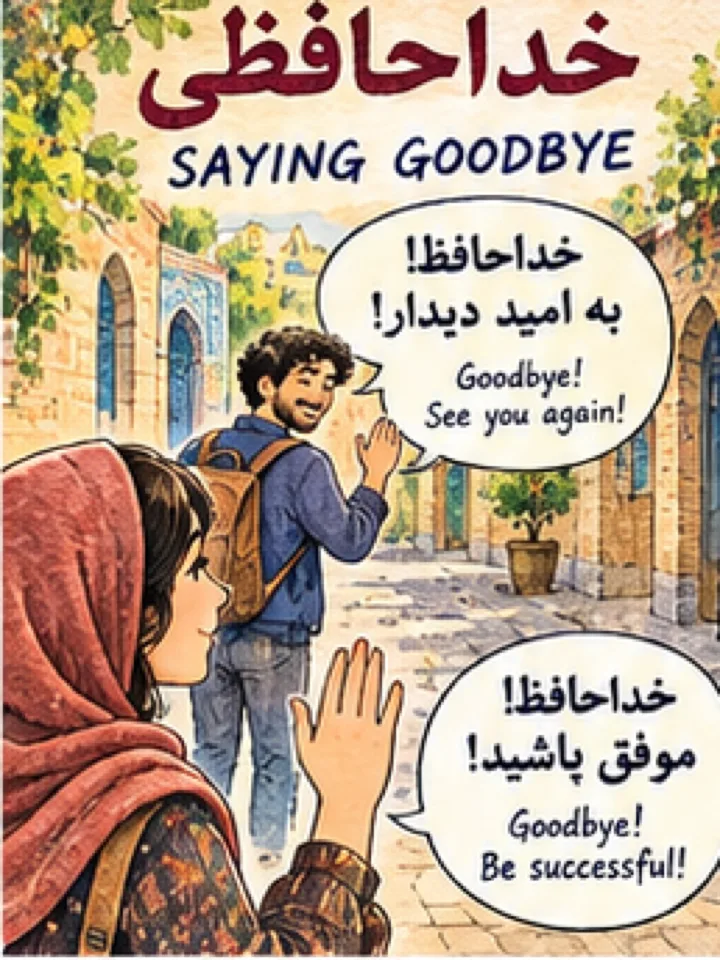
Puya and Sara are friends who are parting for the day. They say خداحافظ (khodâhâfez), the standard "goodbye", promise to see each other tomorrow, and wish each other well. Because they are close, they use the informal "you" and colloquial verb forms.
The dialogue has two short parts. Practice them as a pair with a friend, swapping roles, until the phrases come out without thinking.
The dialogue
Part 1: see you tomorrow
| Speaker | Persian | Pronunciation | English |
|---|---|---|---|
| Puya | خداحافظ. | /khodâhâfez./ | Goodbye. |
| Sara | خداحافظ. | /khodâhâfez./ | Goodbye. |
| Puya | فردا میبینمت. | /fardâ mibinamet./ | See you tomorrow. |
| Sara | باشه، میبینمت. | /bâshe, mibinamet./ | OK, see you. |
Part 2: take care
| Speaker | Persian | Pronunciation | English |
|---|---|---|---|
| Puya | مواظب خودت باش. | /movâzeb-e khodet bâsh./ | Take care of yourself. |
| Sara | تو هم همینطور. | /to ham hamintor./ | You too. |
| Puya | خداحافظ. | /khodâhâfez./ | Goodbye. |
| Sara | خداحافظ. | /khodâhâfez./ | Goodbye. |
Key words and phrases
| Persian | Pronunciation | English |
|---|---|---|
| خداحافظ | /khodâhâfez/ | goodbye |
| فردا | /fardâ/ | tomorrow |
| میبینمت | /mibinamet/ | I'll see you |
| باشه | /bâshe/ | OK, all right |
| مواظب | /movâzeb/ | careful, watchful |
| خودت | /khodet/ | yourself |
| باش | /bâsh/ | be (command, informal) |
| مواظب خودت باش | /movâzeb-e khodet bâsh/ | take care of yourself |
| هم | /ham/ | also, too |
| همینطور | /hamintor/ | the same, likewise |
| تو هم همینطور | /to ham hamintor/ | you too |
Spoken vs written Persian
Most of this dialogue is already close to the written language, but a few words change in formal writing or polite speech. The pairs below show the everyday form first and the written or formal form second.
| Spoken / written | Pronunciation | Meaning |
|---|---|---|
| باشه / باشد | /bâshe / bâshad/ | OK (literally "let it be") |
| میبینمت / تو را میبینم | /mibinamet / to râ mibinam/ | I'll see you |
| تو هم / تو نیز | /to ham / to niz/ | you too (نیز is formal "also") |
| مواظب خودت باش / مواظب خودتان باشید | /movâzeb-e khodet bâsh / movâzeb-e khodetân bâshid/ | take care (informal / polite) |
How the phrases are built
میبینمت (mibinamet) is میبینم (mibinam), "I see", plus the ending ـت (-et), "you". Persian often uses the present tense for the near future, so فردا میبینمت simply means "I'll see you tomorrow". With a polite شما you would say فردا میبینمتون (fardâ mibinametun).
خداحافظ is made of خدا (khodâ), "God", and حافظ (hâfez), "protector", so it literally wishes that God protect you. Another common goodbye is خدانگهدار (khodâ negahdâr). Among friends you will also hear فعلاً (fe'lan), "for now", used like "see you".
باش (bâsh) is the informal command of "to be". The polite or plural command is باشید (bâshid), which is why the formal version of "take care" ends in باشید.
Try it yourself
- Tell a friend you will see them tomorrow: فردا میبینمت (fardâ mibinamet).
- Agree with a plan by saying باشه (bâshe), "OK".
- Wish someone well before they travel: مواظب خودت باش (movâzeb-e khodet bâsh).
- Answer a wish or compliment with تو هم همینطور (to ham hamintor), or politely شما هم همینطور (shomâ ham hamintor).
- Practice the whole goodbye twice, once informally and once with شما forms, so you can switch between them easily.
When you leave a group, it is polite to say goodbye to each person, or to everyone at once with خداحافظ همگی (khodâhâfez hamegi), "goodbye, everyone".
Practice
-
What does {{خداحافظ}} literally mean?
Show answer
May God protect (you): khodâ "God" + hâfez "protector".
-
How do you say "See you tomorrow" to a friend?
Show answer
fardâ mibinamet فردا میبینمت
-
Someone says {{مواظب خودت باش}}. How do you reply "You too"?
Show answer
to ham hamintor تو هم همینطور
-
Make "take care" polite for an older person.
Show answer
movâzeb-e khodetân bâshid مواظب خودتان باشید
Find more dialogues in the Farsi conversation lessons series, and review the sounds behind the transliteration on the Persian pronunciation page.


Take this lesson further
Study with the book
Farsi Conversations: Learn the Most Common Words and Phrases Farsi Speakers use Every Day
This free lesson is part of Farsi conversation lessons. The book puts the whole series in one printable PDF you can study offline.
Serious about Persian? Get all 30 of our Persian learning books for $199.99 (55% less than buying them one by one).
Free Persian Starter Kit (PDF)
The Persian alphabet chart and the 101 most common Persian words with pronunciation, in one printable PDF. You also get a one-time 15% code for any of our books.
We will email you new lessons and book news from Learn Persian Online. Unsubscribe any time.Free: 100 Core Persian Words + 20 Survival Phrases
Get the 14-page printable Starter Pack (all 32 letters, a 7-day reading plan, 100 core words and 20 survival phrases) and a short 5-email course. Free.