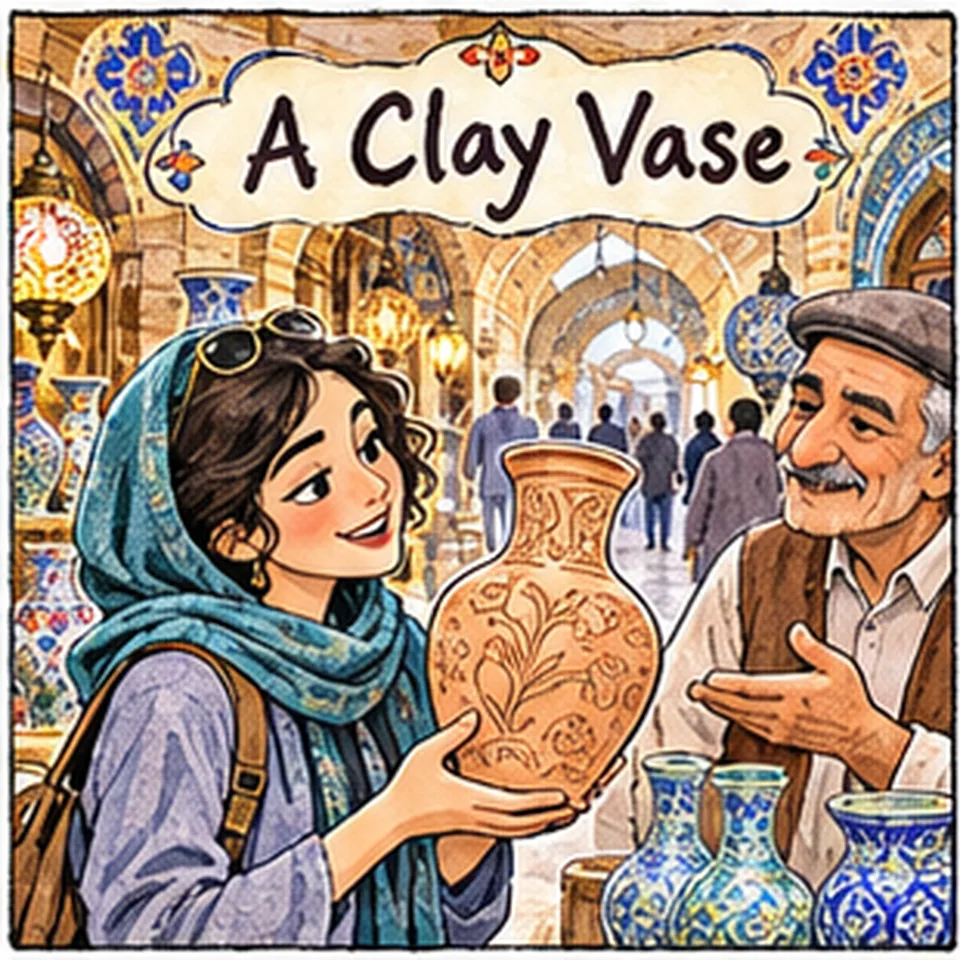
Ask what something is made of and where it was made in Persian: buying a clay vase from Ha
speaking
| English | Pronunciation | Persian | ||
| Customer: | Excuse me, what is this vase made of? | bebakhshid in goldan az chi sâkhte shode? | ببخشید این گلدان از چی ساخته شده؟ | :مشتری |
| Seller: | It is clay. | Un sofâli hast. | اون سفالی هست | :فروشنده |
| Customer: | so beautiful, where was it made? | Khyeli ghashange, kojâ sâkhte shode? | خیلی قشنگه، کجا ساخته شده؟ | :مشتری |
| Seller: | Hamedan, do you want it? | hamedân, mikhâhid un ro? | همدان، میخواید اون رو؟ | :فروشنده |
| Customer: | Yes, sure. | Bale hatman | بله، حتما | :مشتری |
Ask what something is made of and where it was made in Persian: buying a clay vase from Hamedan, passive forms and a short quiz.
Shopping for crafts: what is it made of?
A customer in a handicrafts shop admires a vase. She asks the seller what it is made of and where it was made. It is pottery from Hamedan, and she decides to buy it. The dialogue introduces the passive ساخته شده (sâkhte shode), "(has been) made", which is very useful when shopping.
Both people speak politely, with ببخشید (bebakhshid), "excuse me", and the polite میخواید (mikhâyd), "do you want".
The dialogue
| Speaker | Persian | Pronunciation | English |
|---|---|---|---|
| Customer | ببخشید، این گلدان از چی ساخته شده؟ | /bebakhshid, in goldân az chi sâkhte shode?/ | Excuse me, what is this vase made of? |
| Seller | اون سفالی هست. | /un sofâli hast./ | It's earthenware (clay). |
| Customer | خیلی قشنگه، کجا ساخته شده؟ | /kheyli ghashange, kojâ sâkhte shode?/ | It's very beautiful. Where was it made? |
| Seller | همدان. میخواید اون رو؟ | /hamedân. mikhâyd un ro?/ | In Hamedan. Would you like it? |
| Customer | بله، حتماً. | /bale, hatman./ | Yes, definitely. |
Key words and phrases
| Persian | Pronunciation | English |
|---|---|---|
| مشتری | /moshtari/ | customer |
| فروشنده | /forushande/ | seller, shop assistant |
| ببخشید | /bebakhshid/ | excuse me |
| گلدان | /goldân/ | vase; flowerpot |
| از چی | /az chi/ | from what, (made) of what |
| ساخته شده | /sâkhte shode/ | made, has been made |
| سفال | /sofâl/ | pottery, earthenware |
| سفالی | /sofâli/ | earthenware (adj.), made of clay |
| قشنگ | /ghashang/ | beautiful, pretty |
| کجا | /kojâ/ | where |
| میخواید | /mikhâyd/ | do you want (polite, spoken) |
| حتماً | /hatman/ | definitely, sure |
Spoken vs written Persian
This dialogue mixes written spellings and spoken forms. Here are the pairs, spoken first.
| Spoken / written | Pronunciation | Meaning |
|---|---|---|
| گلدون / گلدان | /goldun / goldân/ | vase |
| چی / چه | /chi / che/ | what |
| ساخته شده / ساخته شده است | /sâkhte shode / sâkhte shode ast/ | has been made |
| اون / آن | /un / ân/ | it, that |
| قشنگه / قشنگ است | /ghashange / ghashang ast/ | it's beautiful |
| میخواید / میخواهید | /mikhâyd / mikhâhid/ | you want (polite) |
| اون رو / آن را | /un ro / ân râ/ | it (as object) |
Grammar note: made of, made in
The passive is formed with the past participle and شدن (shodan), "to become": ساختن (sâkhtan), "to make", becomes ساخته شده (sâkhte shode), "has been made". Use از (az) for the material, از چی ساخته شده؟ "what is it made of?", and کجا or در for the place, در همدان ساخته شده "it was made in Hamedan".
Adding ـی (-i) to a material makes an adjective: سفال "pottery" becomes سفالی "made of pottery", چوب (chub) "wood" becomes چوبی "wooden", نقره (noghre) "silver" becomes نقرهای "silver (adj.)".
Culture note
Hamedan province is well known for pottery, especially the town of Lalejin, so a clay vase from Hamedan is a typical souvenir. When you agree to buy something, بله، حتماً or آره، برمیدارم (âre, barmidâram), "yes, I'll take it", both work.
Try it yourself
- Ask what a bowl is made of: این کاسه از چی ساخته شده؟ (in kâse az chi sâkhte shode?).
- Ask where a carpet was made: این فرش کجا بافته شده؟ (in farsh kojâ bâfte shode?), "where was this carpet woven?".
ببخشید (bebakhshid) is the polite way to get a shop assistant's attention. To ask the price, say قیمتش چنده؟ (gheymatesh chande?), "how much is it?". In many Iranian shops a little friendly bargaining over handicrafts is normal.
Practice
-
Ask "What is this made of?"
Show answer
in az chi sâkhte shode? این از چی ساخته شده؟
-
What is the vase made of, and where was it made?
Show answer
Earthenware (clay), in Hamedan. سفالی، همدان
-
Make an adjective meaning "wooden" from {{چوب}}.
Show answer
chubi چوبی
-
Say "It's very beautiful" in spoken Persian.
Show answer
kheyli ghashange خیلی قشنگه
-
Give the written form of {{اون رو}}.
Show answer
ân râ آن را
Find more dialogues in the Farsi conversation lessons series, and review the sounds behind the transliteration on the Persian pronunciation page.


Take this lesson further
Study with the book
Farsi Conversations: Learn the Most Common Words and Phrases Farsi Speakers use Every Day
This free lesson is part of Farsi conversation lessons. The book puts the whole series in one printable PDF you can study offline.
Serious about Persian? Get all 30 of our Persian learning books for $199.99 (55% less than buying them one by one).
Free Persian Starter Kit (PDF)
The Persian alphabet chart and the 101 most common Persian words with pronunciation, in one printable PDF. You also get a one-time 15% code for any of our books.
We will email you new lessons and book news from Learn Persian Online. Unsubscribe any time.Free: 100 Core Persian Words + 20 Survival Phrases
Get the 14-page printable Starter Pack (all 32 letters, a 7-day reading plan, 100 core words and 20 survival phrases) and a short 5-email course. Free.