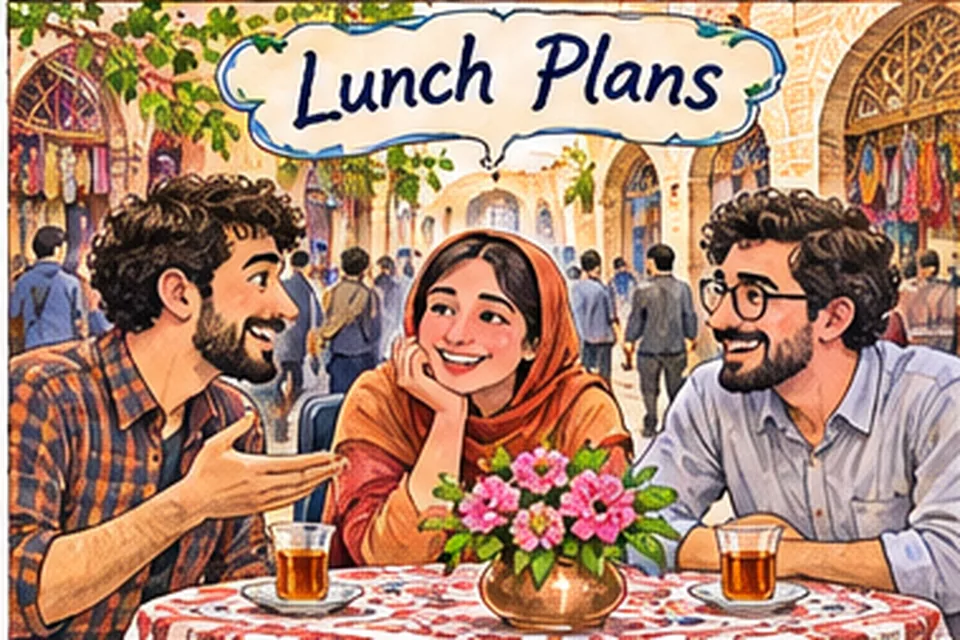
Learn how to invite a friend to lunch in spoken Persian and agree on a time and place, wit
speaking
| English | Pronunciation | Persian | ||
| Neda: | Would you like to have lunch together? | /dust dâri bâham nâhâr bokhorim?/ | دوست داری باهم ناهار بخوریم؟ | :ندا |
| Parisa: | Yes, sure. | /âre, hatman/ | آره، حتما | :پریسا |
| Neda: | When? | /key?/ | کی؟ | :ندا |
| Parisa: | What about 12? | /12 chetore?/ | دوازده چطوره؟ | :پریسا |
| Neda: | No, a little later. | /na ekam dirtar/ | نه یکم دیرتر | :ندا |
| Parisa: | What about 1? | /1 chi?/ | یک چی؟ | :پریسا |
| Neda: | Good, where? | /khobe kojâ?/ | خوبه. کجا؟ | :ندا |
| Parisa: | Shadi restaurant. | /restorâne shadi/ | رستوان شادی | :پریسا |
| Neda: | Ok, I will meet you there. | /bâshe pas onjâ mibinamet/ | باشه، پس اونجا میبینمت | :ندا |
Learn how to invite a friend to lunch in spoken Persian and agree on a time and place, with translation, key phrases and a quiz.
Inviting a friend to lunch in Persian
In this conversation Neda invites her friend Parisa to have lunch together. The two friends agree on a time, Neda asks for something a little later, and they settle on a restaurant. It is a very natural, informal exchange between friends, so the Persian is colloquial throughout.
Notice how short the questions are. In spoken Persian a single word like کی؟ (key?, "when?") or کجا؟ (kojâ?, "where?") is a complete, polite question between friends.
The dialogue
| Speaker | Persian | Pronunciation | English |
|---|---|---|---|
| Neda | دوست داری با هم ناهار بخوریم؟ | /dust dâri bâ ham nâhâr bokhorim?/ | Would you like to have lunch together? |
| Parisa | آره، حتماً. | /âre, hatman./ | Yes, sure. |
| Neda | کی؟ | /key?/ | When? |
| Parisa | دوازده چطوره؟ | /davâzdah chetore?/ | How about twelve? |
| Neda | نه، یکم دیرتر. | /na, yekam dirtar./ | No, a little later. |
| Parisa | یک چی؟ | /yek chi?/ | What about one? |
| Neda | خوبه. کجا؟ | /khube. kojâ?/ | Good. Where? |
| Parisa | رستوران شادی. | /restorân-e shâdi./ | Shadi Restaurant. |
| Neda | باشه، پس اونجا میبینمت. | /bâshe, pas unjâ mibinamet./ | OK, then I'll see you there. |
Key words and phrases
| Persian | Pronunciation | English |
|---|---|---|
| دوست داری…؟ | /dust dâri…?/ | would you like…? (lit. do you like…?) |
| با هم | /bâ ham/ | together |
| ناهار | /nâhâr/ | lunch |
| ناهار خوردن | /nâhâr khordan/ | to have lunch |
| حتماً | /hatman/ | sure, definitely |
| کی؟ | /key?/ | when? |
| … چطوره؟ | /… chetore?/ | how about …? |
| یکم دیرتر | /yekam dirtar/ | a little later |
| … چی؟ | /… chi?/ | what about …? |
| کجا؟ | /kojâ?/ | where? |
| رستوران | /restorân/ | restaurant |
| باشه | /bâshe/ | OK, all right |
| پس | /pas/ | so, then |
| میبینمت | /mibinamet/ | I'll see you |
Spoken vs written Persian
In everyday speech, Persian shortens many words and changes some vowels. The table puts the colloquial forms from this dialogue next to the forms you would see in writing or hear in formal speech.
| Spoken form | Spoken → written pronunciation | Written form (meaning) |
|---|---|---|
| آره | /âre → bale/ | بله (yes) |
| چطوره | /chetore → chetor ast/ | چطور است (how is it) |
| یکم | /yekam → yek kam / kami/ | یک کم، کمی (a little) |
| خوبه | /khube → khub ast/ | خوب است (it is good) |
| اونجا | /unjâ → ânjâ/ | آنجا (there) |
| میبینمت | /mibinamet → to râ mibinam/ | تو را میبینم (I see you) |
Usage and culture notes
Be careful with کی. Said as key it means "when?", and said as ki it means "who?". The spelling is the same, so you rely on pronunciation and context.
To suggest a time, just say the hour and add چطوره؟ (chetore?, "how is it?") or چی؟ (chi?, "what?"). For a more complete question you can add ساعت (sâ'at, "o'clock"): ساعت یک چطوره؟ (sâ'at-e yek chetore?), "How about one o'clock?"
The ending -ت on میبینمت is the object "you" attached to the verb, a very common pattern in speech.
More phrases for making plans
These short phrases fit naturally into the same kind of conversation. Use them to change the meal, the day or the time.
| Persian | Pronunciation | English |
|---|---|---|
| فردا وقت داری؟ | /fardâ vaght dâri?/ | are you free tomorrow? |
| ساعت چند؟ | /sâ'at-e chand?/ | what time? |
| یکم زودتر | /yekam zudtar/ | a little earlier |
| شام بخوریم؟ | /shâm bokhorim?/ | shall we have dinner? |
| ناهار مهمون من | /nâhâr mehmun-e man/ | lunch is on me |
| دیر نکنی | /dir nakoni/ | don't be late |
| فعلاً | /fe'lan/ | bye for now |
Try it yourself: invite a friend to dinner tomorrow, suggest seven o'clock, accept a change to eight, and name a place to meet.
Practice
-
How does Neda ask Parisa whether she would like to have lunch together?
Show answer
dust dâri bâ ham nâhâr bokhorim? دوست داری با هم ناهار بخوریم؟
-
What time do the two friends finally agree on?
Show answer
One o'clock. Neda turns down twelve and asks for a little later.
-
What is the difference between key and ki?
Show answer
Both are spelled کی, but key means "when?" and ki means "who?".
-
Say in Persian: "How about two?"
Show answer
do chetore? دو چطوره؟
-
Give the written form of اونجا. اونجا
Show answer
ânjâ, spelled آنجا, "there".
Previous: Persian Conversation 24. Next: Persian Conversation 26. Review the sounds in the Persian pronunciation guide.


Take this lesson further
Study with the book
Farsi Conversations: Learn the Most Common Words and Phrases Farsi Speakers use Every Day
This free lesson is part of Farsi conversation lessons. The book puts the whole series in one printable PDF you can study offline.
Serious about Persian? Get all 30 of our Persian learning books for $199.99 (55% less than buying them one by one).
Free Persian Starter Kit (PDF)
The Persian alphabet chart and the 101 most common Persian words with pronunciation, in one printable PDF. You also get a one-time 15% code for any of our books.
We will email you new lessons and book news from Learn Persian Online. Unsubscribe any time.Free: 100 Core Persian Words + 20 Survival Phrases
Get the 14-page printable Starter Pack (all 32 letters, a 7-day reading plan, 100 core words and 20 survival phrases) and a short 5-email course. Free.