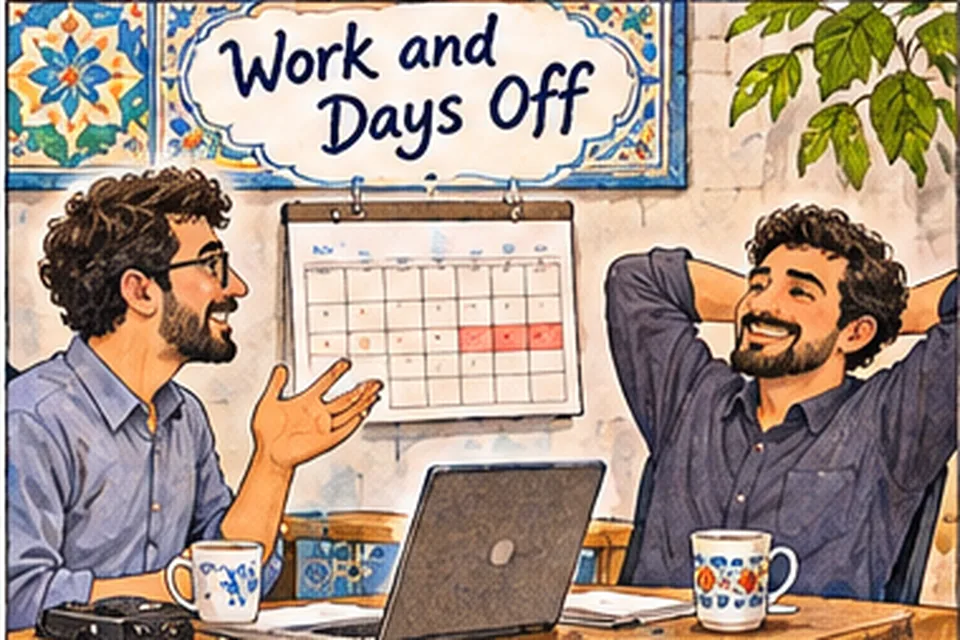
Ask about working hours, pay and days off in spoken Persian, and learn a polite way to dec
speaking
| English | Pronunciation | Persian | ||
| Arash: | How many hours a day do you work? | /rozi chand sâat kâr mikoni?/ |
روزی چند ساعت کار میکنی؟ |
:آرش |
| Pedram: | I work 7 hours a day and you? | /rozi haft sâat kâr mikonam, to chi?/ |
روزی هفت ساعت کار میکنم. تو چی؟ |
:پدارم |
| Arash: | How much is your salary? | /cheghadr hoghogh migiri?/ |
چقدر حقوق میگیری؟ |
:آرش |
| Pedram: | Sorry I cant say. | /bebakhshid nemitonam begam/ | ببخشید نمیتونم بگم |
:پدارم |
| Arash: | Never mind, what day are you off? | /eshkal nadâre, che rozâi tatil hasti?/ | اشکال نداره، چه روزای تعطیل هستی؟ |
:آرش |
| Pedram: | I have Thursdays and Fridays off | /panjshanbe va jome tatilam/ | پنجشنبه و جمعه تعطیلم |
:پدارم |
Ask about working hours, pay and days off in spoken Persian, and learn a polite way to decline a question, with translation and quiz.
Talking about working hours and days off
Arash continues chatting with Pedram about work. He asks how many hours a day Pedram works, how much he earns and which days he has off. Pedram is happy to share his hours but politely declines to talk about his salary.
The word روزی (ruzi) at the start of a sentence means "per day" or "a day": روزی هفت ساعت (ruzi haft sâ'at), "seven hours a day".
The dialogue
| Speaker | Persian | Pronunciation | English |
|---|---|---|---|
| Arash | روزی چند ساعت کار میکنی؟ | /ruzi chand sâ'at kâr mikoni?/ | How many hours a day do you work? |
| Pedram | روزی هفت ساعت کار میکنم. تو چی؟ | /ruzi haft sâ'at kâr mikonam. to chi?/ | I work seven hours a day. What about you? |
| Arash | چقدر حقوق میگیری؟ | /cheghadr hoghugh migiri?/ | How much do you earn? |
| Pedram | ببخشید، نمیتونم بگم. | /bebakhshid, nemitunam begam./ | Sorry, I can't say. |
| Arash | اشکال نداره. چه روزایی تعطیل هستی؟ | /eshkâl nadâre. che ruzâyi ta'til hasti?/ | That's OK. Which days are you off? |
| Pedram | پنجشنبه و جمعه تعطیلم. | /panjshanbe va jom'e ta'tilam./ | I'm off on Thursdays and Fridays. |
Key words and phrases
| Persian | Pronunciation | English |
|---|---|---|
| روزی | /ruzi/ | per day, a day |
| چند ساعت؟ | /chand sâ'at?/ | how many hours? |
| ساعت | /sâ'at/ | hour; o'clock; watch |
| کار کردن | /kâr kardan/ | to work |
| چقدر؟ | /cheghadr?/ | how much? |
| حقوق | /hoghugh/ | salary, wages |
| حقوق گرفتن | /hoghugh gereftan/ | to earn a salary (lit. receive) |
| نمیتونم بگم | /nemitunam begam/ | I can't say |
| اشکال نداره | /eshkâl nadâre/ | never mind, no problem |
| تعطیل | /ta'til/ | closed, off (work or school) |
| پنجشنبه | /panjshanbe/ | Thursday |
| جمعه | /jom'e/ | Friday |
Spoken vs written Persian
In everyday speech, Persian shortens many words and changes some vowels. The table puts the colloquial forms from this dialogue next to the forms you would see in writing or hear in formal speech.
| Spoken form | Spoken → written pronunciation | Written form (meaning) |
|---|---|---|
| نمیتونم | /nemitunam → nemitavânam/ | نمیتوانم (I can't) |
| اشکال نداره | /eshkâl nadâre → eshkâl nadârad/ | اشکال ندارد (it doesn't matter) |
| روزایی | /ruzâyi → ruzhâyi/ | روزهایی (days (which)) |
| تعطیلم | /ta'tilam → ta'til hastam/ | تعطیل هستم (I am off) |
| بگم | /begam → beguyam/ | بگویم ((that) I say) |
Usage and culture notes
In Iran, Friday (جمعه) is the weekly day off, and many workplaces also close on Thursday (پنجشنبه) or work only part of it, so "Thursday and Friday off" is a common answer.
Salary is a personal topic for many people. ببخشید، نمیتونم بگم is a polite, friendly way to decline, and اشکال نداره is the natural reply that moves the conversation on.
The plural ending -ها (-hâ) is usually pronounced -â in speech: روزها → روزا (ruzâ).
More words about work
These words often come up in the same kind of conversation about hours and time off.
| Persian | Pronunciation | English |
|---|---|---|
| ساعت کاری | /sâ'at-e kâri/ | working hours |
| تماموقت | /tamâm-vaght/ | full-time |
| پارهوقت | /pâre-vaght/ | part-time |
| اضافهکاری | /ezâfe-kâri/ | overtime |
| مرخصی | /morakhasi/ | leave, time off |
| آخر هفته | /âkhar-e hafte/ | weekend |
| هر روز | /har ruz/ | every day |
Try it yourself: say how many hours a day you work or study, which days you are off, and whether you work full-time or part-time.
Practice
-
How many hours a day does Pedram work?
Show answer
Seven: ruzi haft sâ'at. روزی هفت ساعت
-
How does Pedram avoid answering the salary question?
Show answer
He says bebakhshid, nemitunam begam, "Sorry, I can't say." ببخشید، نمیتونم بگم
-
Say in Persian: "I work eight hours a day."
Show answer
ruzi hasht sâ'at kâr mikonam. روزی هشت ساعت کار میکنم
-
What does تعطیلم mean, and what is its written form? تعطیلم
Show answer
"I'm off (from work)"; written تعطیل هستم (ta'til hastam).
Previous: Persian Conversation 29. Next: Persian Conversation 31. Review the sounds in the Persian pronunciation guide.


Take this lesson further
Study with the book
Farsi Conversations: Learn the Most Common Words and Phrases Farsi Speakers use Every Day
This free lesson is part of Farsi conversation lessons. The book puts the whole series in one printable PDF you can study offline.
Serious about Persian? Get all 30 of our Persian learning books for $199.99 (55% less than buying them one by one).
Free Persian Starter Kit (PDF)
The Persian alphabet chart and the 101 most common Persian words with pronunciation, in one printable PDF. You also get a one-time 15% code for any of our books.
We will email you new lessons and book news from Learn Persian Online. Unsubscribe any time.Free: 100 Core Persian Words + 20 Survival Phrases
Get the 14-page printable Starter Pack (all 32 letters, a 7-day reading plan, 100 core words and 20 survival phrases) and a short 5-email course. Free.