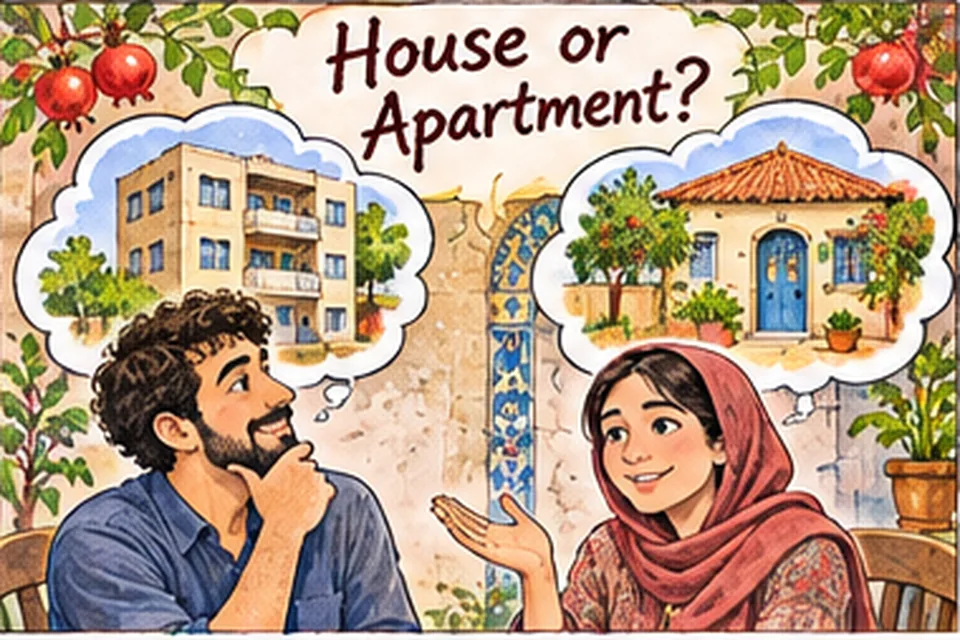
Talk about where you live in spoken Persian: house or apartment, bedrooms and balcony, wit
speaking
| English | Pronunciation | Persian | ||
| Sara: | Do you have house or apartment? | /khone dâri yâ âpârteman?/ | خونه داری یا آپارتمان؟ | :سارا |
| Arash: | I have house, what about you? |
/khone dâram, to chi?/ |
خونه دارم. تو چی؟ |
:آرش |
| Sara: | I have an apartment. | /man ye âpârtemâne dâram/ | من یه آپارتمان دارم | :سارا |
| Arash: | How many bedrooms do you have? | /chand tâ otâgh khâb dârin?/ | چند تا اتاق خواب دارین؟ |
:آرش |
| Sara: | I have two bedrooms. | /do otâgh khâb dâram/ | دو تا اتاق خواب دارم | :سارا |
| Arash: | Do you have a balcony? | /bâlkon ham dâri?/ |
بالکن هم داری؟ |
:آرش |
| Sara: | Yes I have a balcony. | /âre ye bâlkon dâram/ | آره یه بالکن دارم | :سارا |
Talk about where you live in spoken Persian: house or apartment, bedrooms and balcony, with a translated dialogue, key words and quiz.
Talking about your home
Sara and Arash compare their homes. Arash lives in a house, Sara in an apartment with two bedrooms and a balcony. The conversation repeats the verb داشتن (dâshtan, "to have") many times, so it is good practice for this very common verb.
Notice the counting word تا (tâ) after numbers: دو تا اتاق خواب (do tâ otâgh-khâb), "two bedrooms". It is used constantly in speech.
The question … هم داری؟ (… ham dâri?), "do you also have …?", is a handy way to keep this kind of conversation going: you can ask about a yard, a parking space (پارکینگ, pârking) or an elevator in the same way.
The dialogue
| Speaker | Persian | Pronunciation | English |
|---|---|---|---|
| Sara | خونه داری یا آپارتمان؟ | /khune dâri yâ âpârtemân?/ | Do you have a house or an apartment? |
| Arash | خونه دارم. تو چی؟ | /khune dâram. to chi?/ | I have a house. What about you? |
| Sara | من یه آپارتمان دارم. | /man ye âpârtemân dâram./ | I have an apartment. |
| Arash | چند تا اتاق خواب دارین؟ | /chand tâ otâgh-khâb dârin?/ | How many bedrooms do you have? |
| Sara | دو تا اتاق خواب دارم. | /do tâ otâgh-khâb dâram./ | I have two bedrooms. |
| Arash | بالکن هم داری؟ | /bâlkon ham dâri?/ | Do you have a balcony too? |
| Sara | آره، یه بالکن دارم. | /âre, ye bâlkon dâram./ | Yes, I have a balcony. |
Key words and phrases
| Persian | Pronunciation | English |
|---|---|---|
| خونه | /khune/ | house, home |
| آپارتمان | /âpârtemân/ | apartment |
| یا | /yâ/ | or |
| داشتن | /dâshtan/ | to have |
| اتاق | /otâgh/ | room |
| اتاق خواب | /otâgh-khâb/ | bedroom |
| چند تا؟ | /chand tâ?/ | how many? |
| تا | /tâ/ | counting word used after numbers |
| بالکن | /bâlkon/ | balcony |
| هم | /ham/ | too, also |
| یه | /ye/ | a, one |
Spoken vs written Persian
In everyday speech, Persian shortens many words and changes some vowels. The table puts the colloquial forms from this dialogue next to the forms you would see in writing or hear in formal speech.
| Spoken form | Spoken → written pronunciation | Written form (meaning) |
|---|---|---|
| خونه | /khune → khâne/ | خانه (house) |
| یه | /ye → yek/ | یک (a, one) |
| دارین | /dârin → dârid/ | دارید (you (pl./polite) have) |
| آره | /âre → bale/ | بله (yes) |
| دو تا اتاق | /do tâ otâgh → do otâgh/ | دو اتاق (two rooms) |
Usage and culture notes
خونه means both "home" and "house". When people want to say clearly that it is a house and not an apartment, they often say خونهی ویلایی (khune-ye vilâyi).
Arash switches between داری (dâri, informal "you have") and دارین (dârin, plural or polite). Both are fine between friends, but in your own speech try to stay with one form for the same person.
After a number, the noun stays singular: دو تا اتاق, never دو تا اتاقها.
Rooms and parts of a home
Use these with داشتن and تا to describe your own home: یه آشپزخونهی کوچیک داریم (ye âshpazkhune-ye kuchik dârim), "we have a small kitchen".
| Persian | Pronunciation | English |
|---|---|---|
| آشپزخونه | /âshpazkhune/ | kitchen (written: آشپزخانه) |
| حموم | /hammum/ | bathroom with shower (written: حمام) |
| دستشویی | /dastshuyi/ | toilet, washroom |
| پذیرایی | /pazirâyi/ | living room (for guests) |
| حیاط | /hayât/ | yard, courtyard |
| طبقه | /tabaghe/ | floor, story |
| آسانسور | /âsânsor/ | elevator |
Try it yourself: say whether you live in a house or an apartment, how many bedrooms it has, and one other thing it has, such as a yard or a balcony.
Practice
-
Who lives in an apartment, Sara or Arash?
Show answer
Sara.
-
How many bedrooms does Sara have?
Show answer
Two: do tâ otâgh-khâb. دو تا اتاق خواب
-
Ask a friend in Persian: "Do you have a balcony?"
Show answer
bâlkon dâri? بالکن داری؟
-
Say in Persian: "I have three rooms."
Show answer
se tâ otâgh dâram. سه تا اتاق دارم
-
Give the written form of خونه. خونه
Show answer
khâne, spelled خانه.
Previous: Persian Conversation 30. Next: Persian Conversation 32. Review the sounds in the Persian pronunciation guide.


Take this lesson further
Study with the book
Farsi Conversations: Learn the Most Common Words and Phrases Farsi Speakers use Every Day
This free lesson is part of Farsi conversation lessons. The book puts the whole series in one printable PDF you can study offline.
Serious about Persian? Get all 30 of our Persian learning books for $199.99 (55% less than buying them one by one).
Free Persian Starter Kit (PDF)
The Persian alphabet chart and the 101 most common Persian words with pronunciation, in one printable PDF. You also get a one-time 15% code for any of our books.
We will email you new lessons and book news from Learn Persian Online. Unsubscribe any time.Free: 100 Core Persian Words + 20 Survival Phrases
Get the 14-page printable Starter Pack (all 32 letters, a 7-day reading plan, 100 core words and 20 survival phrases) and a short 5-email course. Free.