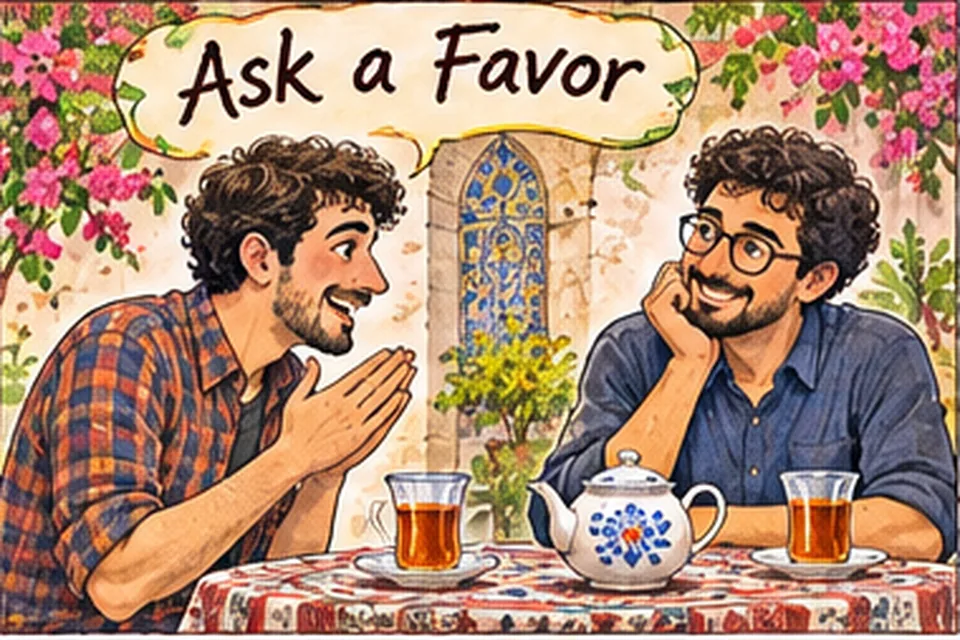
Learn how to ask for a favor politely in spoken Persian with میشه (mishe), plus open and
speaking
| English | Pronunciation | Persian | ||
| Neda: | Could you do me a favor? | /mishe ye lotfi bekoni?/ | میشه یه لطفی بکنی؟ | :ندا |
| Peyman: | Yes, what? | /âre, che kari?/ | آره، چه کاری؟ | :پیمان |
| Neda: | Could you close the window? | /mishe panjere ro bâz koni?/ | میشه پنجره رو باز کنی؟ | :ندا |
| Peyman: | Ok, no problem. | /ok, moshkeli nist/ | اوکی، مشکلی نیست | :پیمان |
Learn how to ask for a favor politely in spoken Persian with میشه (mishe), plus open and close, colloquial forms and a short quiz.
Asking someone for a favor
Neda asks Peyman for a small favor: to open the window. Peyman agrees right away. The exchange is short, but it shows the most common way to make a polite request in everyday Persian.
The key word is میشه (mishe), literally "is it possible?" or "does it become?". Followed by a subjunctive verb, it works like English "could you …?": میشه پنجره رو باز کنی؟ (mishe panjare ro bâz koni?).
Note that the English line on the original page says "close the window", but the Persian باز کنی (bâz koni) means "open". The translation below follows the Persian.
The dialogue
| Speaker | Persian | Pronunciation | English |
|---|---|---|---|
| Neda | میشه یه لطفی بکنی؟ | /mishe ye lotfi bokoni?/ | Could you do me a favor? |
| Peyman | آره، چه کاری؟ | /âre, che kâri?/ | Sure, what is it? |
| Neda | میشه پنجره رو باز کنی؟ | /mishe panjare ro bâz koni?/ | Could you open the window? |
| Peyman | اوکی، مشکلی نیست. | /okey, moshkeli nist./ | OK, no problem. |
Key words and phrases
| Persian | Pronunciation | English |
|---|---|---|
| میشه…؟ | /mishe…?/ | could you…? is it possible…? |
| لطف | /lotf/ | kindness, favor |
| یه لطفی کردن | /ye lotfi kardan/ | to do (someone) a favor |
| چه کاری؟ | /che kâri?/ | what thing? what is it? |
| پنجره | /panjare/ | window |
| باز کردن | /bâz kardan/ | to open |
| بستن | /bastan/ | to close |
| اوکی | /okey/ | OK |
| مشکلی نیست | /moshkeli nist/ | no problem |
| آره | /âre/ | yes (informal) |
Spoken vs written Persian
In everyday speech, Persian shortens many words and changes some vowels. The table puts the colloquial forms from this dialogue next to the forms you would see in writing or hear in formal speech.
| Spoken form | Spoken → written pronunciation | Written form (meaning) |
|---|---|---|
| میشه | /mishe → mishavad/ | میشود (is it possible) |
| یه | /ye → yek/ | یک (a, one) |
| رو | /ro → râ/ | را (object marker) |
| آره | /âre → bale/ | بله (yes) |
| اوکی | /okey → bâshad/ | باشد (OK, all right) |
Usage and culture notes
میشه is informal and very common. In more formal situations, or with someone older, you can say ممکنه…؟ (momkene…?) or لطفاً… (lotfan…) with the polite verb form: لطفاً پنجره رو باز کنین (lotfan panjare ro bâz konin).
مشکلی نیست (moshkeli nist) literally means "there isn't any problem". The -ی on مشکل works like "any" here.
Remember the pair باز کردن (bâz kardan, to open) and بستن (bastan, to close). The subjunctive of بستن is ببندی (bebandi): میشه پنجره رو ببندی؟, "Could you close the window?"
More polite requests
Each of these follows the same pattern as the dialogue: میشه plus a verb in the subjunctive. Add لطفاً (lotfan, "please") for extra politeness.
| Persian | Pronunciation | English |
|---|---|---|
| میشه در رو ببندی؟ | /mishe dar ro bebandi?/ | could you close the door? |
| میشه چراغ رو روشن کنی؟ | /mishe cherâgh ro rowshan koni?/ | could you turn on the light? |
| میشه کمکم کنی؟ | /mishe komakam koni?/ | could you help me? |
| میشه یه لیوان آب بدی؟ | /mishe ye livân âb bedi?/ | could you give me a glass of water? |
| میشه آرومتر صحبت کنی؟ | /mishe ârumtar sohbat koni?/ | could you speak more slowly? |
| لطف کردی | /lotf kardi/ | that was kind of you, thanks |
Try it yourself: ask a friend for a favor, say what it is, and thank them when they agree.
Practice
-
What favor does Neda ask for in the Persian dialogue?
Show answer
She asks Peyman to open the window (panjare ro bâz koni).
-
How do you say "Could you do me a favor?" in spoken Persian?
Show answer
mishe ye lotfi bokoni? میشه یه لطفی بکنی؟
-
Say in Persian: "Could you close the window?"
Show answer
mishe panjare ro bebandi? میشه پنجره رو ببندی؟
-
What does مشکلی نیست mean? مشکلی نیست
Show answer
"No problem" (lit. there isn't any problem).
-
Give the written form of میشه.
Show answer
mishavad, spelled میشود.
Previous: Persian Conversation 32. Next: Persian Conversation 34. Review the sounds in the Persian pronunciation guide.


Take this lesson further
Study with the book
Farsi Conversations: Learn the Most Common Words and Phrases Farsi Speakers use Every Day
This free lesson is part of Farsi conversation lessons. The book puts the whole series in one printable PDF you can study offline.
Serious about Persian? Get all 30 of our Persian learning books for $199.99 (55% less than buying them one by one).
Free Persian Starter Kit (PDF)
The Persian alphabet chart and the 101 most common Persian words with pronunciation, in one printable PDF. You also get a one-time 15% code for any of our books.
We will email you new lessons and book news from Learn Persian Online. Unsubscribe any time.Free: 100 Core Persian Words + 20 Survival Phrases
Get the 14-page printable Starter Pack (all 32 letters, a 7-day reading plan, 100 core words and 20 survival phrases) and a short 5-email course. Free.