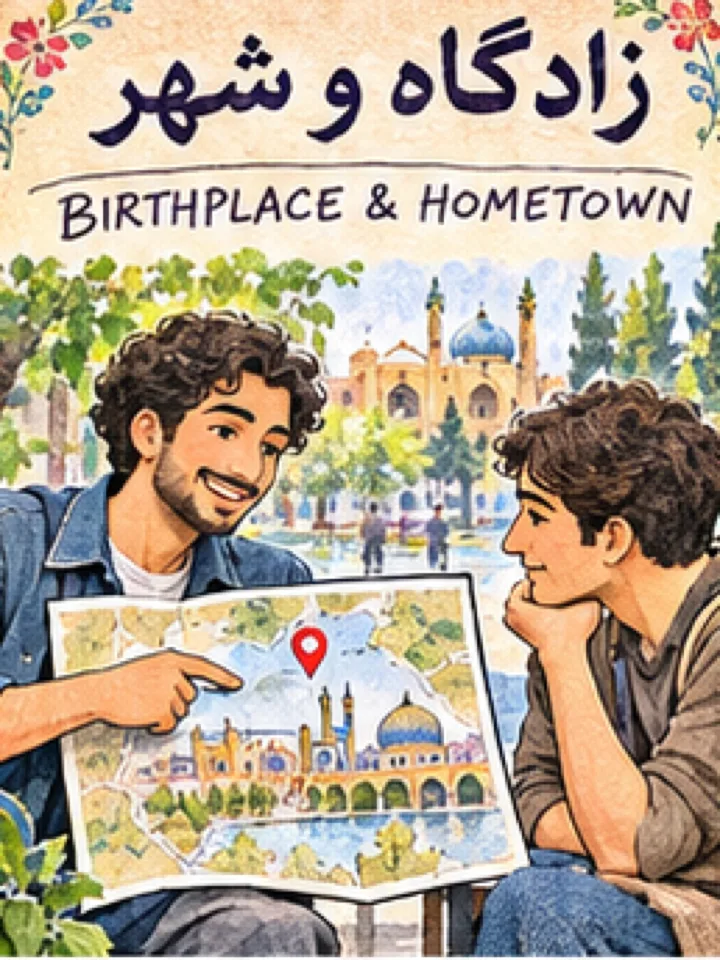
Ask where someone was born and grew up in Persian: a dialogue with be donyâ omadan and boz
speaking
Conversation about age and birthplace ⇒ گفتگو راجب سن و محل تولد

| English | Pronunciation | Persian | ||
| Neda: | Where were you born? | /kojâ be donyâ omadi?/ | کجا به دنیا اومدی؟ | :ندا |
| Sara: | I was born in shiraz. | /shirâz be donyâ omadam/ | شیراز به دنیا اومدم | :سارا |
| Neda: | Did you grow up there? |
/hamonjâ ham bozorg shodi?/ |
همونجا هم بزرگ شدی؟ | :ندا |
| Sara: | Yes, what about you? |
/âre, to chi?/ |
آره، تو چی؟ | :سارا |
| Neda: | I was born in Esfahan.i grew up in Hamedan. |
/man esfahân be donyâ omadam. Hamedân bozorg shodam/ |
من اصفهان به دنیا اومدم همدان بزرگ شدم | :ندا |
Ask where someone was born and grew up in Persian: a dialogue with be donyâ omadan and bozorg shodan, spoken vs written forms and a quiz.
Where were you born and where did you grow up?
Neda and Sara are getting to know each other. Neda asks where Sara was born and whether she grew up there too. Sara was born and raised in Shiraz, while Neda was born in Isfahan and grew up in Hamedan. These are typical small-talk questions in Iran, where people often ask which city someone is from.
The key expressions are به دنیا اومدن (be donyâ omadan), "to be born", literally "to come into the world", and بزرگ شدن (bozorg shodan), "to grow up", literally "to become big".
The dialogue
| Speaker | Persian | Pronunciation | English |
|---|---|---|---|
| Neda | کجا به دنیا اومدی؟ | /kojâ be donyâ omadi?/ | Where were you born? |
| Sara | شیراز به دنیا اومدم. | /shirâz be donyâ omadam./ | I was born in Shiraz. |
| Neda | همونجا هم بزرگ شدی؟ | /hamunjâ ham bozorg shodi?/ | Did you grow up there too? |
| Sara | آره، تو چی؟ | /âre, to chi?/ | Yes. How about you? |
| Neda | من اصفهان به دنیا اومدم. همدان بزرگ شدم. | /man esfahân be donyâ omadam. hamedân bozorg shodam./ | I was born in Isfahan. I grew up in Hamedan. |
Key words and phrases
| Persian | Pronunciation | English |
|---|---|---|
| کجا | /kojâ/ | where |
| دنیا | /donyâ/ | world |
| به دنیا اومدن | /be donyâ omadan/ | to be born (spoken) |
| به دنیا اومدی؟ | /be donyâ omadi?/ | were you born? |
| به دنیا اومدم | /be donyâ omadam/ | I was born |
| همونجا | /hamunjâ/ | right there, the same place |
| بزرگ | /bozorg/ | big |
| بزرگ شدن | /bozorg shodan/ | to grow up |
| بزرگ شدم | /bozorg shodam/ | I grew up |
| آره | /âre/ | yes (casual) |
| تو چی؟ | /to chi?/ | how about you? |
Spoken vs written Persian
In spoken Persian a long â before m or n often turns into u: آمدن becomes اومدن and همان becomes همون. Speakers also drop the preposition در (dar), "in", before city names.
| Spoken / written | Pronunciation | Meaning |
|---|---|---|
| اومدی / آمدی | /omadi / âmadi/ | you came |
| اومدم / آمدم | /omadam / âmadam/ | I came |
| همونجا / همانجا | /hamunjâ / hamânjâ/ | the same place |
| آره / بله | /âre / bale/ | yes |
| چی / چه | /chi / che/ | what |
| شیراز به دنیا اومدم / در شیراز به دنیا آمدم | /shirâz be donyâ omadam / dar shirâz be donyâ âmadam/ | I was born in Shiraz |
Asking about age
The page heading also mentions age, which the dialogue does not cover. In casual speech you ask چند سالته؟ (chand sâlete?), "how old are you?", and answer بیست سالمه (bist sâlame), "I'm twenty". Politely, ask چند سالتونه؟ (chand sâletune?). In writing these become چند سال داری؟ and بیست سال دارم, literally "I have twenty years".
Grammar note
Both verbs in this dialogue are in the simple past. The personal endings are added to the past stem اومد (omad) or شد (shod): اومدم (omadam) "I came", اومدی (omadi) "you came", شدم (shodam) "I became". There is no separate word for "was" in "I was born": Persian just says "I came into the world".
Try it yourself
- Say where you were born: … به دنیا اومدم (… be donyâ omadam), putting your city first.
- Say where you grew up: … بزرگ شدم (… bozorg shodam).
- Ask a friend whether they grew up in the same place: همونجا هم بزرگ شدی؟
- Turn the question back to the other person with تو چی؟ (to chi?), or politely شما چی؟ (shomâ chi?).
- Tell a partner the cities where three people in your family were born, using اومد (omad) for "he or she came".
Practice
-
Ask a friend where they were born.
Show answer
kojâ be donyâ omadi? کجا به دنیا اومدی؟
-
Say "I grew up in Tehran."
Show answer
tehrân bozorg shodam تهران بزرگ شدم
-
What is the literal meaning of {{به دنیا اومدن}}?
Show answer
To come into the world.
-
Write {{همونجا}} in its written form.
Show answer
hamânjâ همانجا
-
Ask a friend how old they are.
Show answer
chand sâlete? چند سالته؟
Find more dialogues in the Farsi conversation lessons series, and review the sounds behind the transliteration on the Persian pronunciation page.


Take this lesson further
Study with the book
Farsi Conversations: Learn the Most Common Words and Phrases Farsi Speakers use Every Day
This free lesson is part of Farsi conversation lessons. The book puts the whole series in one printable PDF you can study offline.
Serious about Persian? Get all 30 of our Persian learning books for $199.99 (55% less than buying them one by one).
Free Persian Starter Kit (PDF)
The Persian alphabet chart and the 101 most common Persian words with pronunciation, in one printable PDF. You also get a one-time 15% code for any of our books.
We will email you new lessons and book news from Learn Persian Online. Unsubscribe any time.Free: 100 Core Persian Words + 20 Survival Phrases
Get the 14-page printable Starter Pack (all 32 letters, a 7-day reading plan, 100 core words and 20 survival phrases) and a short 5-email course. Free.