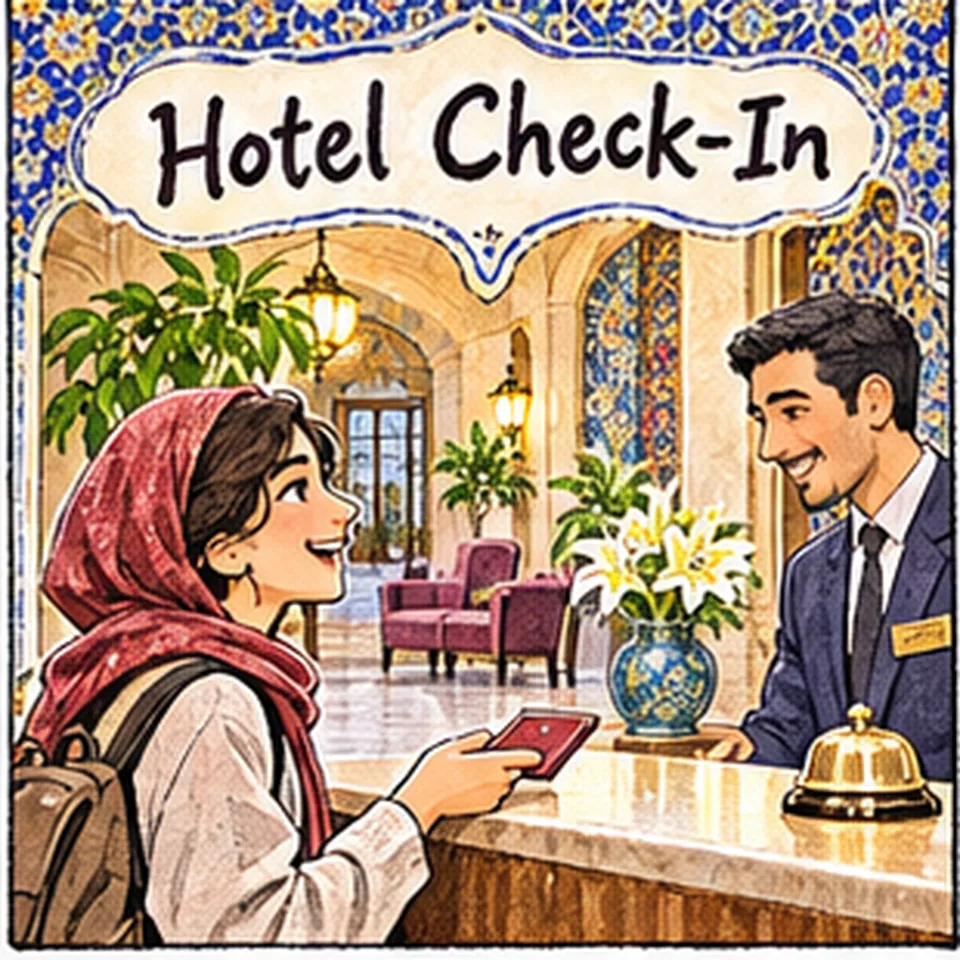
Check in at a hotel in Persian: welcome, reservation and room number phrases, past perfect
speaking
Conversation At Hotel ⇒ گفتگو در هتل

| English | Pronunciation | Persian | ||
| Reception: | Hi wellcome to my hotel. | /sâlâm be hotele mâ khosh âmadid/ | سلام به هتل ما خوش آمدید | :پذیرش |
| Puya: | Thanks. | /mamnonam/ | ممنونم | :پویا |
| Reception: | Do you have a reservation? | /ghablan rezerv kardid?/ | قبلاً رزرو کردید؟ | :پذیرش |
| Puya: | Yes, I have a reservation. | /bale rezerv karde budam/ | بله رزرو کرده بودم | :پویا |
| Reception: | What is your name? | /esmeton chiye?/ | اسمتون چیه؟ | :پذیرش |
| Puya: | Puya Kiyani | /peymâne kiyâni/ | پویا کیانی | :پویا |
| Reception: | Your room is 101 | /bale otâghe shomâ shomâreye 101 hast/ | اتاق شما شماره 101 هست | :پذیرش |
Check in at a hotel in Persian: welcome, reservation and room number phrases, past perfect rezerv karde budam, spoken vs written forms and a quiz.
Checking in at a hotel in Persian
Puya arrives at a hotel. The receptionist welcomes him, asks if he has a reservation, takes his name and gives him his room number. The receptionist speaks politely with شما forms, as hotel staff in Iran normally do with guests.
Useful phrases here are خوش آمدید (khosh âmadid), "welcome", and رزرو کردن (rezerv kardan), "to book", a verb built from the French loanword رزرو plus کردن.
The dialogue
| Speaker | Persian | Pronunciation | English |
|---|---|---|---|
| Receptionist | سلام، به هتل ما خوش آمدید. | /salâm, be hotel-e mâ khosh âmadid./ | Hello, welcome to our hotel. |
| Puya | ممنونم. | /mamnunam./ | Thank you. |
| Receptionist | قبلاً رزرو کردید؟ | /ghablan rezerv kardid?/ | Do you have a reservation? |
| Puya | بله، رزرو کرده بودم. | /bale, rezerv karde budam./ | Yes, I made a reservation. |
| Receptionist | اسمتون چیه؟ | /esmetun chiye?/ | What's your name? |
| Puya | پویا کیانی. | /puyâ kiyâni./ | Puya Kiyani. |
| Receptionist | اتاق شما شماره 101 هست. | /otâgh-e shomâ shomâre-ye sad-o-yek hast./ | Your room is number 101. |
Key words and phrases
| Persian | Pronunciation | English |
|---|---|---|
| پذیرش | /paziresh/ | reception, front desk |
| هتل | /hotel/ | hotel |
| به … خوش آمدید | /be … khosh âmadid/ | welcome to … |
| ممنونم | /mamnunam/ | thank you |
| قبلاً | /ghablan/ | before, previously |
| رزرو کردن | /rezerv kardan/ | to book, to reserve |
| رزرو کرده بودم | /rezerv karde budam/ | I had booked |
| اسم | /esm/ | name |
| اتاق | /otâgh/ | room |
| شماره | /shomâre/ | number |
| صد و یک | /sad-o yek/ | one hundred and one |
Spoken vs written Persian
The receptionist mixes formal and spoken forms, which is typical of polite speech. Here are the everyday and written versions side by side.
| Spoken / written | Pronunciation | Meaning |
|---|---|---|
| خوش اومدین / خوش آمدید | /khosh omadin / khosh âmadid/ | welcome |
| کردین / کردید | /kardin / kardid/ | you did (polite) |
| اسمتون / اسمتان | /esmetun / esmetân/ | your name |
| چیه / چیست | /chiye / chist/ | what is it? |
| هست / است | /hast / ast/ | is |
Grammar note: the past perfect
رزرو کرده بودم (rezerv karde budam) is the past perfect, "I had booked": the past participle کرده (karde) plus the past of "to be", بودم (budam). Puya uses it because the booking happened before his arrival. A simple past رزرو کردم (rezerv kardam), "I booked", would also be fine here.
هتل ما means "our hotel", not "my hotel": ما (mâ) is "we, our". Staff usually speak of their workplace this way.
Try it yourself
- Tell the receptionist you have a booking: رزرو دارم (rezerv dâram), "I have a reservation".
- Ask for a room if you have none: اتاق خالی دارید؟ (otâgh-e khâli dârid?), "do you have a free room?"
- Give your full name when asked اسمتون چیه؟.
- Say your room number with اتاق شماره … (otâgh-e shomâre …).
Other phrases at the front desk
| Persian | Pronunciation | English |
|---|---|---|
| کلید | /kelid/ | key |
| صبحانه | /sobhâne/ | breakfast |
| صبحانه ساعت چنده؟ | /sobhâne sâ'at chande?/ | what time is breakfast? |
| اتاق یکنفره | /otâgh-e yek-nafare/ | single room |
| اتاق دونفره | /otâgh-e do-nafare/ | double room |
| پاسپورت | /pâsport/ | passport |
Numbers above twenty are joined with و, pronounced -o: صد و یک is sad-o yek, "one hundred and one", and بیست و پنج is bist-o panj, "twenty-five". Hotel staff will often read a room number this way, though you may also hear the digits one by one.
Practice
-
How does the receptionist say "welcome to our hotel"?
Show answer
be hotel-e mâ khosh âmadid به هتل ما خوش آمدید
-
What tense is {{رزرو کرده بودم}} and what does it mean?
Show answer
Past perfect: "I had booked".
-
Say "I have a reservation."
Show answer
rezerv dâram رزرو دارم
-
How do you say "room number 205"?
Show answer
otâgh-e shomâre-ye devist-o panj اتاق شمارهی ۲۰۵
-
Give the spoken form of {{خوش آمدید}}.
Show answer
khosh omadin خوش اومدین
Find more dialogues in the Farsi conversation lessons series, and review the sounds behind the transliteration on the Persian pronunciation page.


Take this lesson further
Study with the book
Farsi Conversations: Learn the Most Common Words and Phrases Farsi Speakers use Every Day
This free lesson is part of Farsi conversation lessons. The book puts the whole series in one printable PDF you can study offline.
Serious about Persian? Get all 30 of our Persian learning books for $199.99 (55% less than buying them one by one).
Free Persian Starter Kit (PDF)
The Persian alphabet chart and the 101 most common Persian words with pronunciation, in one printable PDF. You also get a one-time 15% code for any of our books.
We will email you new lessons and book news from Learn Persian Online. Unsubscribe any time.Free: 100 Core Persian Words + 20 Survival Phrases
Get the 14-page printable Starter Pack (all 32 letters, a 7-day reading plan, 100 core words and 20 survival phrases) and a short 5-email course. Free.