200 Most Common Persian Verbs
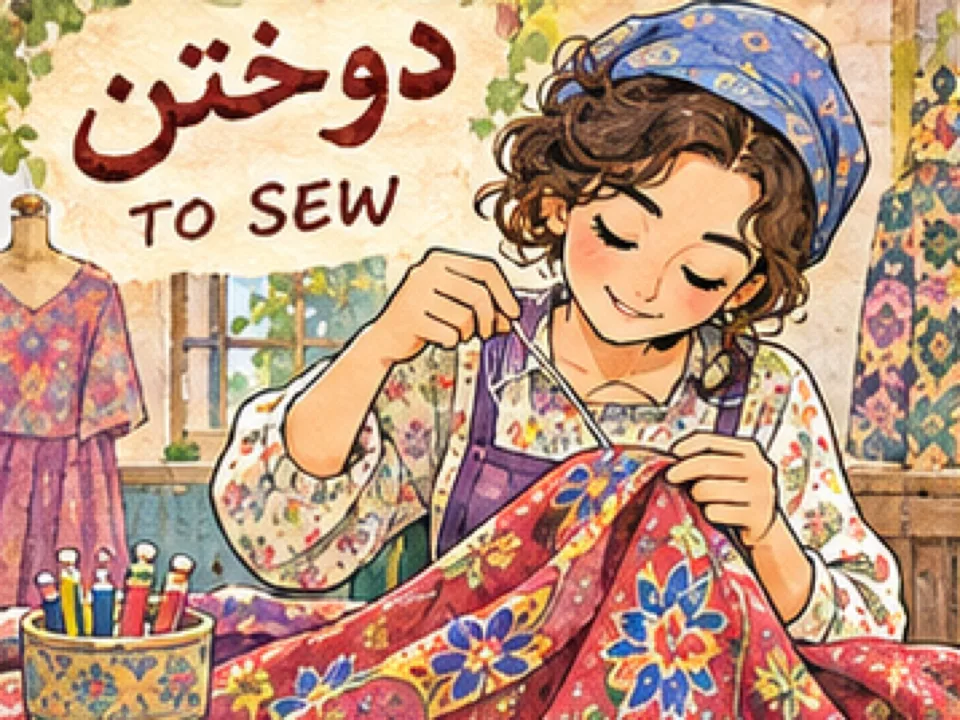
دوختَن
Watch and listen to Reza Nazari explain this verb. More in the free 200 Persian Verbs video course.
Sew – Suture
مُتَرادِفِ فارسی: بِهَم چَسباندَن – بَخیِه کَردَن
مُتَضادِ فارسی: جُدا کَردَن
:صَرف
گُذَشتِه: دوختَم – دوختی – دوخت – دوختیم – دوختید – دوختَند
حال: می دوزَم – می دوزی – می دوزَد – می دوزیم – می دوزید – می دوزَند
:مِثال
.خیاط لِباسِ مَن را دوخت
.مادَرِ مَن لِباس می دوزَد
.او یک پیرهَن دوختِه اَست
دوختن (dukhtan) means "to sew" or "to stitch" in Persian. See its irregular stems, full conjugation, examples, phrases and a quiz.
How to use دوختن (dukhtan)
دوختن means "to sew" or "to stitch". It is a simple transitive verb with an irregular present stem: the past stem is دوخت (dukht) and the present stem is دوز (duz). So "she sewed" is دوخت but "she sews" is میدوزد (miduzad). The same kht to z pattern appears in سوختن / سوز (to burn) and آموختن / آموز (to learn).
It is used for clothes and curtains, and also for stitches in medicine: زخم را دوختند ("they stitched up the wound"). Figuratively, چشم دوختن به (cheshm dukhtan be) means "to stare at, to fix your eyes on". A tailor is خیاط (khayyât), and the noun دوخت means "sewing" or the cut of a garment.
Verb stems
| Infinitive | دوختن | /dukhtan/ | to sew, to stitch |
|---|---|---|---|
| Past stem | دوخت | /dukht/ | used for past tenses |
| Present stem | دوز | /duz/ | used for present, subjunctive and imperative |
Conjugation of دوختن
| Person | Simple past | Present | Future | Subjunctive |
|---|---|---|---|---|
| من I |
دوختم /dukhtam/ |
میدوزم /miduzam/ |
خواهم دوخت /khâham dukht/ |
بدوزم /beduzam/ |
| تو you (sg.) |
دوختی /dukhti/ |
میدوزی /miduzi/ |
خواهی دوخت /khâhi dukht/ |
بدوزی /beduzi/ |
| او he / she |
دوخت /dukht/ |
میدوزد /miduzad/ |
خواهد دوخت /khâhad dukht/ |
بدوزد /beduzad/ |
| ما we |
دوختیم /dukhtim/ |
میدوزیم /miduzim/ |
خواهیم دوخت /khâhim dukht/ |
بدوزیم /beduzim/ |
| شما you (pl./polite) |
دوختید /dukhtid/ |
میدوزید /miduzid/ |
خواهید دوخت /khâhid dukht/ |
بدوزید /beduzid/ |
| آنها they |
دوختند /dukhtand/ |
میدوزند /miduzand/ |
خواهند دوخت /khâhand dukht/ |
بدوزند /beduzand/ |
Negative and imperative
| Persian | Pronunciation | English |
|---|---|---|
| ندوختم | /nadukhtam/ | I did not sew |
| نمیدوزم | /nemiduzam/ | I do not sew / I am not sewing |
| بدوز! | /beduz!/ | Sew! (to one person) |
| بدوزید! | /beduzid!/ | Sew! (to several people, or politely) |
| ندوز! | /naduz!/ | Don't sew! |
The examples above, translated
| Persian | Pronunciation | English |
|---|---|---|
| خیاط لباس من را دوخت. | /khayyât lebâs-e man râ dukht./ | The tailor made my clothes. |
| مادر من لباس میدوزد. | /mâdar-e man lebâs miduzad./ | My mother sews clothes. |
| او یک پیراهن دوخته است. | /u yek pirâhan dukhte ast./ | She has sewn a shirt. |
More example sentences
| Persian | Pronunciation | English |
|---|---|---|
| خیاط برای من یک کت و شلوار دوخت. | /khayyât barâye man yek kot o shalvâr dukht./ | The tailor made me a suit. |
| مادربزرگم هنوز با دست میدوزد. | /mâdarbozorgam hanuz bâ dast miduzad./ | My grandmother still sews by hand. |
| دکمهی پیراهنم افتاد، میتوانی آن را بدوزی؟ | /dokme-ye pirâhanam oftâd, mitavâni ân râ beduzi?/ | A button came off my shirt. Can you sew it on? |
| دکتر زخم دستش را دوخت. | /doktor zakhm-e dastash râ dukht./ | The doctor stitched the cut on his hand. |
Common phrases
| Persian | Pronunciation | English |
|---|---|---|
| چرخ خیاطی | /charkh-e khayyâti/ | sewing machine |
| لباس دوختن | /lebâs dukhtan/ | to make clothes |
| چشم دوختن به | /cheshm dukhtan be/ | to stare at |
| خیاطی | /khayyâti/ | tailoring; tailor's shop |
In spoken Persian
In speech you'll hear میدوزه (miduze) and میدوزن (miduzan), as in اینو برام میدوزی؟ (ino barâm miduzi?, "will you sew this for me?"). Tehranis often say پیرهن (pirhan) for پیراهن (pirâhan, "shirt").
Watch out for
- Don't confuse میدوزم (miduzam, "I sew") with میدوم (midavam, "I run"). The vowel in دوختن is a long u: dukhtan.
- Note: the third page example writes پیرهن, the colloquial form; the standard written spelling is پیراهن (pirâhan).
Practice
-
Translate into Persian: "My mother sewed a dress for me."
Show answer
mâdaram barâye man yek lebâs dukht. مادرم برای من یک لباس دوخت.
-
What is the present stem of this verb? دوختن
Show answer
duz دوز
-
What does this sentence mean? او به در چشم دوخته بود.
Show answer
He was staring at the door.
This is lesson 124 of 200 Most Common Persian Verbs. For the sounds used in the pronunciation guide, see Persian pronunciation.


Take this lesson further

Study with the book
200 Absolutely Essential Persian Verbs
This free lesson is part of 200 Most Common Persian Verbs. The book puts the whole series in one printable PDF you can study offline.
Serious about Persian? Get all 30 of our Persian learning books for $199.99 (55% less than buying them one by one).
Free Persian Starter Kit (PDF)
The Persian alphabet chart and the 101 most common Persian words with pronunciation, in one printable PDF. You also get a one-time 15% code for any of our books.
We will email you new lessons and book news from Learn Persian Online. Unsubscribe any time.Free: 100 Core Persian Words + 20 Survival Phrases
Get the 14-page printable Starter Pack (all 32 letters, a 7-day reading plan, 100 core words and 20 survival phrases) and a short 5-email course. Free.
Practise with free Persian games