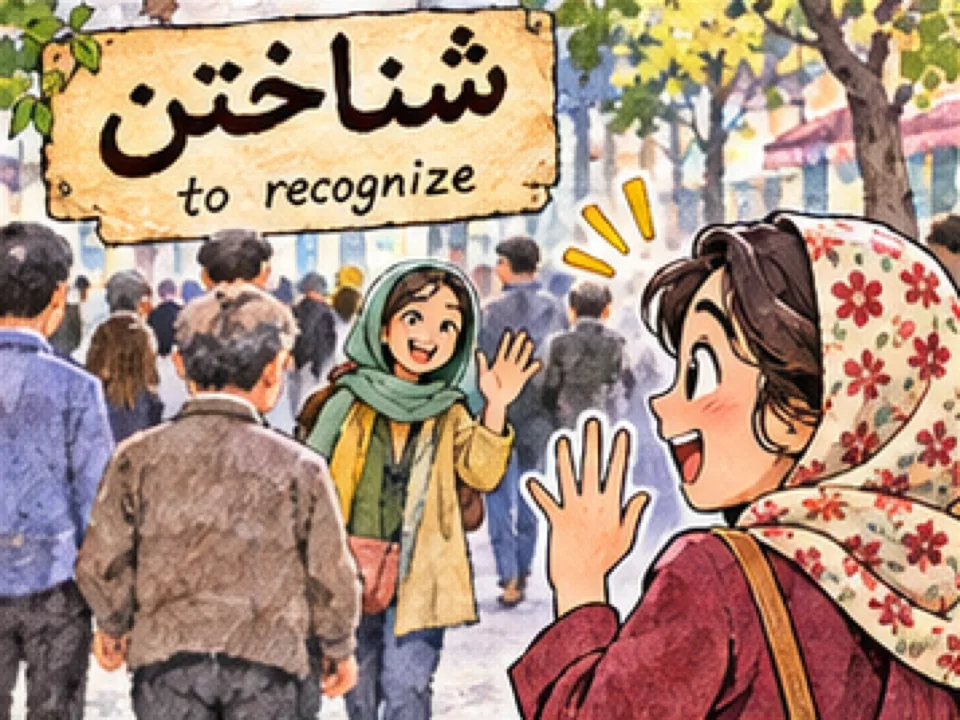
200 Most Common Persian Verbs
شِناختَن
Watch and listen to Reza Nazari explain this verb. More in the free 200 Persian Verbs video course.
Identify – Recognize
مُتَرادِفِ فارسی: بِه یاد آوَردَن – فَهمیدَن
مُتَضادِ فارسی: بِجا نیاوَردَن – نَفهمیدَن
:صَرف
گُذَشتِه: شِناختَم – شِناختی – شِناخت – شِناختیم – شِناختید – شِناختَند
حال: می شِناسَم – می شِناسی – می شِناسَد – می شِناسیم – می شِناسید
می شِناسَند
:مِثال
.مَن آن مَرد را شِناختَم
.او تَمامِ بازیگَران را می شِناسَد
شناختن (shenâkhtan) means "to know, to recognize" in Persian. Here are its stems, full conjugation, examples with English, common phrases and a short quiz.
How to use شناختن (shenâkhtan)
شناختن is a simple transitive verb meaning "to know" a person, place or thing (to be familiar with it) and "to recognize". Its present stem changes خت to س: شناس (shenâs), so "I know him" is او را میشناسم (u râ mishenâsam). In the past, شناختم usually means "I recognized".
English "know" has two Persian equivalents. Use شناختن for people and places, like French connaître, and دانستن (dânestan) for facts and information: اسمش را میدانم, "I know his name", but خودش را میشناسم, "I know him". Useful derived words are شناسنامه (shenâsnâme, "birth certificate") and ناشناس (nâshenâs, "unknown, anonymous").
Verb stems
| Infinitive | شناختن | /shenâkhtan/ | to know (a person or place), to recognize |
|---|---|---|---|
| Past stem | شناخت | /shenâkht/ | used for past tenses |
| Present stem | شناس | /shenâs/ | used for present, subjunctive and imperative |
Conjugation of شناختن
| Person | Simple past | Present | Future | Subjunctive |
|---|---|---|---|---|
| من I |
شناختم /shenâkhtam/ |
میشناسم /mishenâsam/ |
خواهم شناخت /khâham shenâkht/ |
بشناسم /beshenâsam/ |
| تو you (sg.) |
شناختی /shenâkhti/ |
میشناسی /mishenâsi/ |
خواهی شناخت /khâhi shenâkht/ |
بشناسی /beshenâsi/ |
| او he / she |
شناخت /shenâkht/ |
میشناسد /mishenâsad/ |
خواهد شناخت /khâhad shenâkht/ |
بشناسد /beshenâsad/ |
| ما we |
شناختیم /shenâkhtim/ |
میشناسیم /mishenâsim/ |
خواهیم شناخت /khâhim shenâkht/ |
بشناسیم /beshenâsim/ |
| شما you (pl./polite) |
شناختید /shenâkhtid/ |
میشناسید /mishenâsid/ |
خواهید شناخت /khâhid shenâkht/ |
بشناسید /beshenâsid/ |
| آنها they |
شناختند /shenâkhtand/ |
میشناسند /mishenâsand/ |
خواهند شناخت /khâhand shenâkht/ |
بشناسند /beshenâsand/ |
Negative and imperative
| Persian | Pronunciation | English |
|---|---|---|
| نشناختم | /nashenâkhtam/ | I did not recognize |
| نمیشناسم | /nemishenâsam/ | I do not know (him/her/it) |
| بشناس! | /beshenâs!/ | Get to know (it)! (to one person) |
| بشناسید! | /beshenâsid!/ | Get to know (it)! (to several people, or politely) |
| نشناس! | /nashenâs!/ | Don't get to know (it)! |
The examples above, translated
| Persian | Pronunciation | English |
|---|---|---|
| من آن مرد را شناختم. | /man ân mard râ shenâkhtam./ | I recognized that man. |
| او تمام بازیگران را میشناسد. | /u tamâm-e bâzigarân râ mishenâsad./ | She knows all the actors. |
| او من را خوب میشناسد. | /u man râ khub mishenâsad./ | He knows me well. |
More example sentences
| Persian | Pronunciation | English |
|---|---|---|
| ببخشید، شما را نشناختم. | /bebakhshid, shomâ râ nashenâkhtam./ | Sorry, I didn't recognize you. |
| این شهر را خوب میشناسی؟ | /in shahr râ khub mishenâsi?/ | Do you know this city well? |
| او را از صدایش شناختم. | /u râ az sedâyash shenâkhtam./ | I recognized her by her voice. |
| میخواهم خانوادهات را بشناسم. | /mikhâham khânevâde-at râ beshenâsam./ | I want to get to know your family. |
Common phrases
| Persian | Pronunciation | English |
|---|---|---|
| شناسنامه | /shenâsnâme/ | birth certificate, ID booklet |
| کارت شناسایی | /kârt-e shenâsâyi/ | ID card |
| ناشناس | /nâshenâs/ | unknown, anonymous |
| شناخته شده | /shenâkhte shode/ | well-known |
In spoken Persian
In Tehran speech: میشناسیش؟ (mishenâsish?), "Do you know him?", and نشناختمت (nashenâkhtamet), "I didn't recognize you". Endings shorten as usual: میشناسه (mishenâse), میشناسن (mishenâsan).
Watch out for
- Do not use شناختن for facts: "I know the answer" is جواب را میدانم (javâb râ midânam), not "javâb râ mishenâsam".
- Remember the present stem شناس: میشناسیم (mishenâsim), بشناس (beshenâs).
Practice
-
Translate into Persian: "I know your brother."
Show answer
barâdarat râ mishenâsam. برادرت را میشناسم.
-
Which verb fits "I know the answer": shenâkhtan or dânestan?
Show answer
dânestan: javâb râ midânam. جواب را میدانم.
-
Give the negative past form for "I".
Show answer
nashenâkhtam نشناختم
Related verbs in this course
This is lesson 149 of 200 Most Common Persian Verbs. For the sounds used in the pronunciation guide, see Persian pronunciation.
.او مَن را خوب می شِناسَد


Take this lesson further

Study with the book
200 Absolutely Essential Persian Verbs
This free lesson is part of 200 Most Common Persian Verbs. The book puts the whole series in one printable PDF you can study offline.
Serious about Persian? Get all 30 of our Persian learning books for $199.99 (55% less than buying them one by one).
Free Persian Starter Kit (PDF)
The Persian alphabet chart and the 101 most common Persian words with pronunciation, in one printable PDF. You also get a one-time 15% code for any of our books.
We will email you new lessons and book news from Learn Persian Online. Unsubscribe any time.Free: 100 Core Persian Words + 20 Survival Phrases
Get the 14-page printable Starter Pack (all 32 letters, a 7-day reading plan, 100 core words and 20 survival phrases) and a short 5-email course. Free.
Practise with free Persian games