200 Most Common Persian Verbs
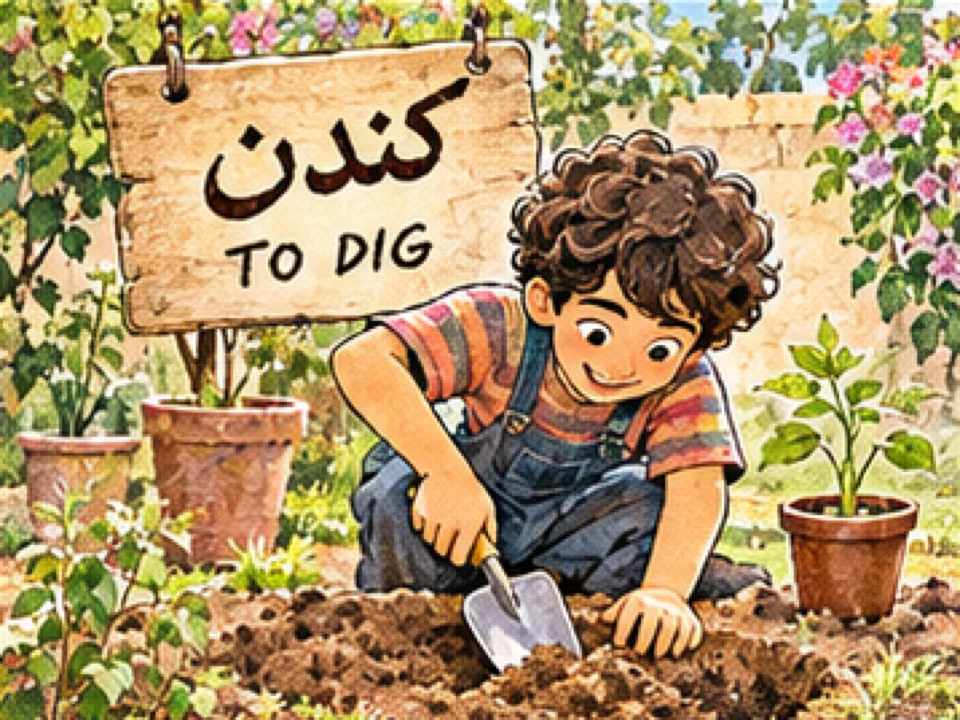
کَندَن
Watch and listen to Reza Nazari explain this verb. More in the free 200 Persian Verbs video course.
Dig – Mine
مُتَرادِفِ فارسی: حَفر کَردَن – جُدا کَردَن
مُتَضادِ فارسی: پُر کَردَن – بِه هَم مُتَصِل کَردَن
:صَرف
گُذَشتِه: کَندَم – کَندی – کَند – کَندیم – کَندید – کَندَند
حال: می کَنَم – می کَنی – می کَنَد – می کَنیم – می کَنید – می کَنَند
:مِثال
.آنها بَرایِ یافتَنِ اَشیاء قیمَتی زَمین را کَندَند
.مَن آن کاغَذ را اَز رویِ دیوار کَندَم
.او پوستِ میوِه را کَند
کندن (kandan) means "to dig" or "to pull off" in Persian. See its stems, full conjugation, examples, common idioms and a short quiz.
How to use کندن (kandan)
کندن is a simple, transitive verb with regular stems: past کند (kand), present کن (kan). It has two main meanings: "to dig" (چاه کندن, "to dig a well") and "to pull off, to tear off" (کاغذ را از دیوار کندم, "I tore the paper off the wall"). It is also used for picking flowers and peeling fruit.
Watch out for spelling: the present forms of کندن look exactly like those of کردن. میکنم can be mikanam ("I dig") or mikonam ("I do"), and only context tells you which. The verb is neutral and appears in strong idioms such as دل کندن ("to tear yourself away, to let go") and جان کندن ("to struggle desperately, to toil").
Verb stems
| Infinitive | کندن | /kandan/ | to dig; to pull off, to tear off, to peel |
|---|---|---|---|
| Past stem | کند | /kand/ | used for past tenses |
| Present stem | کن | /kan/ | used for present, subjunctive and imperative |
Conjugation of کندن
| Person | Simple past | Present | Future | Subjunctive |
|---|---|---|---|---|
| من I |
کندم /kandam/ |
میکنم /mikanam/ |
خواهم کند /khâham kand/ |
بکنم /bekanam/ |
| تو you (sg.) |
کندی /kandi/ |
میکنی /mikani/ |
خواهی کند /khâhi kand/ |
بکنی /bekani/ |
| او he / she |
کند /kand/ |
میکند /mikanad/ |
خواهد کند /khâhad kand/ |
بکند /bekanad/ |
| ما we |
کندیم /kandim/ |
میکنیم /mikanim/ |
خواهیم کند /khâhim kand/ |
بکنیم /bekanim/ |
| شما you (pl./polite) |
کندید /kandid/ |
میکنید /mikanid/ |
خواهید کند /khâhid kand/ |
بکنید /bekanid/ |
| آنها they |
کندند /kandand/ |
میکنند /mikanand/ |
خواهند کند /khâhand kand/ |
بکنند /bekanand/ |
Negative and imperative
| Persian | Pronunciation | English |
|---|---|---|
| نکندم | /nakandam/ | I did not dig |
| نمیکنم | /nemikanam/ | I do not dig / I am not digging |
| بکن! | /bekan!/ | Dig! (to one person) |
| بکنید! | /bekanid!/ | Dig! (to several people, or politely) |
| نکن! | /nakan!/ | Don't dig! |
The examples above, translated
| Persian | Pronunciation | English |
|---|---|---|
| آنها برای یافتن اشیاء قیمتی زمین را کندند. | /ân-hâ barâ-ye yâftan-e ashyâ'-e gheymati zamin râ kandand/ | They dug up the ground to find valuable objects. |
| من آن کاغذ را از روی دیوار کندم. | /man ân kâghaz râ az ru-ye divâr kandam/ | I tore that paper off the wall. |
| او پوست میوه را کند. | /u pust-e mive râ kand/ | He peeled the fruit. |
More example sentences
| Persian | Pronunciation | English |
|---|---|---|
| کارگران یک چاه عمیق کندند. | /kârgarân yek châh-e amigh kandand/ | The workers dug a deep well. |
| بچه گلها را از باغچه کند. | /bachche gol-hâ râ az bâghche kand/ | The child pulled the flowers out of the flower bed. |
| دل کندن از این شهر برایم سخت است. | /del kandan az in shahr barâyam sakht ast/ | It's hard for me to leave this city behind. |
| سگ در باغ زمین را کند. | /sag dar bâgh zamin râ kand/ | The dog dug up the ground in the garden. |
Common phrases
| Persian | Pronunciation | English |
|---|---|---|
| چاه کندن | /châh kandan/ | to dig a well |
| دل کندن | /del kandan/ | to let go, to tear oneself away |
| جان کندن | /jân kandan/ | to toil, to struggle desperately |
| پوست کندن | /pust kandan/ | to peel |
In spoken Persian
In speech the endings shorten: میکنه (mikane, "he digs") and میکنن (mikanan, "they dig"). Because these look like the spoken forms of کردن (mikone, mikonan), listen for the vowel. جون کندم (jun kandam) is a common way to say "I worked myself to the bone".
Watch out for
- Don't confuse کندن (kandan) with کردن (kardan). Both present stems are written کن, but they are pronounced kan and kon: میکند is mikanad ("he digs") or mikonad ("he does").
Practice
-
Translate into Persian: "They dug a hole."
Show answer
ân-hâ yek gowdâl kandand. آنها یک گودال کندند.
-
How is "I dig" written and pronounced?
Show answer
mikanam میکنم
-
What does this sentence mean? او پوست سیب را کند.
Show answer
She peeled the apple.
Related verbs in this course
This is lesson 179 of 200 Most Common Persian Verbs. For the sounds used in the pronunciation guide, see Persian pronunciation.


Take this lesson further

Study with the book
200 Absolutely Essential Persian Verbs
This free lesson is part of 200 Most Common Persian Verbs. The book puts the whole series in one printable PDF you can study offline.
Serious about Persian? Get all 30 of our Persian learning books for $199.99 (55% less than buying them one by one).
Free Persian Starter Kit (PDF)
The Persian alphabet chart and the 101 most common Persian words with pronunciation, in one printable PDF. You also get a one-time 15% code for any of our books.
We will email you new lessons and book news from Learn Persian Online. Unsubscribe any time.Free: 100 Core Persian Words + 20 Survival Phrases
Get the 14-page printable Starter Pack (all 32 letters, a 7-day reading plan, 100 core words and 20 survival phrases) and a short 5-email course. Free.
Practise with free Persian games