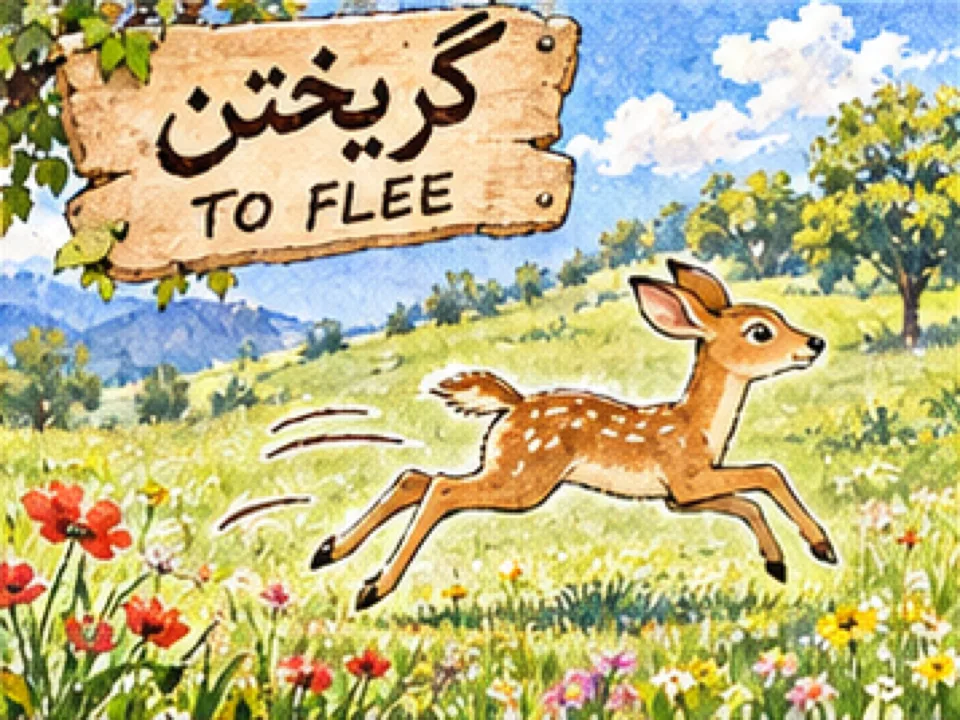
200 Most Common Persian Verbs
گُریختَن
Watch and listen to Reza Nazari explain this verb. More in the free 200 Persian Verbs video course.
Scape – Run away
مُتَرادِفِ فارسی: فَرار کَردَن
مُتَضادِ فارسی: پابَرجا ماندَن – ایِستادِگی کَردَن
:صَرف
گُذَشتِه: گُریختَم – گُریختی – گُریخت – گُریختیم – گُریختید – گُریختَند
حال: می گُریزَم – می گُریزی – می گُریزَد – می گُریزیم – می گُریزید
می گُریزَند
:مِثال
.زِندانی اَز زِندان گُریخت
.تو اَز نَصیحَتهایِ پِدَرَت می گُریزی
گریختن (gorikhtan) means "to flee" or "to run away" in Persian. See its irregular stem, conjugation, examples, phrases and a quiz.
How to use گریختن (gorikhtan)
گریختن is a simple, intransitive verb meaning "to flee" or "to escape". Its present stem is irregular: past گریخت (gorikht), present گریز (goriz), so "he fled" is گریخت (gorikht) and "he flees" is میگریزد (migorizad). The place or danger you escape from takes از: از زندان گریخت ("he escaped from prison").
The verb is literary and formal; you meet it in news, stories and poetry. In everyday speech people say فرار کردن (farâr kardan), or casually در رفتن (dar raftan). It is also used figuratively for avoiding something: از مسئولیت گریختن ("to run away from responsibility"). The same stem appears in گریز (goriz, "escape") and گریزان (gorizân, "fleeing, avoiding").
Verb stems
| Infinitive | گریختن | /gorikhtan/ | to flee, to escape, to run away |
|---|---|---|---|
| Past stem | گریخت | /gorikht/ | used for past tenses |
| Present stem | گریز | /goriz/ | used for present, subjunctive and imperative |
Conjugation of گریختن
| Person | Simple past | Present | Future | Subjunctive |
|---|---|---|---|---|
| من I |
گریختم /gorikhtam/ |
میگریزم /migorizam/ |
خواهم گریخت /khâham gorikht/ |
بگریزم /begorizam/ |
| تو you (sg.) |
گریختی /gorikhti/ |
میگریزی /migorizi/ |
خواهی گریخت /khâhi gorikht/ |
بگریزی /begorizi/ |
| او he / she |
گریخت /gorikht/ |
میگریزد /migorizad/ |
خواهد گریخت /khâhad gorikht/ |
بگریزد /begorizad/ |
| ما we |
گریختیم /gorikhtim/ |
میگریزیم /migorizim/ |
خواهیم گریخت /khâhim gorikht/ |
بگریزیم /begorizim/ |
| شما you (pl./polite) |
گریختید /gorikhtid/ |
میگریزید /migorizid/ |
خواهید گریخت /khâhid gorikht/ |
بگریزید /begorizid/ |
| آنها they |
گریختند /gorikhtand/ |
میگریزند /migorizand/ |
خواهند گریخت /khâhand gorikht/ |
بگریزند /begorizand/ |
Negative and imperative
| Persian | Pronunciation | English |
|---|---|---|
| نگریختم | /nagorikhtam/ | I did not flee |
| نمیگریزم | /nemigorizam/ | I do not flee / I am not fleeing |
| بگریز! | /begoriz!/ | Flee! (to one person) |
| بگریزید! | /begorizid!/ | Flee! (to several people, or politely) |
| نگریز! | /nagoriz!/ | Don't flee! |
The examples above, translated
| Persian | Pronunciation | English |
|---|---|---|
| زندانی از زندان گریخت. | /zendâni az zendân gorikht/ | The prisoner escaped from prison. |
| تو از نصیحتهای پدرت میگریزی. | /to az nasihat-hâ-ye pedarat migorizi/ | You run away from your father's advice. |
| او کیف من را دزدید و گریخت. | /u kif-e man râ dozdid va gorikht/ | He stole my bag and ran away. |
More example sentences
| Persian | Pronunciation | English |
|---|---|---|
| مردم از آتش گریختند. | /mardom az âtash gorikhtand/ | The people fled from the fire. |
| گربه از دست بچهها گریخت. | /gorbe az dast-e bachche-hâ gorikht/ | The cat got away from the children. |
| نمیتوانی از حقیقت بگریزی. | /nemitavâni az haghighat begorizi/ | You can't run away from the truth. |
| سربازان از میدان جنگ نگریختند. | /sarbâzân az meydân-e jang nagorikhtand/ | The soldiers did not flee the battlefield. |
Common phrases
| Persian | Pronunciation | English |
|---|---|---|
| فرار کردن | /farâr kardan/ | to escape, to run away (everyday) |
| گریز | /goriz/ | escape, flight |
| گریزان | /gorizân/ | fleeing, avoiding |
| گریزناپذیر | /goriznâpazir/ | unavoidable, inevitable |
In spoken Persian
گریختن almost never appears in casual speech. Tehran speakers say فرار کرد (farâr kard, "he ran away") or the slangy در رفت (dar raft, "he got away"). If the verb is used, the spoken endings follow the normal pattern: میگریزه (migorize) for میگریزد.
Watch out for
- The present stem is گریز (goriz), not گریخ: میگریزم, بگریز.
- Note: the page's English gloss has a typo ("Scape" for "escape"), and the present-tense list is missing a dash between میگریزید and میگریزند.
Practice
-
Translate into Persian: "The thief fled."
Show answer
dozd gorikht. دزد گریخت.
-
What is the present-tense form for "they"?
Show answer
migorizand میگریزند
-
What does this sentence mean? (It uses the everyday synonym.) او از خانه فرار کرد.
Show answer
He ran away from home.
Related verbs in this course
This is lesson 183 of 200 Most Common Persian Verbs. For the sounds used in the pronunciation guide, see Persian pronunciation.
.او کیفِ مَن را دُزدید وَ گُریخت


Take this lesson further

Study with the book
200 Absolutely Essential Persian Verbs
This free lesson is part of 200 Most Common Persian Verbs. The book puts the whole series in one printable PDF you can study offline.
Serious about Persian? Get all 30 of our Persian learning books for $199.99 (55% less than buying them one by one).
Free Persian Starter Kit (PDF)
The Persian alphabet chart and the 101 most common Persian words with pronunciation, in one printable PDF. You also get a one-time 15% code for any of our books.
We will email you new lessons and book news from Learn Persian Online. Unsubscribe any time.Free: 100 Core Persian Words + 20 Survival Phrases
Get the 14-page printable Starter Pack (all 32 letters, a 7-day reading plan, 100 core words and 20 survival phrases) and a short 5-email course. Free.
Practise with free Persian games