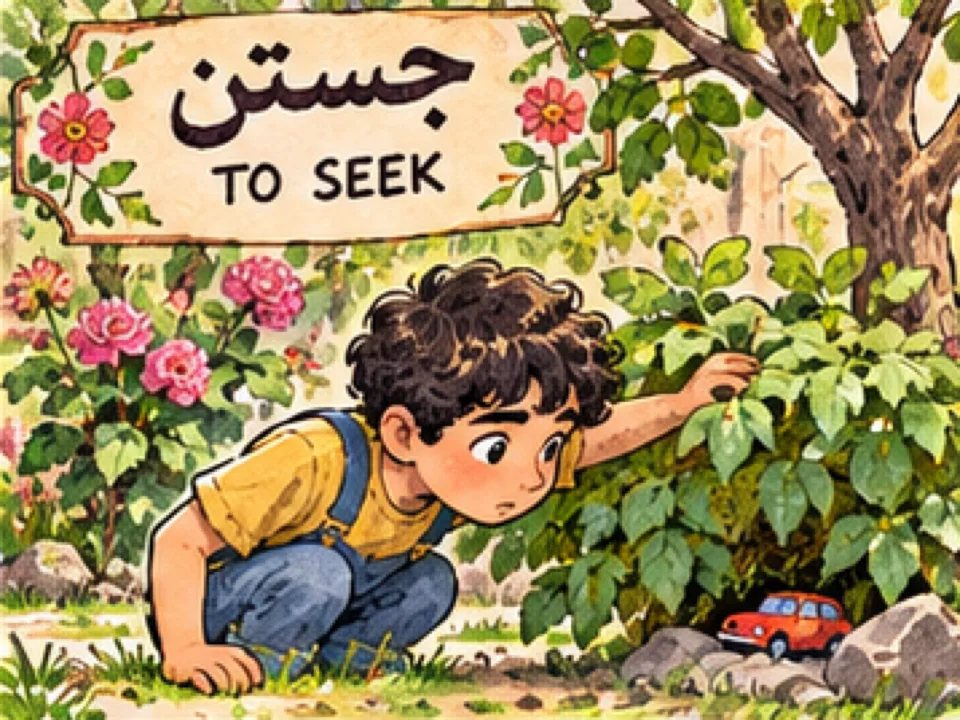
200 Most Common Persian Verbs
جُستَن
Watch and listen to Reza Nazari explain this verb. More in the free 200 Persian Verbs video course.
Scoot – Jump
مُتَرادِفِ فارسی: پَرِش کَردَن
-:مُتَضادِ فارسی
:صَرف
گُذَشتِه: جُستَم – جُستی – جُست – جُستیم – جُستید – جُستَند
حال: می جویَم – می جویی – می جویَد – می جوییم – می جویید – می جویَند
:مِثال
.مَن اَز پلِّه ها بِه پایین جُستَم
.ما اَز حَرفهایِ او بَهرِه جوییدیم
.قورباغِه اَز آب بیرون جُست
جستن (jostan) means "to seek, to look for" in Persian. Learn its stems, full conjugation, examples, common phrases and a short quiz.
How to use جستن (jostan)
جستن read as jostan is a simple transitive verb meaning "to seek, to look for." Its past stem is جست (jost) and its present stem is جو (ju), so "I seek" is میجویم (mijuyam). It is literary; in everyday Persian you would say دنبال چیزی گشتن (donbâl-e chizi gashtan). It lives on in common words such as جستوجو (jostoju, "search") and جوینده (juyande, "seeker").
The same spelling read as jastan is a different verb meaning "to jump, to leap," with present stem جه (jah): میجهد (mijahad), "he jumps." The page mixes the two. Its English gloss and its first and third examples are jastan ("to jump"), while its conjugation table is jostan ("to seek"). This lesson follows the table and gives the jostan forms. For everyday jumping, Persian uses پریدن (paridan).
Verb stems
| Infinitive | جستن | /jostan/ | to seek, to look for (literary) |
|---|---|---|---|
| Past stem | جست | /jost/ | used for past tenses |
| Present stem | جو | /ju/ | used for present, subjunctive and imperative |
Conjugation of جستن
| Person | Simple past | Present | Future | Subjunctive |
|---|---|---|---|---|
| من I |
جستم /jostam/ |
میجویم /mijuyam/ |
خواهم جست /khâham jost/ |
بجویم /bejuyam/ |
| تو you (sg.) |
جستی /josti/ |
میجویی /mijuyi/ |
خواهی جست /khâhi jost/ |
بجویی /bejuyi/ |
| او he / she |
جست /jost/ |
میجوید /mijuyad/ |
خواهد جست /khâhad jost/ |
بجوید /bejuyad/ |
| ما we |
جستیم /jostim/ |
میجوییم /mijuyim/ |
خواهیم جست /khâhim jost/ |
بجوییم /bejuyim/ |
| شما you (pl./polite) |
جستید /jostid/ |
میجویید /mijuyid/ |
خواهید جست /khâhid jost/ |
بجویید /bejuyid/ |
| آنها they |
جستند /jostand/ |
میجویند /mijuyand/ |
خواهند جست /khâhand jost/ |
بجویند /bejuyand/ |
Negative and imperative
| Persian | Pronunciation | English |
|---|---|---|
| نجستم | /najostam/ | I did not seek |
| نمیجویم | /nemijuyam/ | I do not seek / I am not seeking |
| بجو! | /beju!/ | Seek! (to one person) |
| بجویید! | /bejuyid!/ | Seek! (to several people, or politely) |
| نجو! | /naju!/ | Don't seek! |
The examples above, translated
| Persian | Pronunciation | English |
|---|---|---|
| من از پلهها به پایین جستم. | /man az pelle-hâ be pâyin jastam./ | I jumped down the stairs. |
| ما از حرفهای او بهره جستیم. | /mâ az harf-hâ-ye u bahre jostim./ | We benefited from what he said. |
| قورباغه از آب بیرون جست. | /ghurbâghe az âb birun jast./ | The frog jumped out of the water. |
More example sentences
| Persian | Pronunciation | English |
|---|---|---|
| او همیشه راه تازهای میجوید. | /u hamishe râh-e tâze-i mijuyad./ | He is always looking for a new way. |
| پزشکان راهی برای درمان این بیماری میجویند. | /pezeshkân râhi barâye darmân-e in bimâri mijuyand./ | Doctors are seeking a way to treat this disease. |
| او از دوستش یاری جست. | /u az dustash yâri jost./ | He sought help from his friend. |
| از این فرصت بهره جستیم. | /az in forsat bahre jostim./ | We made use of this opportunity. |
Common phrases
| Persian | Pronunciation | English |
|---|---|---|
| جستوجو کردن | /jostoju kardan/ | to search |
| بهره جستن | /bahre jostan/ | to make use of, to benefit from |
| جوینده یابنده است | /juyande yâbande ast/ | seek and you shall find (literally "the seeker is a finder") |
| جوینده | /juyande/ | seeker |
In spoken Persian
جستن is not used in everyday speech. To say you are looking for something, Tehranis say دنبالش میگردم (donbâlesh migardam), "I'm looking for it." For jumping they use پریدن: از رو جوب پرید (az ru jub parid), "He jumped over the gutter."
Watch out for
- Note: جستن has two readings. Jostan means "to seek" (present میجوید, mijuyad), while jastan means "to jump" (present میجهد, mijahad). The page gives "jump" as the meaning but the "seek" conjugation.
- Note: the page's second example has بهره جوییدیم, which is not a real form. The past of بهره جستن is بهره جستیم (bahre jostim), "we made use of," shown above.
Practice
-
Translate into Persian: "He sought help."
Show answer
u yâri jost. او یاری جست.
-
Give the present form for "they".
Show answer
mijuyand میجویند
-
What does this proverb mean? جوینده یابنده است.
Show answer
Seek and you shall find (the seeker is a finder).
Related verbs in this course
This is lesson 77 of 200 Most Common Persian Verbs. For the sounds used in the pronunciation guide, see Persian pronunciation.


Take this lesson further

Study with the book
200 Absolutely Essential Persian Verbs
This free lesson is part of 200 Most Common Persian Verbs. The book puts the whole series in one printable PDF you can study offline.
Serious about Persian? Get all 30 of our Persian learning books for $199.99 (55% less than buying them one by one).
Free Persian Starter Kit (PDF)
The Persian alphabet chart and the 101 most common Persian words with pronunciation, in one printable PDF. You also get a one-time 15% code for any of our books.
We will email you new lessons and book news from Learn Persian Online. Unsubscribe any time.Free: 100 Core Persian Words + 20 Survival Phrases
Get the 14-page printable Starter Pack (all 32 letters, a 7-day reading plan, 100 core words and 20 survival phrases) and a short 5-email course. Free.
Practise with free Persian games