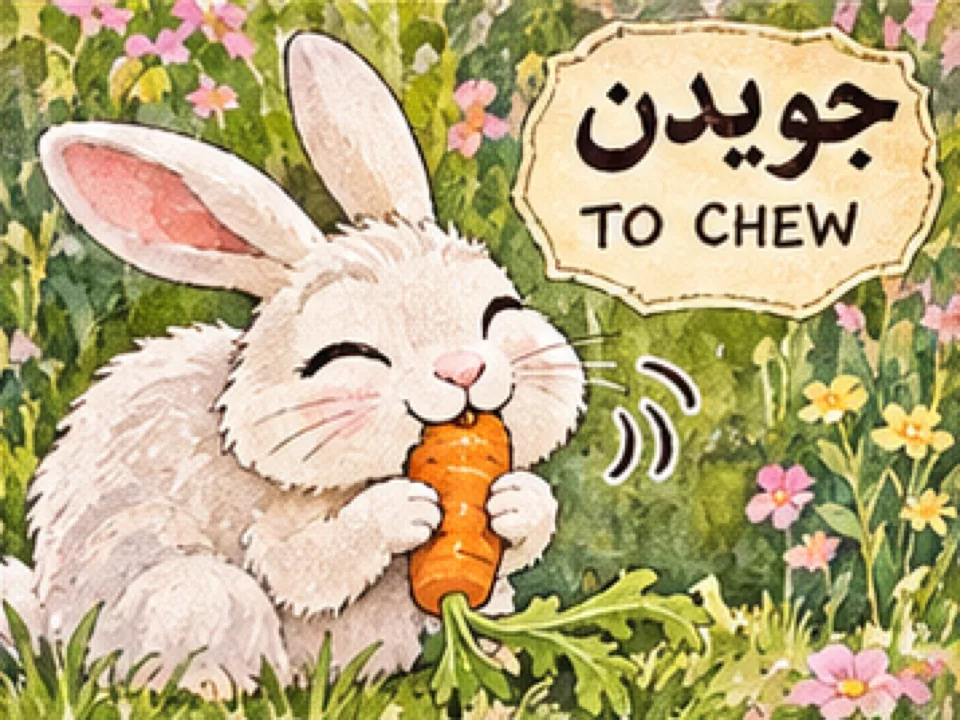
200 Most Common Persian Verbs
جَویدَن
Watch and listen to Reza Nazari explain this verb. More in the free 200 Persian Verbs video course.
Chew – Chaw
مُتَرادِفِ فارسی: گاز زدن
-:مُتَضادِ فارسی
:صَرف
گُذَشتِه: جَویدَم – جَویدی – جَوید – جَویدیم – جَویدید – جَویدَند
حال: می جَوَم – می جَوی – می جَوَد – می جَویم – می جَوید – می جَوَند
:مِثال
.بَچِه هایِ خیلی کوچَک غَذا را نِمی تَوانَند بِجَوَند
.غَذا را بایَد خوب جَوید بَعد خورد
جویدن (javidan) means "to chew" in Persian. Learn its stems, full conjugation, examples, common phrases and a short quiz.
How to use جویدن (javidan)
جویدن is a simple transitive verb. Its past stem is جوید (javid) and its present stem is جو (jav), so "I chew" is میجوم (mijavam) and "he chews" is میجود (mijavad). A definite object takes را: غذایت را خوب بجو, "chew your food well."
The verb is everyday and literal: chewing food, gum, a pen or your nails. Don't confuse it with گاز زدن (gâz zadan), "to bite," which the page lists as a synonym: you bite with گاز زدن and then chew with جویدن. Swallowing is قورت دادن (ghurt dâdan). Animals that chew the cud نشخوار میکنند (noshkhâr mikonand), a word also used for going over the same thoughts again and again.
Verb stems
| Infinitive | جویدن | /javidan/ | to chew |
|---|---|---|---|
| Past stem | جوید | /javid/ | used for past tenses |
| Present stem | جو | /jav/ | used for present, subjunctive and imperative |
Conjugation of جویدن
| Person | Simple past | Present | Future | Subjunctive |
|---|---|---|---|---|
| من I |
جویدم /javidam/ |
میجوم /mijavam/ |
خواهم جوید /khâham javid/ |
بجوم /bejavam/ |
| تو you (sg.) |
جویدی /javidi/ |
میجوی /mijavi/ |
خواهی جوید /khâhi javid/ |
بجوی /bejavi/ |
| او he / she |
جوید /javid/ |
میجود /mijavad/ |
خواهد جوید /khâhad javid/ |
بجود /bejavad/ |
| ما we |
جویدیم /javidim/ |
میجویم /mijavim/ |
خواهیم جوید /khâhim javid/ |
بجویم /bejavim/ |
| شما you (pl./polite) |
جویدید /javidid/ |
میجوید /mijavid/ |
خواهید جوید /khâhid javid/ |
بجوید /bejavid/ |
| آنها they |
جویدند /javidand/ |
میجوند /mijavand/ |
خواهند جوید /khâhand javid/ |
بجوند /bejavand/ |
Negative and imperative
| Persian | Pronunciation | English |
|---|---|---|
| نجویدم | /najavidam/ | I did not chew |
| نمیجوم | /nemijavam/ | I do not chew / I am not chewing |
| بجو! | /bejav!/ | Chew! (to one person) |
| بجوید! | /bejavid!/ | Chew! (to several people, or politely) |
| نجو! | /najav!/ | Don't chew! |
The examples above, translated
| Persian | Pronunciation | English |
|---|---|---|
| بچههای خیلی کوچک غذا را نمیتوانند بجوند. | /bachche-hâ-ye kheyli kuchak ghazâ râ nemitavânand bejavand./ | Very young children can't chew food. |
| غذا را باید خوب جوید بعد خورد. | /ghazâ râ bâyad khub javid ba'd khord./ | Food should be chewed well before it is eaten. |
| آن اسب علفها را جوید. | /ân asb alaf-hâ râ javid./ | That horse chewed the grass. |
More example sentences
| Persian | Pronunciation | English |
|---|---|---|
| غذایت را آهسته بجو. | /ghazâyat râ âheste bejav./ | Chew your food slowly. |
| او سر کلاس آدامس میجود. | /u sar-e kelâs âdâms mijavad./ | She chews gum in class. |
| سگ کفش مرا جوید. | /sag kafsh-e marâ javid./ | The dog chewed my shoe. |
| وقتی استرس دارم، ناخنهایم را میجوم. | /vaghti esteres dâram, nâkhon-hâyam râ mijavam./ | When I'm stressed, I bite my nails. |
Common phrases
| Persian | Pronunciation | English |
|---|---|---|
| آدامس جویدن | /âdâms javidan/ | to chew gum |
| ناخن جویدن | /nâkhon javidan/ | to bite one's nails |
| نشخوار کردن | /noshkhâr kardan/ | to chew the cud; to ruminate |
| گاز زدن | /gâz zadan/ | to bite |
In spoken Persian
In Tehran speech the present is میجوم (mijavam), میجوه (mijave), میجون (mijavan). Parents often say خوب بجو (khub bejav), "Chew well."
Watch out for
- The present stem is جو (jav): میجود (mijavad), "he chews," not "mijuyad."
- Note: the page lists گاز زدن as a synonym, but it means "to bite," not "to chew."
Practice
-
Translate into Persian: "I chewed the bread."
Show answer
man nân râ javidam. من نان را جویدم.
-
Give the imperative for one person ("Chew!").
Show answer
bejav! بجو!
-
What does this sentence mean? بچه غذایش را نجوید.
Show answer
The child didn't chew his (or her) food.
Related verbs in this course
This is lesson 82 of 200 Most Common Persian Verbs. For the sounds used in the pronunciation guide, see Persian pronunciation.
.آن اَسب عَلَف ها را جَوید


Take this lesson further

Study with the book
200 Absolutely Essential Persian Verbs
This free lesson is part of 200 Most Common Persian Verbs. The book puts the whole series in one printable PDF you can study offline.
Serious about Persian? Get all 30 of our Persian learning books for $199.99 (55% less than buying them one by one).
Free Persian Starter Kit (PDF)
The Persian alphabet chart and the 101 most common Persian words with pronunciation, in one printable PDF. You also get a one-time 15% code for any of our books.
We will email you new lessons and book news from Learn Persian Online. Unsubscribe any time.Free: 100 Core Persian Words + 20 Survival Phrases
Get the 14-page printable Starter Pack (all 32 letters, a 7-day reading plan, 100 core words and 20 survival phrases) and a short 5-email course. Free.
Practise with free Persian games