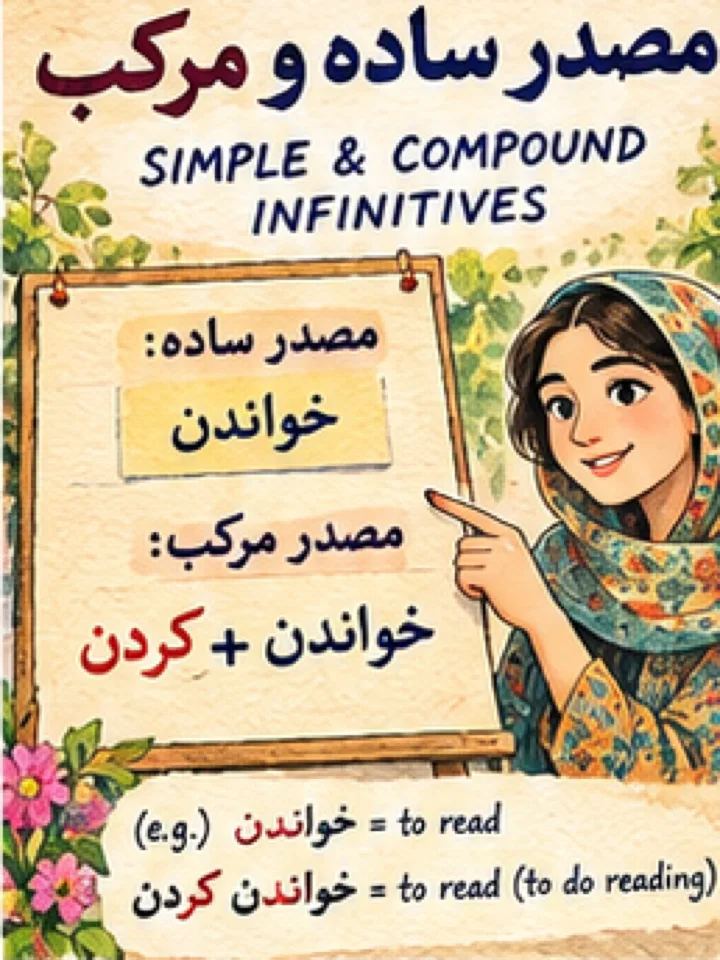
Learn how Persian infinitives end in -tan, -dan and -idan, how compound verbs like kâr kar
Simple and compound Infinitives
Simple Infinitives
Farsi infinitives end with letter “ن”.Simple infinitives have one word:
| Englis | Pronunciation | Persian |
| To become | /shodan/ | شُدَن |
| To see | /didan/ | دیدَن |
| To write | /neveshtan/ | نِوِشتَن |
| To go | /raftan/ | رَفتَن |
| To say | /goftan/ | گُفتَن |
| To hear |
/shenidan/ |
شِنیدَن |
Compound Infinitives
A compound infinitive is a combination of a verb and noun or adjective.
| English | Pronunciation | Persian |
| To live |
/zendegi kardan/ |
زِندِگی کَردَن |
| To talk | /goftegu kardan/ | گُفتِگو کَردَن |
| To wake up | /bidâr shodan/ | بیدار شُدَن |
| To fly | /parvâz kardan/ | پَرواز کَردَن |
| To see | /negah kardan/ | نِگاه کَردَن |
| To advise | /pand dâdan/ | پَند دادن |
Learn how Persian infinitives end in -tan, -dan and -idan, how compound verbs like kâr kardan work, and where mi- and na- go in them.
Simple and compound infinitives
The infinitive (مصدر, masdar) is the dictionary form of a Persian verb, like "to go" in English. Every Persian infinitive ends in ن (n), in one of three endings: -tan, -dan or -idan. Persian has two kinds of verbs: simple verbs, which are one word, and compound verbs, which are made of two parts. Compound verbs are extremely common; many everyday actions are expressed with them.
Simple infinitives
| Persian | Pronunciation | English |
|---|---|---|
| رفتن | /raftan/ | to go (-tan) |
| گفتن | /goftan/ | to say (-tan) |
| نوشتن | /neveshtan/ | to write (-tan) |
| خوردن | /khordan/ | to eat (-dan) |
| آمدن | /âmadan/ | to come (-dan) |
| دیدن | /didan/ | to see (-dan) |
| شنیدن | /shenidan/ | to hear (-idan) |
| خریدن | /kharidan/ | to buy (-idan) |
Remove the final ن and you have the past stem: رفتن → رفت (raft). The present stem has to be learned separately (lesson 11).
Compound infinitives
A compound verb joins a word that carries the meaning (a noun, adjective or short phrase) with a common "light" verb that carries the grammar. The light verbs you will meet most are کردن (kardan), شدن (shodan), دادن (dâdan), زدن (zadan), داشتن (dâshtan), گرفتن (gereftan) and کشیدن (keshidan).
| Persian | Pronunciation | English |
|---|---|---|
| کار کردن | /kâr kardan/ | to work |
| صحبت کردن | /sohbat kardan/ | to talk, to speak |
| گوش دادن | /gush dâdan/ | to listen |
| حرف زدن | /harf zadan/ | to talk |
| دوست داشتن | /dust dâshtan/ | to like, to love |
| دوش گرفتن | /dush gereftan/ | to take a shower |
| عکس گرفتن | /'aks gereftan/ | to take a photo |
| سیگار کشیدن | /sigâr keshidan/ | to smoke |
| بیدار شدن | /bidâr shodan/ | to wake up |
| خسته شدن | /khaste shodan/ | to get tired |
How compound verbs behave
- Only the light verb is conjugated: کار میکنم (kâr mikonam), "I work"; کار کردم (kâr kardam), "I worked".
- The prefixes می, نـ and بـ go on the light verb, never on the first word: کار نمیکنم (kâr nemikonam), "I don't work".
- کردن usually means doing something to something, شدن a change that happens: تمام کردن (tamâm kardan), "to finish (something)", vs. تمام شدن (tamâm shodan), "to be finished, to end".
- In a dictionary, look up the first word: زندگی کردن is listed under زندگی.
The infinitive as a noun
An infinitive can also work like an English "-ing" noun: خواندن (khândan), "reading"; شنا کردن (shenâ kardan), "swimming". It can take an ezâfe and an object after it: خواندنِ فارسی (khândan-e fârsi), "reading Persian".
Example sentences
| Persian | Pronunciation | English |
|---|---|---|
| من هر روز کار میکنم. | /man har ruz kâr mikonam./ | I work every day. |
| او فارسی صحبت میکند. | /u fârsi sohbat mikonad./ | He / She speaks Persian. |
| ما به موسیقی گوش میدهیم. | /mâ be musighi gush midahim./ | We listen to music. |
| من قهوه دوست ندارم. | /man ghahve dust nadâram./ | I don't like coffee. |
| آنها صبح زود بیدار میشوند. | /ânhâ sobh-e zud bidâr mishavand./ | They wake up early in the morning. |
| خواندنِ فارسی سخت نیست. | /khândan-e fârsi sakht nist./ | Reading Persian isn't hard. |
| هواپیما ساعتِ پنج پرواز میکند. | /havâpeymâ sâ'at-e panj parvâz mikonad./ | The plane takes off at five. |
| لطفاً به من نگاه کن. | /lotfan be man negâh kon./ | Please look at me. |
| فیلم تمام شد. | /film tamâm shod./ | The film ended. |
Spoken Persian
Compound verbs work the same way in speech; only the light verb takes spoken endings: کار میکنه (kâr mikone), "he / she works"; بیدار میشم (bidâr misham), "I wake up"; گوش بده (gush bede), "listen". Speakers often prefer حرف زدن (harf zadan) to the more formal صحبت کردن.
Common mistakes
- Putting می in front of the noun: میزندگی کنم is wrong; say زندگی میکنم.
- Mixing up کردن and شدن: بیدار کردن is "to wake someone up", بیدار شدن is "to wake up".
- Translating word by word. گوش دادن is literally "to give ear" but simply means "to listen".
- Confusing نگاه کردن, "to look at", with دیدن, "to see".
- Previous: polite pronouns (lesson 13)
- Next: short forms of "to be" (lesson 15)
- Persian grammar lessons
Practice
-
Is {{شنیدن}} simple or compound? شنیدن
Show answer
Simple: one word, "to hear".
-
Say "I don't work".
Show answer
kâr nemikonam کار نمیکنم
-
What does {{گوش دادن}} mean? گوش دادن
Show answer
to listen
-
Which light verb makes "to wake up" (by yourself)?
Show answer
shodan: bidâr shodan بیدار شدن
-
Translate: "We talk Persian." (with harf zadan)
Show answer
mâ fârsi harf mizanim. ما فارسی حرف میزنیم.
See all the lessons in this series on the Persian grammar page.


Take this lesson further

Study with the book
Farsi Grammar in Use: For Beginners
This free lesson is part of Persian grammar lessons. The book puts the whole series in one printable PDF you can study offline.
Serious about Persian? Get all 30 of our Persian learning books for $199.99 (55% less than buying them one by one).
Free Persian Starter Kit (PDF)
The Persian alphabet chart and the 101 most common Persian words with pronunciation, in one printable PDF. You also get a one-time 15% code for any of our books.
We will email you new lessons and book news from Learn Persian Online. Unsubscribe any time.Free: Persian Alphabet + 100 Core Words (PDF)
Get the 14-page printable Starter Pack (all 32 letters, a 7-day reading plan, 100 core words and 20 survival phrases) and a short 5-email course. Free.