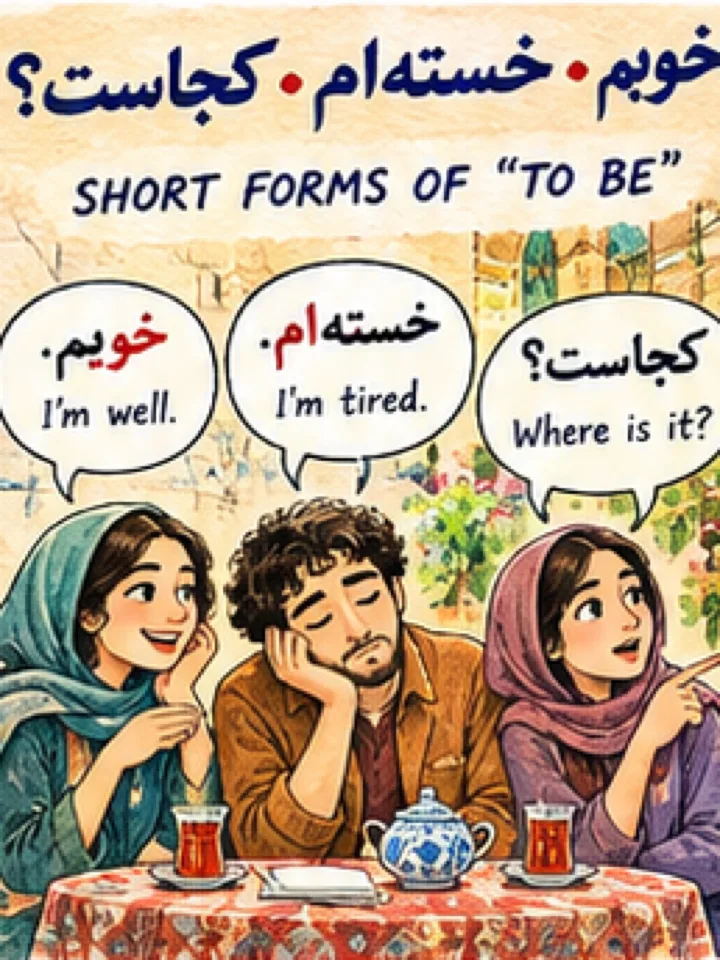
Learn the short (joined) forms of “to be” in Persian: -am, -i, -im, -id, -and, how they at
Joined form of verb “to be”
|
اُستاد هَستَم /ostâd hastam/ |
= |
اُستادَم
/ostâdam/ |
I am a teacher. |
|
خوب هَستَم /khub hastam/ |
= |
خوبَم
/khubam/ |
I’m good. |
|
ایرانی هَستَم /irâni hastam/ |
= |
ایرانیَم
/iraniam/ |
I’m Iranian. |
|
دوست هَستید /dust hastid/ |
= |
دوستید /dustid/ |
You are friends. |
|
چِطور هَستی؟ /chertor hasti?/ |
= |
چِطوری؟ /chetori?/ |
How are you? |
|
کُجا هَست؟ /kojâ hast?/ |
= |
کُجاست؟ /kojâst?/ |
Where is it? |
Exercise20: Join form of verb “to be”.
1. خوب هستم..
2. پزشک هستم.
3. تهرانی هستم.
4. بچه هست.
Learn the short (joined) forms of "to be" in Persian: -am, -i, -im, -id, -and, how they attach after consonants and vowels, and how they sound in speech.
The joined form of "to be"
Besides the full forms هستم، هستی، است (lesson 7), Persian has short forms of "to be" that attach directly to the word before them. خوب هستم (khub hastam) and خوبم (khubam) both mean "I'm good"; the short form is what people normally say, and it is common in writing, too. The short endings are almost the same as the present verb endings: -am, -i, -ast, -im, -id, -and.
After a consonant
| Persian | Pronunciation | English |
|---|---|---|
| خوبم | /khubam/ | I'm good |
| خوبی | /khubi/ | you're good |
| خوب است | /khub ast/ | he / she is good (written separately) |
| خوبیم | /khubim/ | we're good |
| خوبید | /khubid/ | you (pl.) are good |
| خوبند | /khuband/ | they're good |
The third person is the exception: in writing it stays the separate word است. After â and u it joins as -st (lesson 8): کجاست (kojâst).
After a vowel
How the ending attaches depends on the last letter of the word:
| Written form | Pronunciation | Rule |
|---|---|---|
| دانشجویم / دانشجویی / دانشجوست | /dâneshjuyam / dâneshjuyi / dâneshjust/ | after â or u: a y sound is added (I am / you are / he is a student) |
| خستهام / خستهای / خسته است | /khaste-am / khaste-i / khaste ast/ | after silent ه: write ا after a half-space (I am / you are / he is tired) |
| ایرانیام / ایرانیای / ایرانی است | /irâni-am / irâni-i / irâni ast/ | after -i: write ا after a half-space (I am / you are / he is Iranian) |
| خستهایم / خستهاید / خستهاند | /khaste-im / khaste-id / khaste-and/ | plural after silent ه |
The negative has no short form. You always use نیستم، نیستی، نیست: خسته نیستم (khaste nistam), "I'm not tired".
The page's examples, explained
| Persian | Pronunciation | English |
|---|---|---|
| استاد هستم = استادم | /ostâd hastam = ostâdam/ | I am a teacher. |
| خوب هستم = خوبم | /khub hastam = khubam/ | I'm good. |
| ایرانی هستم = ایرانیام | /irâni hastam = irâni-am/ | I'm Iranian. |
| دوست هستید = دوستید | /dust hastid = dustid/ | You are friends. |
| چطور هستی؟ = چطوری؟ | /chetor hasti? = chetori?/ | How are you? |
| کجا هست؟ = کجاست؟ | /kojâ hast? = kojâst?/ | Where is it? |
More examples
| Persian | Pronunciation | English |
|---|---|---|
| من خستهام. | /man khaste-am./ | I'm tired. |
| تو کجایی؟ | /to kojâyi?/ | Where are you? |
| ما آمادهایم. | /mâ âmâde-im./ | We're ready. |
| شما معلمید؟ | /shomâ mo'allemid?/ | Are you a teacher? |
| آنها دانشجویند. | /ânhâ dâneshjuyand./ | They're students. |
| من گرسنهام. | /man gorosne-am./ | I'm hungry. |
| تو خیلی مهربانی. | /to kheyli mehrabâni./ | You're very kind. |
| ما ایرانیایم. | /mâ irâni-im./ | We're Iranian. |
| من اهلِ تهرانم. | /man ahl-e tehrânam./ | I'm from Tehran. |
Spoken Persian
Speech uses the short forms almost always. The third person becomes -e after a consonant: خوبه (khube), "it's good". After a vowel it is -e or -ye: ایرانیه (irâniye), "he / she is Iranian". After â it stays -s(t): کجاس؟ (kojâs?). The plurals are -in and -an: خستهاین؟ (khaste-in?), "Are you tired?"; خوبن (khuban), "they're good".
Common mistakes
- Making a short negative. There is none: say خوب نیستم, not نخوبم.
- Writing ایرانیم for "I am Iranian". It is ambiguous, because it can also be read irânim, "we are Iranian". Write ایرانیام.
- Joining after a silent ه without the alef: write خستهام, not خستم.
- Forgetting the y sound after â and u: دانشجویم, not دانشجوم, in writing.
Do the exercise on this page, then check your answers.
- Lesson 15 answers, explained
- Previous: simple and compound infinitives (lesson 14)
- Next: the object marker râ (lesson 16)
Practice
-
Shorten: {{گرسنه هستی؟}} گرسنه هستی؟
Show answer
gorosne-i? "Are you hungry?" گرسنهای؟
-
Shorten: {{ما معلم هستیم.}} ما معلم هستیم.
Show answer
mâ mo'allemim. "We're teachers." ما معلمیم.
-
Is there a short form of {{نیستم}}? نیستم
Show answer
No. The negative is always nistam, nisti, nist, and so on.
-
How do you say "it's good" in spoken Persian?
Show answer
khube خوبه
-
Shorten: {{شما کجا هستید؟}} شما کجا هستید؟
Show answer
shomâ kojâyid? "Where are you?" شما کجایید؟
See all the lessons in this series on the Persian grammar page.


Take this lesson further

Study with the book
Farsi Grammar in Use: For Beginners
This free lesson is part of Persian grammar lessons. The book puts the whole series in one printable PDF you can study offline.
Serious about Persian? Get all 30 of our Persian learning books for $199.99 (55% less than buying them one by one).
Free Persian Starter Kit (PDF)
The Persian alphabet chart and the 101 most common Persian words with pronunciation, in one printable PDF. You also get a one-time 15% code for any of our books.
We will email you new lessons and book news from Learn Persian Online. Unsubscribe any time.Free: Persian Alphabet + 100 Core Words (PDF)
Get the 14-page printable Starter Pack (all 32 letters, a 7-day reading plan, 100 core words and 20 survival phrases) and a short 5-email course. Free.