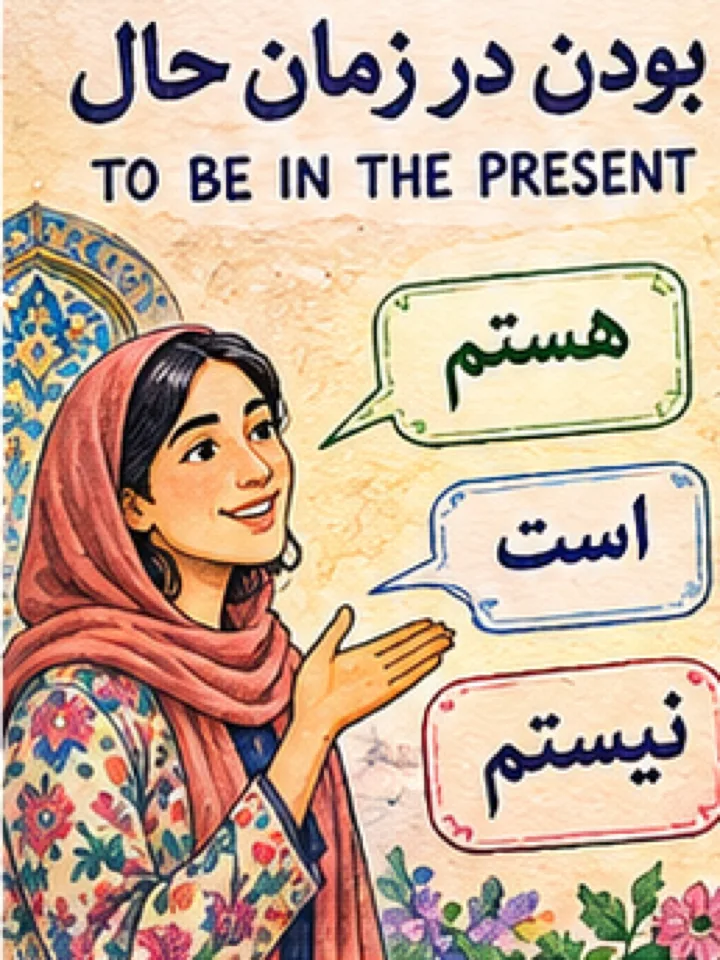
Learn the present tense of “to be” in Persian: hastam, hasti, ast, the negative nistam, wo
Simple Present
| هستیم | دانِشجو | ما |
| Verb | object | subject |
Example:
| persian | Pronunciation | English |
| .مَن اُستاد هَستَم | /man ostâd hastam/ | I am a teacher. |
| .اِسمِ مَن سارا اَست | /esme man sârâ ast/ | My name is Sarah. |
| .این میز اَست | /in miz ast/ | This is a table. |
| .ما دانِشجو نیستیم | /mâ dâneshju nistim/ | We are not students. |
| .شُما اُستاد هَستید | /shomâ ostâd hastid/ | You are teachers. |
| .آن کِتاب اَست | /ân ketâb ast/ | That is a book. |
Exercise11: complete with Simple Present.
| است | مثال: این کتاب |
| ………………….. | 1. ندا استاد |
| ………………….. | 2. آن دفتر |
| ………………….. | 3. اسم من سارا |
| ………………….. | 4. شما دانشجو |
| ………………….. | 5. ما پزشک |
Learn the present tense of "to be" in Persian: hastam, hasti, ast, the negative nistam, word order, spoken forms and common learner mistakes.
The present tense of "to be" in Persian
To say "I am a teacher", "this is a book" or "we are not students", Persian uses the present tense of بودن (budan), "to be". It has two sets of forms: the full forms based on هست (hast), taught in this lesson, and short endings such as خوبم (khubam), "I'm fine", taught in lesson 15. The full forms are the clearest place to start.
Word order: the verb comes last
A Persian sentence with "to be" follows the order subject + description + verb. The description (a noun or adjective, called the predicate) sits in the middle, and the verb always closes the sentence: ما دانشجو هستیم (mâ dâneshju hastim), literally "we student are", "We are students". Notice that the noun دانشجو stays singular even though the subject is plural; this is normal in Persian.
All the forms
| Persian | Pronunciation | English |
|---|---|---|
| هستم / نیستم | /hastam / nistam/ | I am / I am not |
| هستی / نیستی | /hasti / nisti/ | you are / you are not |
| است (هست) / نیست | /ast (hast) / nist/ | he, she, it is / is not |
| هستیم / نیستیم | /hastim / nistim/ | we are / we are not |
| هستید / نیستید | /hastid / nistid/ | you (pl.) are / are not |
| هستند / نیستند | /hastand / nistand/ | they are / they are not |
The third person singular has two forms. است (ast) is the normal word for "is". هست (hast) is used for emphasis ("it is so") and to mean "there is, exists": نان هست؟ (nân hast?), "Is there any bread?" The negative of both is نیست (nist).
The page's examples, explained
| Persian | Pronunciation | English |
|---|---|---|
| من استاد هستم. | /man ostâd hastam./ | I am a teacher. (man → hastam) |
| اسمِ من سارا است. | /esm-e man sârâ ast./ | My name is Sara. ("my name" is third person → ast) |
| این میز است. | /in miz ast./ | This is a table. |
| ما دانشجو نیستیم. | /mâ dâneshju nistim./ | We are not students. (negative of hastim) |
| شما استاد هستید. | /shomâ ostâd hastid./ | You are teachers. / You are a teacher. (polite) |
| آن کتاب است. | /ân ketâb ast./ | That is a book. |
More examples
| Persian | Pronunciation | English |
|---|---|---|
| من خسته هستم. | /man khaste hastam./ | I am tired. |
| تو دانشجو هستی؟ | /to dâneshju hasti?/ | Are you a student? |
| هوا سرد است. | /havâ sard ast./ | The weather is cold. |
| ما دوست هستیم. | /mâ dust hastim./ | We are friends. |
| شما ایرانی هستید؟ | /shomâ irâni hastid?/ | Are you Iranian? |
| آنها در خانه هستند. | /ânhâ dar khâne hastand./ | They are at home. |
| من پزشک نیستم. | /man pezeshk nistam./ | I am not a doctor. |
| این خانه بزرگ نیست. | /in khâne bozorg nist./ | This house is not big. |
| کتاب من روی میز است. | /ketâb-e man ru-ye miz ast./ | My book is on the table. |
Spoken Persian
In conversation people rarely say هستم after an adjective or noun. They use the short endings: خستهام (khaste-am), "I'm tired", and for "is" a simple -e: خوبه (khube), "it's good"; این کتابه (in ketâbe), "this is a book". The plural -id and -and become -in and -an: شما ایرانی هستین؟ (shomâ irâni hastin?). The negative نیست stays the same in speech.
Common mistakes
- Putting the verb in the middle, English style: من هستم دانشجو is wrong; say من دانشجو هستم.
- Using هست everywhere for "is". In neutral sentences use است: هوا گرم است.
- Negating with نه: من نه دانشجو هستم is wrong; use نیستم: من دانشجو نیستم.
- Using a singular verb with شما: شما خسته هستید, not شما خسته هستی.
Try the exercise on this page first, then check your work on the answer page.
Practice
-
Complete: {{من ایرانی …}} من ایرانی …
Show answer
hastam: "I am Iranian" من ایرانی هستم.
-
Make negative: {{آنها خسته هستند.}} آنها خسته هستند.
Show answer
ânhâ khaste nistand. آنها خسته نیستند.
-
Translate: "The weather is good."
Show answer
havâ khub ast. هوا خوب است.
-
Which form means "there is": {{است}} or {{هست}}? است / هست
Show answer
hast, as in nân hast? "Is there bread?" هست
-
How would you say "It's good" in spoken Persian?
Show answer
khube خوبه
See all the lessons in this series on the Persian grammar page.
Answer key
Do the exercises above first, then check your answers here.
| هستیم | دانِشجو | ما | |
|
object | subject |
Answer
تمرین: 1. ندا استاد است. 2. آن دفتر است. 3. اسم من سارا است. 4. شما دانشجو هستید 5. ما پزشک هستیم.
Answers to the lesson 7 exercise on the Persian verb "to be", each explained and translated, with a short recap and three extra practice items.
Lesson 7 exercise: the answers explained
The exercise asks you to finish each sentence with the right present form of "to be". The rule is simple: the verb must match the subject. A noun or a name (Neda, "that notebook", "my name") is third person singular and takes است (ast); شما takes هستید (hastid); ما takes هستیم (hastim).
| Answer | Pronunciation | English |
|---|---|---|
| مثال: این کتاب است. | /mesâl: in ketâb ast./ | Example: This is a book. |
| ۱. ندا استاد است. | /1. nedâ ostâd ast./ | Neda is a teacher (professor). |
| ۲. آن دفتر است. | /2. ân daftar ast./ | That is a notebook. |
| ۳. اسم من سارا است. | /3. esm-e man sârâ ast./ | My name is Sara. |
| ۴. شما دانشجو هستید. | /4. shomâ dâneshju hastid./ | You are students. / You are a student. (polite) |
| ۵. ما پزشک هستیم. | /5. mâ pezeshk hastim./ | We are doctors. |
Why each answer is right
- 1. ندا (Neda) is one person who is neither "I" nor "you", so she is third person singular: است.
- 2. آن دفتر (ân daftar), "that notebook", is a thing, third person singular: است. Note that دفتر means "notebook", not "office" here.
- 3. The subject is اسم من (esm-e man), "my name", not من. "My name" is third person, so the verb is است, not هستم. Because سارا ends in â, you can also write اسم من ساراست (lesson 8).
- 4. شما always takes the -id ending: هستید. It can mean several people or one person addressed politely. دانشجو stays singular after a plural subject.
- 5. ما takes -im: هستیم. Again the noun پزشک stays singular.
How you would say them in conversation
| Spoken form | Pronunciation | English |
|---|---|---|
| ندا استاده. | /nedâ ostâde./ | Neda is a teacher. |
| اسمم ساراست. | /esmam sârâst./ | My name is Sara. |
| شما دانشجویین؟ | /shomâ dâneshjuyin?/ | Are you students? |
| ما پزشکیم. | /mâ pezeshkim./ | We're doctors. |
Quick recap
Present of "to be": هستم، هستی، است، هستیم، هستید، هستند (hastam, hasti, ast, hastim, hastid, hastand). Negative: نیستم، نیستی، نیست، نیستیم، نیستید، نیستند. The verb goes at the end of the sentence.
Practice
-
Complete: {{آنها معلم …}} آنها معلم …
Show answer
hastand: "They are teachers." آنها معلم هستند.
-
Complete: {{تو خسته …}} تو خسته …
Show answer
hasti: "You are tired." تو خسته هستی.
-
Make negative: {{رضا پزشک است.}} رضا پزشک است.
Show answer
rezâ pezeshk nist: "Reza is not a doctor." رضا پزشک نیست.


Take this lesson further

Study with the book
Farsi Grammar in Use: For Beginners
This free lesson is part of Persian grammar lessons. The book puts the whole series in one printable PDF you can study offline.
Serious about Persian? Get all 30 of our Persian learning books for $199.99 (0% less than buying them one by one).
Free Persian Starter Kit (PDF)
The Persian alphabet chart and the 101 most common Persian words with pronunciation, in one printable PDF. You also get a one-time 15% code for any of our books.
We will email you new lessons and book news from Learn Persian Online. Unsubscribe any time.Free: Persian Alphabet + 100 Core Words (PDF)
Get the 14-page printable Starter Pack (all 32 letters, a 7-day reading plan, 100 core words and 20 survival phrases) and a short 5-email course. Free.