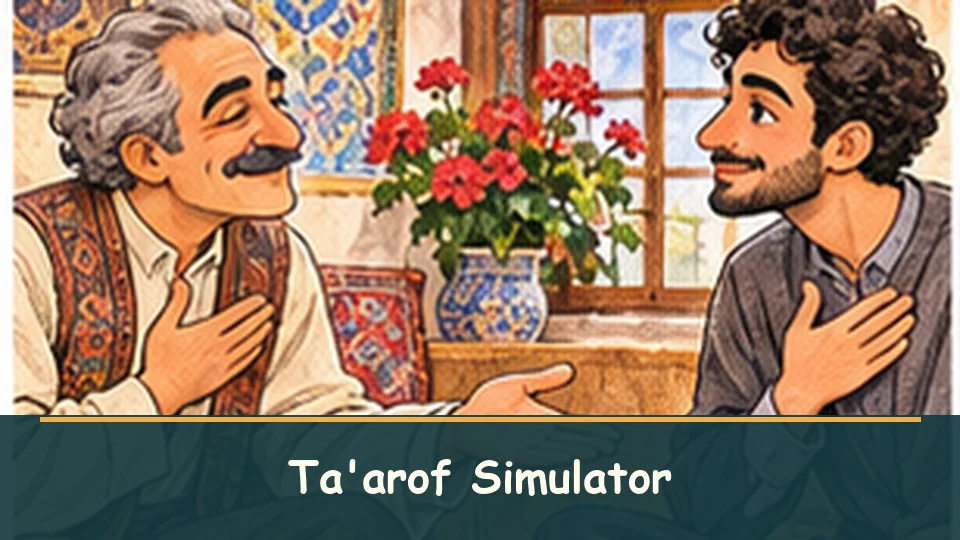
Taarof (تعارف) is the Persian etiquette of offering, refusing and insisting. This free simulator lets you practise it in 10 everyday situations, from tea at a family home to a taxi driver who won’t take your money. Pick your replies in Persian and see how polite and how natural you sound.
40 core taarof phrases with the reply people usually give. Spoken Tehran forms are shown; the written form is in brackets where it differs a lot.
How to play
Choose a situation. The other person speaks first, in natural spoken Tehran Persian with a transliteration and an English translation. You answer by picking one of three or four replies (tap it, or press 1–4 on your keyboard). After each reply you see two scores and a short explanation of how an Iranian listener would hear it. Each situation has several endings, depending on what you say, and finishes with a cultural note. Your best scores and the endings you have found are saved in your browser.
Want a harder game? Tick Challenge to hide the English under your replies, so you have to read the Persian. When your device has a Persian voice, the 🔊 buttons read every line aloud.
Two meters: politeness and naturalness
Taarof is not “the more polite, the better”. The politeness meter asks whether you showed respect: did you thank your host, insist on paying, offer the way at the door? The naturalness meter asks whether a real person would say it in that moment. Refusing tea five times, piling up compliments at the doorstep or sitting on the floor to avoid the best chair are all “polite” on paper and awkward in real life. Good taarof finds the balance: refuse once, accept warmly, play yourself down and the other person up.
For the background (where the word comes from, what scholars say about it and why it matters), read our guide Taarof: the Persian art of politeness. This page is the practice room.
Taarof at a glance
| Situation | They say | A good reply |
|---|---|---|
| Host offers tea | چای میخورین؟ châi mikhorin? | زحمت نکشید (zahmat nakeshid), then accept the second offer |
| Driver or seller won’t take money | قابل نداره ghâbel nadâre | لطف دارید. چقدر تقدیم کنم؟ (lotf dârid. cheghadr taghdim konam?) |
| Thanks for food or help | دستتون درد نکنه dastetun dard nakone | سرتون درد نکنه (saretun dard nakone) |
| Greeting someone at work | خسته نباشید khaste nabâshid | سلامت باشید (salâmat bâshid) |
| Two people at a door | شما بفرمایید shomâ befarmâyid | Offer it back once, then با اجازهتون (bâ ejâze-tun) |
| Someone praises you | چه فارسی خوبی! che fârsi-ye khubi! | لطف دارید (lotf dârid) or نظر لطفتونه (nazar-e lotfetune) |
| Someone eating offers to share | بفرمایید ناهار befarmâyid nâhâr | نوش جان (nush-e jân, “enjoy”) |
| You want to leave | (you start) | دیگه رفع زحمت کنیم (dige raf’-e zahmat konim) |
Why even AI gets taarof wrong
Taarof is hard because the words and the meaning point in different directions: “it’s nothing” means “please pay”, and “no thank you” can mean “ask me again”. A 2025 study presented at EMNLP, We Politely Insist: Your LLM Must Learn the Persian Art of Taarof (Gohari Sadr et al.), built a benchmark of 450 taarof role-play scenarios and found that five leading AI language models scored 40–48% lower than native Persian speakers in situations where taarof was the culturally expected response. Learners face the same trap, which is why this simulator scores naturalness and not just correctness.
Not everyone does it the same way
The dialogues use polite, everyday Tehran Persian. Taarof is shared across Iran, among Persian, Azeri, Kurdish, Baluch and other communities, and in the diaspora, but how much of it people use varies. Close friends and many younger urban Iranians keep it short and may split the bill (dongi) without a fight. Older relatives, formal visits and smaller towns tend to involve more rounds of offering and refusing. Some families open gifts at once; others never do. Afghan (Dari) and Tajik speakers have their own politeness formulas. Treat the scores as a guide, watch what the people around you do, and remember that a warm tone matters more than a perfect phrase.
Ready for real conversations? Farsi Conversations gives you everyday Persian dialogues with the words and phrases people actually use, including the polite ones you met here.
See Farsi ConversationsRelated tools and lessons
- Taarof: Persian politeness explained
- Conversation: coffee or tea? Offering drinks
- Conversation: inviting someone to dinner
- Polite Persian: shomâ instead of to
- Farmudan: the polite verb behind befarmâyid
- Spoken vs written Persian
- Spoken Persian converter
- Persian flashcards
- Persian reader: easy stories
- All free Persian tools
FAQ
What does taarof mean?
Taarof (تعارف, ta’ârof) is the Persian system of ritual politeness: offering and insisting, refusing before accepting, praising others and playing yourself down. It shapes everyday moments such as serving tea, paying, going through doors and saying goodbye.
How many times should I refuse an offer?
Usually once is enough, then accept the second offer with thanks. If you truly don’t want something, say تعارف ندارم (ta’ârof nadâram, “I mean it”) so your host can stop insisting. With close friends and younger people, even one refusal is often skipped.
What should I say when a taxi driver says “ghâbel nadâre”?
Thank him and insist on paying: لطف دارید. خواهش میکنم، چقدر میشه؟ (lotf dârid. khâhesh mikonam, cheghadr mishe?). The phrase is a courtesy, not a free ride. Play the taxi situation above to try it.
Is taarof dishonest?
No. Both sides usually know the script, so nobody is fooled. The offer itself is a kindness, and refusing it at first shows you don’t want to be a burden. Many offers are also completely sincere; the skill is telling which is which.
Do I need to do taarof as a foreigner?
Iranians don’t expect visitors to know every formula, and most are delighted when you try. A few phrases go a long way: دستتون درد نکنه, خسته نباشید, شما بفرمایید, and insisting on paying.
Free Persian Starter Pack: Alphabet + 100 Core Words
Get the 14-page printable Starter Pack (all 32 letters, a 7-day reading plan, 100 core words and 20 survival phrases) and a short 5-email course. Free.