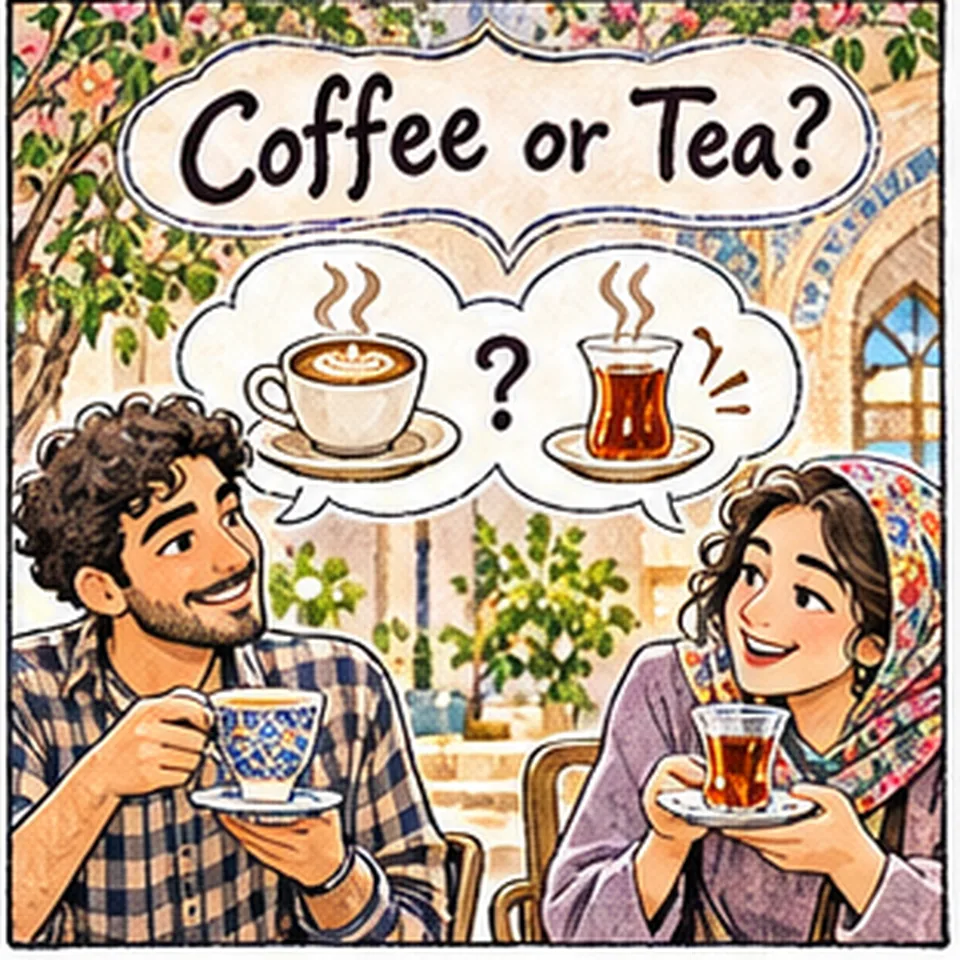
Offer and accept drinks in Persian: coffee or tea, with or without sugar, cake, plus spoke
speaking

| English | Pronunciation | Persian | ||
| Sara: | Would you like coffee or tea? | /to ghahve mikhori yâ chây?/ | تو قهوه میخوری یا چای؟ | :سارا |
| Parisa: | Coffee, thanks. | /ghahve, merci/ | قهوه، مرسی | :پریسا |
| Sara: | With sugar or not? | /bâ shekar yâ bishekar?/ | با شکر یا بیشکر؟ | :سارا |
| Parisa: | With sugar. | /bâ shekar/ | باشکر | :پریسا |
| Sara: | What about cake?do you eat? | /keyk chi? Mikhori biyâram?/ | کیک چی؟ می خوری بیارم؟ | :سارا |
| Parisa: | Yes I eat. | /âre mikhoram/ | آره می خورم | :پریسا |
Offer and accept drinks in Persian: coffee or tea, with or without sugar, cake, plus spoken vs written forms, a culture note and a quiz.
Offering a guest coffee or tea
Sara has Parisa over and offers her something to drink. Parisa chooses coffee with sugar and happily accepts a piece of cake. Offering drinks and sweets is a basic part of hospitality in Iran, so you will hear questions like these in almost any home you visit.
Notice that Persian uses خوردن (khordan), "to eat", for drinks too in everyday speech: قهوه میخوری؟ is "will you have coffee?".
The dialogue
| Speaker | Persian | Pronunciation | English |
|---|---|---|---|
| Sara | تو قهوه میخوری یا چای؟ | /to ghahve mikhori yâ chây?/ | Would you like coffee or tea? |
| Parisa | قهوه، مرسی. | /ghahve, mersi./ | Coffee, thanks. |
| Sara | با شکر یا بیشکر؟ | /bâ shekar yâ bi-shekar?/ | With sugar or without? |
| Parisa | با شکر. | /bâ shekar./ | With sugar. |
| Sara | کیک چی؟ میخوری بیارم؟ | /keyk chi? mikhori biyâram?/ | What about cake? Shall I bring you some? |
| Parisa | آره، میخورم. | /âre, mikhoram./ | Yes, I'd love some. |
Key words and phrases
| Persian | Pronunciation | English |
|---|---|---|
| قهوه | /ghahve/ | coffee |
| چای | /chây/ | tea |
| یا | /yâ/ | or |
| میخوری؟ | /mikhori?/ | will you have? (eat or drink) |
| مرسی | /mersi/ | thanks |
| با | /bâ/ | with |
| بی | /bi-/ | without (prefix) |
| شکر | /shekar/ | sugar |
| کیک | /keyk/ | cake |
| بیارم؟ | /biyâram?/ | shall I bring? |
| آره | /âre/ | yes (casual) |
| میخورم | /mikhoram/ | I'll have, I eat |
Spoken vs written Persian
This dialogue is casual, between two friends. The written or more formal forms are shown second.
| Spoken / written | Pronunciation | Meaning |
|---|---|---|
| چایی / چای | /châyi / chây/ | tea (both are said) |
| بیارم / بیاورم | /biyâram / biyâvaram/ | shall I bring |
| آره / بله | /âre / bale/ | yes |
| مرسی / متشکرم | /mersi / motashakkeram/ | thanks |
| میخوری / مینوشی | /mikhori / minushi/ | you drink (نوشیدن is formal) |
Culture note
Tea is the everyday hot drink in Iran and is usually offered to guests as soon as they arrive. It is often drunk with a sugar cube, قند (ghand), rather than with sugar stirred in. شکر (shekar) is granulated sugar, the kind you would put in coffee.
Grammar note
بیارم (biyâram) is the subjunctive of آوردن (âvardan), "to bring". Used as a question it makes a polite offer: بیارم؟ "shall I bring (it)?". The same pattern works with other verbs: بریزم؟ (berizam?), "shall I pour?". بی (bi-) means "without": بیشکر "sugarless".
Try it yourself
- Offer a friend tea or coffee: چای میخوری یا قهوه؟
- Ask for tea without sugar: چای بیشکر، لطفاً (chây-e bi-shekar, lotfan).
- Politely decline cake: نه، مرسی (na, mersi).
When a host offers you something, you may hear the polite formula بفرمایید (befarmâyid), "please, help yourself". A guest often thanks the host with دستتون درد نکنه (dastetun dard nakone), literally "may your hand not hurt", a common way to thank someone for something they made or served.
Compare how Sara offers the choice with یا (yâ), "or": قهوه میخوری یا چای؟. You can answer with just the word you choose, as Parisa does, followed by a quick مرسی. The same "with or without" pattern works for milk: با شیر یا بیشیر؟ (bâ shir yâ bi-shir?).
Persian also uses the present tense for offers and answers about the near future: میخورم here means "I'll have some".
Practice
-
What does Parisa choose to drink?
Show answer
Coffee with sugar. قهوه با شکر
-
Offer a friend some cake.
Show answer
keyk mikhori biyâram? کیک میخوری بیارم؟
-
What does the prefix {{بی}} mean?
Show answer
without
-
Which verb do Iranians usually use for drinking tea in everyday speech?
Show answer
khordan, "to eat" خوردن
-
What is {{قند}}?
Show answer
A sugar cube, often used with tea.
Find more dialogues in the Farsi conversation lessons series, and review the sounds behind the transliteration on the Persian pronunciation page.


Take this lesson further
Study with the book
Farsi Conversations: Learn the Most Common Words and Phrases Farsi Speakers use Every Day
This free lesson is part of Farsi conversation lessons. The book puts the whole series in one printable PDF you can study offline.
Serious about Persian? Get all 30 of our Persian learning books for $199.99 (55% less than buying them one by one).
Free Persian Starter Kit (PDF)
The Persian alphabet chart and the 101 most common Persian words with pronunciation, in one printable PDF. You also get a one-time 15% code for any of our books.
We will email you new lessons and book news from Learn Persian Online. Unsubscribe any time.Free: 100 Core Persian Words + 20 Survival Phrases
Get the 14-page printable Starter Pack (all 32 letters, a 7-day reading plan, 100 core words and 20 survival phrases) and a short 5-email course. Free.