200 Most Common Persian Verbs
ریختَن
Watch and listen to Reza Nazari explain this verb. More in the free 200 Persian Verbs video course.
Shed – Strew
مُتَرادِفِ فارسی: پاشیدَن
مُتَضادِ فارسی: جَمع کَردَن
:صَرف
گُذَشتِه: ریختَم – ریختی – ریخت – ریختیم – ریختید – ریختَند
حال: می ریزَم – می ریزی – می ریزَد – می ریزیم – می ریزید – می ریزَند
:مِثال
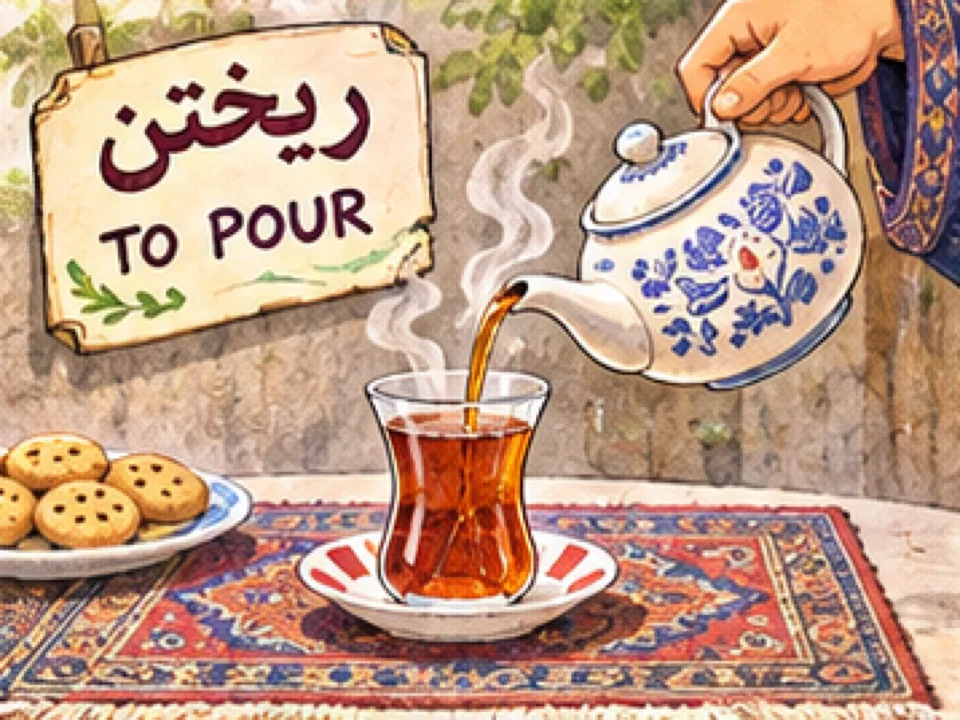
.او دَر لیوان چای ریخت
.مَن بَر رویِ زَمین دانِه ریختَم
.او زَمین خورد وَ بَرگِه هایَش بَر رویِ زَمین ریخت
ریختن (rikhtan) means "to pour" or "to spill" in Persian. See its stems, full conjugation, translated examples, phrases and a quiz.
How to use ریختن (rikhtan)
ریختن is a simple verb with an irregular present stem: the past stem is ریخت (rikht) and the present stem is ریز (riz). Its core meaning is "to pour": چای ریختن (chây rikhtan, "to pour tea"). It also covers "to spill", "to scatter" and "to throw out", as in آشغالها را بیرون ریخت ("he threw the rubbish out").
The verb can be transitive or intransitive. With an object, someone pours or spills something; without one, the thing itself falls or spills: موهایش ریخت ("his hair fell out"), برگها ریختند ("the leaves fell"). It is an everyday word in speech and writing. Don't confuse the stem ریز with the adjective ریز (riz, "tiny").
Verb stems
| Infinitive | ریختن | /rikhtan/ | to pour, to spill, to scatter |
|---|---|---|---|
| Past stem | ریخت | /rikht/ | used for past tenses |
| Present stem | ریز | /riz/ | used for present, subjunctive and imperative |
Conjugation of ریختن
| Person | Simple past | Present | Future | Subjunctive |
|---|---|---|---|---|
| من I |
ریختم /rikhtam/ |
میریزم /mirizam/ |
خواهم ریخت /khâham rikht/ |
بریزم /berizam/ |
| تو you (sg.) |
ریختی /rikhti/ |
میریزی /mirizi/ |
خواهی ریخت /khâhi rikht/ |
بریزی /berizi/ |
| او he / she |
ریخت /rikht/ |
میریزد /mirizad/ |
خواهد ریخت /khâhad rikht/ |
بریزد /berizad/ |
| ما we |
ریختیم /rikhtim/ |
میریزیم /mirizim/ |
خواهیم ریخت /khâhim rikht/ |
بریزیم /berizim/ |
| شما you (pl./polite) |
ریختید /rikhtid/ |
میریزید /mirizid/ |
خواهید ریخت /khâhid rikht/ |
بریزید /berizid/ |
| آنها they |
ریختند /rikhtand/ |
میریزند /mirizand/ |
خواهند ریخت /khâhand rikht/ |
بریزند /berizand/ |
Negative and imperative
| Persian | Pronunciation | English |
|---|---|---|
| نریختم | /narikhtam/ | I did not pour |
| نمیریزم | /nemirizam/ | I do not pour / I am not pouring |
| بریز! | /beriz!/ | Pour! (to one person) |
| بریزید! | /berizid!/ | Pour! (to several people, or politely) |
| نریز! | /nariz!/ | Don't pour! |
The examples above, translated
| Persian | Pronunciation | English |
|---|---|---|
| او در لیوان چای ریخت. | /u dar livân chây rikht./ | She poured tea into the glass. |
| من بر روی زمین دانه ریختم. | /man bar ru-ye zamin dâne rikhtam./ | I scattered seeds on the ground. |
| او زمین خورد و برگههایش بر روی زمین ریخت. | /u zamin khord va barge-hâyash bar ru-ye zamin rikht./ | He fell, and his papers spilled onto the floor. |
More example sentences
| Persian | Pronunciation | English |
|---|---|---|
| لطفاً برای من یک لیوان آب بریز. | /lotfan barâye man yek livân âb beriz./ | Please pour me a glass of water. |
| بچه شیر را روی میز ریخت. | /bachche shir râ ru-ye miz rikht./ | The child spilled the milk on the table. |
| در پاییز برگ درختها میریزد. | /dar pâyiz barg-e derakht-hâ mirizad./ | In autumn the leaves fall from the trees. |
| مادرم در غذا کمی نمک ریخت. | /mâdaram dar ghazâ kami namak rikht./ | My mother put a little salt in the food. |
Common phrases
| Persian | Pronunciation | English |
|---|---|---|
| اشک ریختن | /ashk rikhtan/ | to shed tears |
| به هم ریختن | /be ham rikhtan/ | to mess up; to get upset |
| دور ریختن | /dur rikhtan/ | to throw away |
| خون ریختن | /khun rikhtan/ | to shed blood |
In spoken Persian
In Tehran speech the present ends in -e for "he/she": میریزه (mirize), and میریزن (mirizan) for "they". At the table you will often hear برات چای بریزم؟ (barât chây berizam?, "shall I pour you some tea?"). ریخت به هم (rikht be ham) means "he got upset" or "it got messed up".
Watch out for
- The present stem is ریز: میریزم (mirizam), "I pour". Learners sometimes say میریختم (mirikhtam) for "I pour", but that is the past progressive, "I was pouring".
- Note: the page glosses the verb as "shed, strew". Its most common meanings are "to pour" and "to spill".
Practice
-
Translate into Persian: "I poured the tea."
Show answer
man chây râ rikhtam. من چای را ریختم.
-
Give the imperative "Pour!" for one person.
Show answer
beriz! بریز!
-
What does this sentence mean? اتاقش خیلی به هم ریخته است.
Show answer
His room is very messy.
Related verbs in this course
This is lesson 134 of 200 Most Common Persian Verbs. For the sounds used in the pronunciation guide, see Persian pronunciation.


Take this lesson further

Study with the book
200 Absolutely Essential Persian Verbs
This free lesson is part of 200 Most Common Persian Verbs. The book puts the whole series in one printable PDF you can study offline.
Serious about Persian? Get all 30 of our Persian learning books for $199.99 (55% less than buying them one by one).
Free Persian Starter Kit (PDF)
The Persian alphabet chart and the 101 most common Persian words with pronunciation, in one printable PDF. You also get a one-time 15% code for any of our books.
We will email you new lessons and book news from Learn Persian Online. Unsubscribe any time.Free: 100 Core Persian Words + 20 Survival Phrases
Get the 14-page printable Starter Pack (all 32 letters, a 7-day reading plan, 100 core words and 20 survival phrases) and a short 5-email course. Free.
Practise with free Persian games