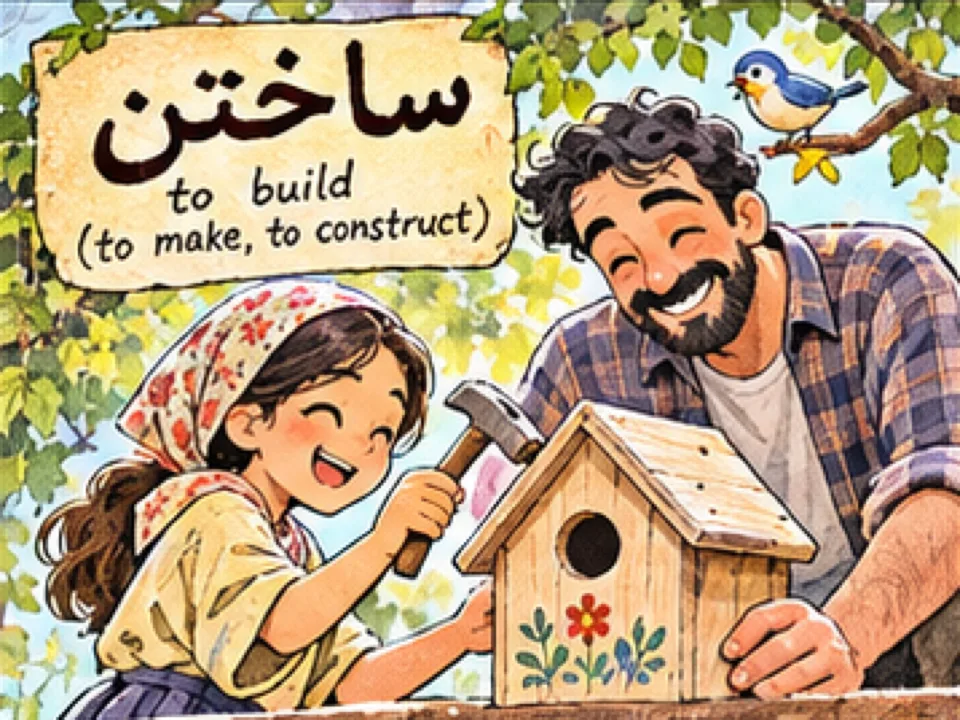
200 Most Common Persian Verbs
ساختَن
Watch and listen to Reza Nazari explain this verb. More in the free 200 Persian Verbs video course.
Establish – Build
مُتَرادِفِ فارسی: دُرست کَردَن – ایجاد کَردَن – بِوجود آوَردَن
مُتَضادِ فارسی: خَراب کَردَن – ویران کَردَن
:صَرف
گُذَشتِه: ساختَم – ساختی – ساخت – ساختیم – ساختید – ساختَند
حال: می سازَم – می سازی – می سازَد – می سازیم – می سازید – می سازَند
:مِثال
.مِعمار یِک خانِه زیبا بَرایِ ما ساخت
.مَن یِک وَسیله بَرقی ساختَم
ساختن (sâkhtan) means "to build, to make" in Persian. Here are its stems, full conjugation, examples with English, common phrases and a short quiz.
How to use ساختن (sâkhtan)
ساختن is a simple transitive verb meaning "to build" or "to make": houses, bridges, furniture, films and even songs. Like many verbs in ختن, its present stem replaces خت with ز: ساز (sâz), so "I build" is میسازم (misâzam). The passive "was built" is ساخته شد (sâkhte shod).
It is neutral and common in speech and writing. For quick, everyday "making" or "fixing", Persians often prefer درست کردن (dorost kardan): شام درست کردم, "I made dinner". ساختن also has an intransitive idiom, با کسی ساختن (bâ kasi sâkhtan), "to get along with someone". Derived words include ساختمان (sâkhtemân, "building") and سازنده (sâzande, "maker; constructive").
Verb stems
| Infinitive | ساختن | /sâkhtan/ | to build, to make |
|---|---|---|---|
| Past stem | ساخت | /sâkht/ | used for past tenses |
| Present stem | ساز | /sâz/ | used for present, subjunctive and imperative |
Conjugation of ساختن
| Person | Simple past | Present | Future | Subjunctive |
|---|---|---|---|---|
| من I |
ساختم /sâkhtam/ |
میسازم /misâzam/ |
خواهم ساخت /khâham sâkht/ |
بسازم /besâzam/ |
| تو you (sg.) |
ساختی /sâkhti/ |
میسازی /misâzi/ |
خواهی ساخت /khâhi sâkht/ |
بسازی /besâzi/ |
| او he / she |
ساخت /sâkht/ |
میسازد /misâzad/ |
خواهد ساخت /khâhad sâkht/ |
بسازد /besâzad/ |
| ما we |
ساختیم /sâkhtim/ |
میسازیم /misâzim/ |
خواهیم ساخت /khâhim sâkht/ |
بسازیم /besâzim/ |
| شما you (pl./polite) |
ساختید /sâkhtid/ |
میسازید /misâzid/ |
خواهید ساخت /khâhid sâkht/ |
بسازید /besâzid/ |
| آنها they |
ساختند /sâkhtand/ |
میسازند /misâzand/ |
خواهند ساخت /khâhand sâkht/ |
بسازند /besâzand/ |
Negative and imperative
| Persian | Pronunciation | English |
|---|---|---|
| نساختم | /nasâkhtam/ | I did not build |
| نمیسازم | /nemisâzam/ | I do not build / I am not building |
| بساز! | /besâz!/ | Build! (to one person) |
| بسازید! | /besâzid!/ | Build! (to several people, or politely) |
| نساز! | /nasâz!/ | Don't build! |
The examples above, translated
| Persian | Pronunciation | English |
|---|---|---|
| معمار یک خانه زیبا برای ما ساخت. | /me'mâr yek khâne-ye zibâ barâye mâ sâkht./ | The architect built a beautiful house for us. |
| من یک وسیله برقی ساختم. | /man yek vasile-ye barghi sâkhtam./ | I made an electrical device. |
| او یک فروشگاه میسازد. | /u yek forushgâh misâzad./ | He is building a store. |
More example sentences
| Persian | Pronunciation | English |
|---|---|---|
| پدربزرگم این خانه را با دست خودش ساخت. | /pedarbozorgam in khâne râ bâ dast-e khodash sâkht./ | My grandfather built this house with his own hands. |
| این کارخانه قطعات ماشین میسازد. | /in kârkhâne ghata'ât-e mâshin misâzad./ | This factory makes car parts. |
| میخواهند اینجا یک پل بسازند. | /mikhâhand injâ yek pol besâzand./ | They want to build a bridge here. |
| او با همکارانش خوب میسازد. | /u bâ hamkârânash khub misâzad./ | He gets along well with his colleagues. |
Common phrases
| Persian | Pronunciation | English |
|---|---|---|
| ساختمان | /sâkhtemân/ | building |
| ساخته شدن | /sâkhte shodan/ | to be built, to be made |
| با کسی ساختن | /bâ kasi sâkhtan/ | to get along with someone |
| فیلم ساختن | /film sâkhtan/ | to make a film |
In spoken Persian
In Tehran speech: میسازه (misâze), "he builds", and با هم نمیسازیم (bâ ham nemisâzim), "we don't get along". A common phrase is این غذا بهم نمیسازه (in ghazâ behem nemisâze), "this food doesn't agree with me".
Watch out for
- The present stem is ساز (sâz): میسازیم (misâzim), بساز (besâz). Do not say "misâkhtam" for the present; that is the past progressive, "I was building".
Practice
-
Translate into Persian: "We built a house."
Show answer
mâ yek khâne sâkhtim. ما یک خانه ساختیم.
-
Give the subjunctive form for "they".
Show answer
besâzand بسازند
-
What does this sentence mean? این غذا به من نمیسازد.
Show answer
This food doesn't agree with me.
Related verbs in this course
- به وجود آوردن (be vojud âvardan): to create, to bring about, to cause
- تولید کردن (tolid kardan): to produce, to manufacture, to generate
- خراب کردن (kharâb kardan): to ruin, to destroy, to break; to tear down
This is lesson 137 of 200 Most Common Persian Verbs. For the sounds used in the pronunciation guide, see Persian pronunciation.
.او یِک فروشگاه می سازَد


Take this lesson further

Study with the book
200 Absolutely Essential Persian Verbs
This free lesson is part of 200 Most Common Persian Verbs. The book puts the whole series in one printable PDF you can study offline.
Serious about Persian? Get all 30 of our Persian learning books for $199.99 (55% less than buying them one by one).
Free Persian Starter Kit (PDF)
The Persian alphabet chart and the 101 most common Persian words with pronunciation, in one printable PDF. You also get a one-time 15% code for any of our books.
We will email you new lessons and book news from Learn Persian Online. Unsubscribe any time.Free: 100 Core Persian Words + 20 Survival Phrases
Get the 14-page printable Starter Pack (all 32 letters, a 7-day reading plan, 100 core words and 20 survival phrases) and a short 5-email course. Free.
Practise with free Persian games