200 Most Common Persian Verbs
بُریدَن
Watch and listen to Reza Nazari explain this verb. More in the free 200 Persian Verbs video course.
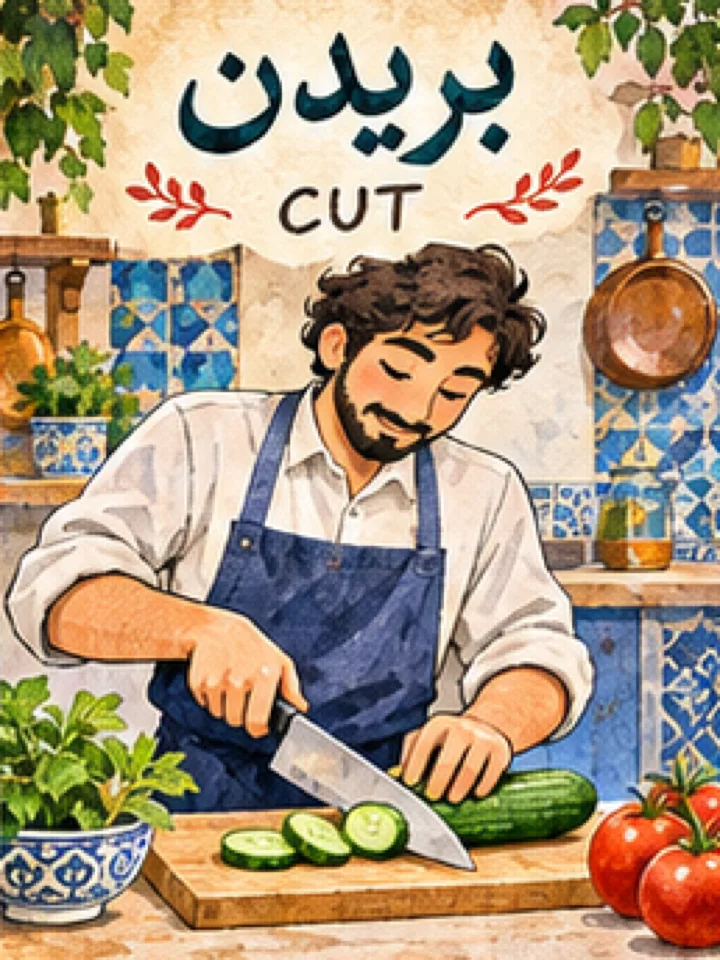
Cut- Chop
مُتَرادِفِ فارسی: جُدا کَردَن
مُتَضادِ فارسی: چَسباندَن
:صَرف
گُذَشتِه: بُریدَم – بُریدی – بُرید – بُریدیم – بُریدید – بُریدَند
حال: می بُرَم – می بُری – می بُرَد – می بُریم – می بُرید – می بُرَند
:مِثال
.آنها دِرَختانِ جَنگَل را بُریدَند
.او دَستَش را با چاقو بُرید
.خَیاط پارچِه را بُرید
بریدن (boridan) means "to cut" in Persian. Here you will find its stems, full conjugation, new examples, everyday phrases and a short quiz.
How to use بریدن (boridan)
بریدن is a simple transitive verb meaning "to cut": paper, cloth, bread, a tree, or a finger by accident. Its past stem is برید (borid) and its present stem is بر (bor), pronounced with an o. Be careful: بردن (bordan, "to carry") also has the present stem بر, but it is pronounced bar, so میبرم can be miboram (I cut) or mibaram (I carry).
Iranians use بریدن for clean cuts with a knife or scissors. To cut off electricity, a phone call or a relationship, the usual verb is قطع کردن (ghat' kardan), and to chop food into small pieces is خرد کردن (khord kardan). بریدن also has a figurative use: in speech دیگه بریدم (dige boridam) means "I can't take it anymore, I give up".
Verb stems
| Infinitive | بریدن | /boridan/ | to cut |
|---|---|---|---|
| Past stem | برید | /borid/ | used for past tenses |
| Present stem | بر | /bor/ | used for present, subjunctive and imperative |
Conjugation of بریدن
| Person | Simple past | Present | Future | Subjunctive |
|---|---|---|---|---|
| من I |
بریدم /boridam/ |
میبرم /miboram/ |
خواهم برید /khâham borid/ |
ببرم /beboram/ |
| تو you (sg.) |
بریدی /boridi/ |
میبری /mibori/ |
خواهی برید /khâhi borid/ |
ببری /bebori/ |
| او he / she |
برید /borid/ |
میبرد /miborad/ |
خواهد برید /khâhad borid/ |
ببرد /beborad/ |
| ما we |
بریدیم /boridim/ |
میبریم /miborim/ |
خواهیم برید /khâhim borid/ |
ببریم /beborim/ |
| شما you (pl./polite) |
بریدید /boridid/ |
میبرید /miborid/ |
خواهید برید /khâhid borid/ |
ببرید /beborid/ |
| آنها they |
بریدند /boridand/ |
میبرند /miborand/ |
خواهند برید /khâhand borid/ |
ببرند /beborand/ |
Negative and imperative
| Persian | Pronunciation | English |
|---|---|---|
| نبریدم | /naboridam/ | I did not cut |
| نمیبرم | /nemiboram/ | I do not cut / I am not cutting |
| ببر! | /bebor!/ | Cut! (to one person) |
| ببرید! | /beborid!/ | Cut! (to several people, or politely) |
| نبر! | /nabor!/ | Don't cut! |
The examples above, translated
| Persian | Pronunciation | English |
|---|---|---|
| آنها درختان جنگل را بریدند. | /ân-hâ derakhtân-e jangal râ boridand./ | They cut down the trees of the forest. |
| او دستش را با چاقو برید. | /u dast-ash râ bâ châghu borid./ | He cut his hand with a knife. |
| خیاط پارچه را برید. | /khayyât pârche râ borid./ | The tailor cut the fabric. |
More example sentences
| Persian | Pronunciation | English |
|---|---|---|
| مادرم کیک را برید. | /mâdar-am keyk râ borid./ | My mother cut the cake. |
| کاغذ را با قیچی ببر. | /kâghaz râ bâ gheychi bebor./ | Cut the paper with scissors. |
| مراقب باش، این چاقو خیلی خوب میبرد. | /morâgheb bâsh, in châghu kheyli khub miborad./ | Be careful, this knife cuts very well. |
| دیروز انگشتم را بریدم. | /diruz angosht-am râ boridam./ | Yesterday I cut my finger. |
Common phrases
| Persian | Pronunciation | English |
|---|---|---|
| امید بریدن (از) | /omid boridan (az)/ | to give up hope (on) |
| دیگه بریدم | /dige boridam/ | I've had enough, I give up (colloquial) |
| بریدگی | /boridegi/ | a cut (wound) |
| بریدهی روزنامه | /boride-ye ruznâme/ | a newspaper clipping |
In spoken Persian
In Tehran speech the endings are shortened: میبره (mibore) instead of میبرد (miborad), and میبرن (miboran) for "they cut". The figurative بریدم (boridam), "I'm exhausted, I give up", is very common among young people: از این کار بریدم (az in kâr boridam), "I'm fed up with this job".
Watch out for
- ببر can be bebor ("cut", from بریدن) or bebar ("take", from بردن). Context tells you which one is meant: نان را ببر is "cut the bread", نان را به خانه ببر is "take the bread home".
- For cutting into small pieces in the kitchen, use خرد کردن: پیاز را خرد کن (piyâz râ khord kon), "chop the onion".
Practice
-
Translate into Persian: "I cut the bread."
Show answer
man nân râ boridam. من نان را بریدم.
-
What does this sentence mean? این قیچی خوب نمیبرد.
Show answer
These scissors don't cut well.
-
What is the present-tense form for "they" (they cut)?
Show answer
miborand میبرند
Related verbs in this course
- جدا کردن (jodâ kardan): to separate, to divide, to detach
- چسباندن (chasbândan): to stick, to attach, to glue
- دوختن (dukhtan): to sew, to stitch
This is lesson 31 of 200 Most Common Persian Verbs. For the sounds used in the pronunciation guide, see Persian pronunciation.


Take this lesson further

Study with the book
200 Absolutely Essential Persian Verbs
This free lesson is part of 200 Most Common Persian Verbs. The book puts the whole series in one printable PDF you can study offline.
Serious about Persian? Get all 30 of our Persian learning books for $199.99 (55% less than buying them one by one).
Free Persian Starter Kit (PDF)
The Persian alphabet chart and the 101 most common Persian words with pronunciation, in one printable PDF. You also get a one-time 15% code for any of our books.
We will email you new lessons and book news from Learn Persian Online. Unsubscribe any time.Free: 100 Core Persian Words + 20 Survival Phrases
Get the 14-page printable Starter Pack (all 32 letters, a 7-day reading plan, 100 core words and 20 survival phrases) and a short 5-email course. Free.
Practise with free Persian games