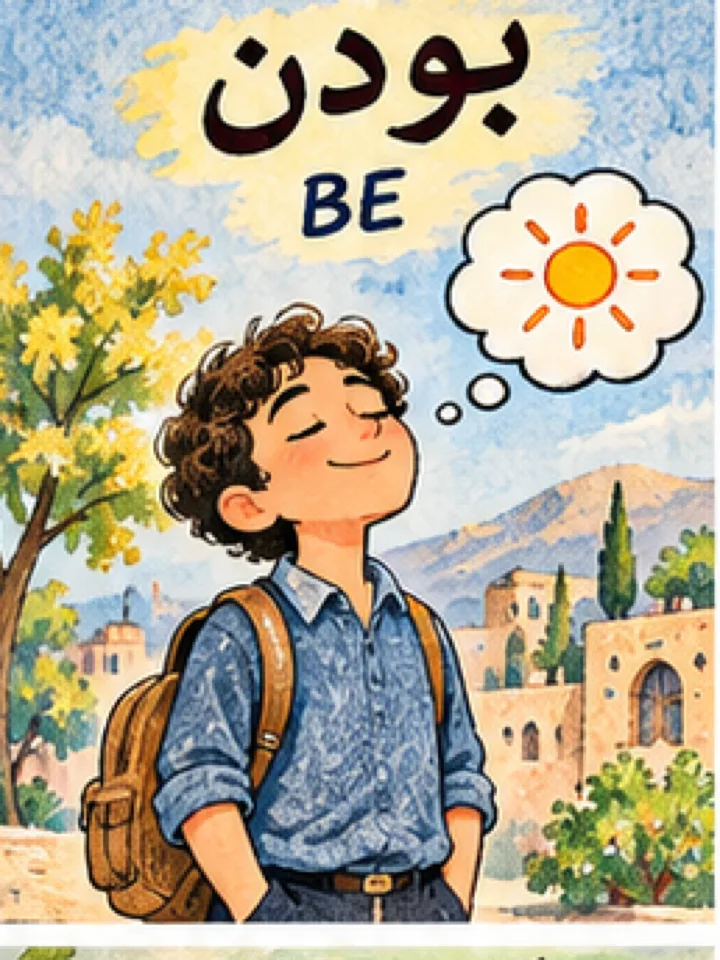
200 Most Common Persian Verbs
بودَن
Watch and listen to Reza Nazari explain this verb. More in the free 200 Persian Verbs video course.
Exist – Be
مُتَرادِفِ فارسی: حُضُور داشتَن
مُتَضادِ فارسی: مَحو شُدَن – غایِب بُودَن
:صَرف
گُذَشتِه: بُودَم – بُودی – بُود – بُودیم – بُودید – بُودَند
حال: هَستَم – هَستی – هَست – هَستیم – هَستید – هَستَند
:مِثال
.مَن دیروز خانِه بُودَم
.تو اِمروز دانِشگاه بُودی
.آنها دیروز فُروشگاه بُودَند
بودن (budan) means "to be" in Persian. Learn its irregular present forms, short endings, full conjugation, examples, phrases and a quiz.
How to use بودن (budan)
بودن is the Persian verb "to be" and one of the most irregular verbs in the language. The past is regular (بودم, budam, "I was"), but the present has two sets of forms: the full forms هستم، هستی، است (hastam, hasti, ast) and the short endings -ام، -ای، -است that attach to the word before them: خستهام (khaste-am), "I'm tired". The subjunctive and imperative use another stem: باش (bâsh).
In speech and most writing the short endings are the default after adjectives and nouns; هستم sounds more careful or emphatic. هست (hast) also means "there is": نان هست؟, "is there any bread?". The negative present is irregular: نیستم (nistam), "I am not", and نیست (nist), "is not". A form with می, میباشد, exists only in very formal or bureaucratic writing.
Verb stems
| Infinitive | بودن | /budan/ | to be |
|---|---|---|---|
| Past stem | بود | /bud/ | used for past tenses |
| Present stem | هست / باش | /hast / bâsh/ | used for present, subjunctive and imperative |
Conjugation of بودن
| Person | Simple past | Present | Future | Subjunctive |
|---|---|---|---|---|
| من I |
بودم /budam/ |
هستم /hastam/ |
خواهم بود /khâham bud/ |
باشم /bâsham/ |
| تو you (sg.) |
بودی /budi/ |
هستی /hasti/ |
خواهی بود /khâhi bud/ |
باشی /bâshi/ |
| او he / she |
بود /bud/ |
است /ast/ |
خواهد بود /khâhad bud/ |
باشد /bâshad/ |
| ما we |
بودیم /budim/ |
هستیم /hastim/ |
خواهیم بود /khâhim bud/ |
باشیم /bâshim/ |
| شما you (pl./polite) |
بودید /budid/ |
هستید /hastid/ |
خواهید بود /khâhid bud/ |
باشید /bâshid/ |
| آنها they |
بودند /budand/ |
هستند /hastand/ |
خواهند بود /khâhand bud/ |
باشند /bâshand/ |
Negative and imperative
| Persian | Pronunciation | English |
|---|---|---|
| نبودم | /nabudam/ | I was not |
| نیستم | /nistam/ | I am not |
| باش! | /bâsh!/ | Be! (to one person) |
| باشید! | /bâshid!/ | Be! (to several people, or politely) |
| نباش! | /nabâsh!/ | Don't be! |
The examples above, translated
| Persian | Pronunciation | English |
|---|---|---|
| من دیروز خانه بودم. | /man diruz khâne budam/ | I was at home yesterday. |
| تو امروز دانشگاه بودی. | /to emruz dâneshgâh budi/ | You were at the university today. |
| آنها دیروز فروشگاه بودند. | /ân-hâ diruz forushgâh budand/ | They were at the store yesterday. |
More example sentences
| Persian | Pronunciation | English |
|---|---|---|
| من دانشجو هستم. | /man dâneshju hastam/ | I am a student. |
| هوا امروز سرد است. | /havâ emruz sard ast/ | The weather is cold today. |
| دیشب کجا بودی؟ | /dishab kojâ budi?/ | Where were you last night? |
| امیدوارم حالت خوب باشد. | /omidvâram hâlat khub bâshad/ | I hope you are well. |
Common phrases
| Persian | Pronunciation | English |
|---|---|---|
| هست | /hast/ | there is |
| نیست | /nist/ | is not; there isn't |
| حالت چطور است؟ | /hâlat chetor ast?/ | How are you? |
| باشه | /bâshe/ | OK (colloquial, from باشد) |
In spoken Persian
Tehran speech uses the short endings constantly: خوبم (khubam), "I'm fine", کجایی؟ (kojâyi?), "where are you?", خستهای؟ (khaste-i?), "are you tired?". The third person است usually becomes a final e or disappears: خوبه (khube), "it's good", کجاست؟ (kojâst?), "where is it?". باشد becomes باشه (bâshe), the everyday word for "OK".
Watch out for
- The negative present is نیستم، نیستی، نیست، نیستیم، نیستید، نیستند (nistam, nisti, nist, nistim, nistid, nistand). The negative of است is نیست.
- Do not build a present with می: "I am" is هستم or -ام. The subjunctive (باشم, bâsham) and the imperative (باش, bâsh) come from the stem باش. Note: the source page lists هست for "he/she"; the standard form is است, while هست is emphatic or means "there is".
Practice
-
Translate into Persian: "We are tired."
Show answer
mâ khaste hastim. (or: mâ khaste-im.) ما خسته هستیم.
-
What does this sentence mean? پدرم الان خانه نیست.
Show answer
My father isn't home now.
-
Give the subjunctive for "you" (singular), as in "I hope you are happy".
Show answer
bâshi باشی
Related verbs in this course
This is lesson 37 of 200 Most Common Persian Verbs. For the sounds used in the pronunciation guide, see Persian pronunciation.


Take this lesson further

Study with the book
200 Absolutely Essential Persian Verbs
This free lesson is part of 200 Most Common Persian Verbs. The book puts the whole series in one printable PDF you can study offline.
Serious about Persian? Get all 30 of our Persian learning books for $199.99 (55% less than buying them one by one).
Free Persian Starter Kit (PDF)
The Persian alphabet chart and the 101 most common Persian words with pronunciation, in one printable PDF. You also get a one-time 15% code for any of our books.
We will email you new lessons and book news from Learn Persian Online. Unsubscribe any time.Free: 100 Core Persian Words + 20 Survival Phrases
Get the 14-page printable Starter Pack (all 32 letters, a 7-day reading plan, 100 core words and 20 survival phrases) and a short 5-email course. Free.
Practise with free Persian games