How to Learn Persian (Farsi): A Step-by-Step Guide for Beginners
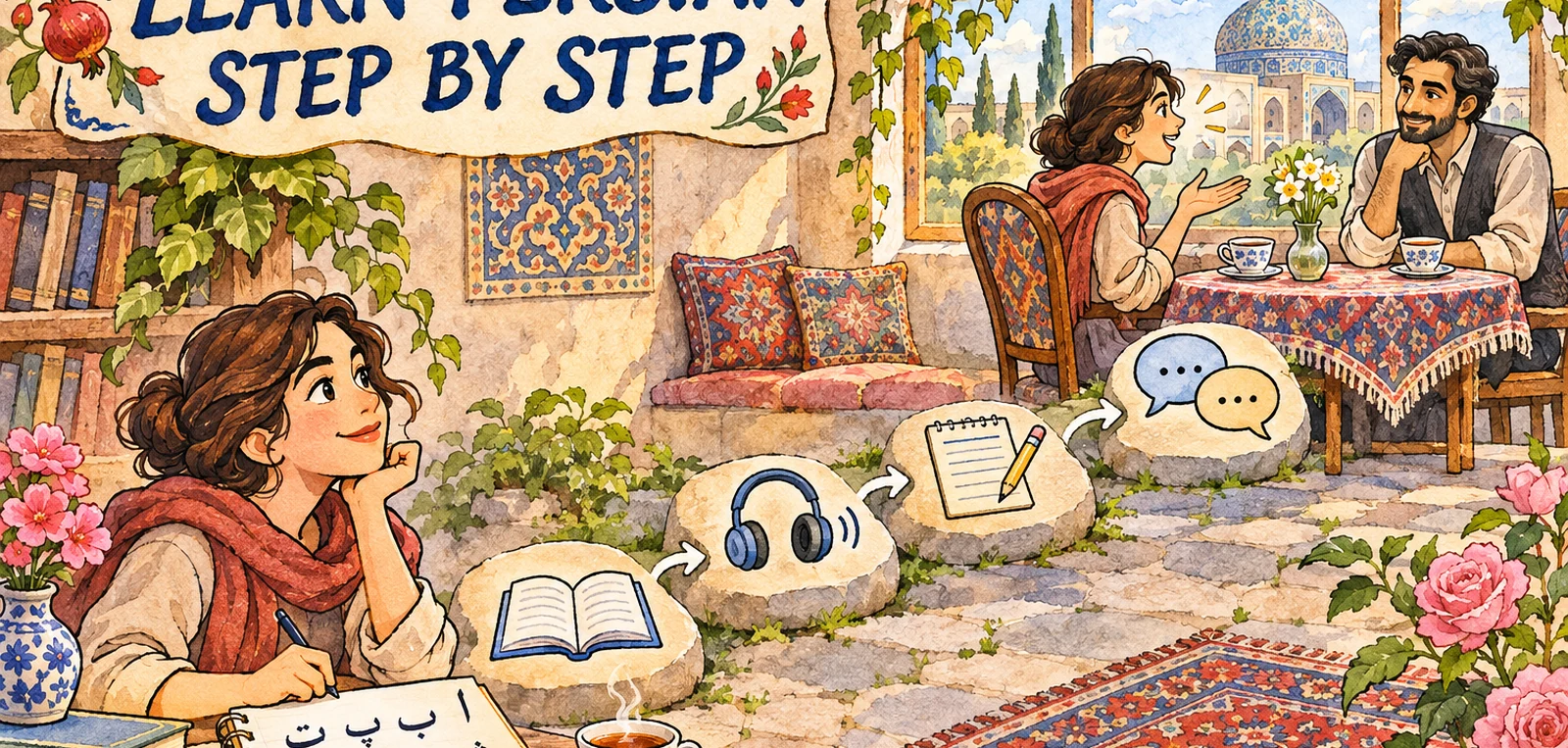
To learn Persian (Farsi), start with the 32-letter alphabet, follow one structured course for 20 to 30 minutes a day, learn the most common words and verbs, and start speaking in your first weeks. Most learners read the script within a month and hold simple conversations within a few months. This guide gives you the plan step by step, with the free lessons and tools on this site for each stage.
Your plan at a glance
| Stage | Goal | Use |
|---|---|---|
| Weeks 1 to 4 | Read and write all 32 letters; say hello, thank you and your name | Persian alphabet guide, handwriting practice |
| Months 2 and 3 | About 500 everyday words; present and past tense; short conversations | Learn Farsi in 100 Days, 101 most common words |
| Months 4 to 6 | The 200 most common verbs; spoken Persian; simple texts | 200 verbs, spoken vs written Persian |
| Months 6 to 12 | Talk about daily life, follow slow audio, read graded stories | intermediate lessons, Persian reader, a tutor |
| Year 2 | Read news and modern prose, then classical poetry | advanced lessons, Rumi’s Masnavi |
Step 1: Know which Persian you are learning
Persian and Farsi are the same language: Farsi (فارسی) is its name in Persian, Persian is its English name. It is spoken in Iran, in Afghanistan (where it is called Dari) and in Tajikistan (where it is called Tajik and written in Cyrillic). The three are mutually intelligible. If you are not sure which to choose, read Farsi vs Persian vs Dari vs Tajik.
Persian also has two registers: the written language of books and news, and the spoken language of Tehran and daily life. You need both. Learn words and grammar in their written form first, then learn how they are said, so that میخواهم (mikhâham, “I want”) becomes میخوام (mikhâm) in speech.
Step 2: Learn the alphabet first
The Persian alphabet has 32 letters and is written from right to left. Most letters join to the next one and change shape slightly depending on their position, and the short vowels a, e and o are usually not written. That sounds harder than it is: the shapes follow a few simple patterns, and seven letters never join to the left.
- Learn four or five letters a day, with their sounds and joined forms.
- Write every letter by hand. Writing fixes the shapes in memory faster than reading alone.
- Read real words from day three, even slowly: سلام (salâm, hello), مرسی (mersi, thanks), آب (âb, water).
Use the Persian alphabet guide, the letter-by-letter lessons, the alphabet game and our guide on how to read Persian. Can you skip the script and use Latin letters? For a short trip, yes; for anything more, no. Signs, menus, messages and every book are in Persian script, and transliteration hides sounds you need to hear.
Step 3: Get the sounds right early
Persian has six vowels (â, a, e, o, i, u) and only a few sounds that English lacks: kh (as in Scottish loch), gh/q (a sound made at the back of the throat) and a clear, short r. Stress usually falls on the last syllable of a word. Listen to native audio from the first lesson and copy it out loud; ten minutes of shadowing a day does more for your accent than any rule.
Step 4: Follow one course, every day
Learners who reach fluency are rarely the ones with the best materials; they are the ones who study a little every day. Pick one structured course and stay with it. Our free Learn Farsi in 100 Days gives you one short lesson a day, from the alphabet to real conversations. A good 25-minute session looks like this:
- 5 minutes: review yesterday’s words with flashcards.
- 10 minutes: the new lesson, read aloud.
- 5 minutes: write five sentences using the new words.
- 5 minutes: listen to something in Persian and repeat it.
How many hours you need depends on your goal; we explain the numbers in how many hours a week should you study Persian.
Step 5: Build your core vocabulary
A small number of words covers most of what people say. Start with the 101 most common Persian words, then learn words by topic: family, colors, food, numbers and the rest of the vocabulary lessons. Learn words in short phrases rather than alone, and review them on a schedule: the next day, three days later, a week later. Look up anything you meet in the Persian dictionary.
Good news for English speakers: Persian shares many words with English through their common Indo-European roots and through borrowing, such as مادر (mâdar, mother), برادر (barâdar, brother) and در (dar, door).
Step 6: Learn the grammar that matters
Persian grammar is friendlier than its script suggests. There is no grammatical gender and no case endings, and verb endings are regular. A handful of patterns carry most of the language:
- Word order: subject, object, verb. من نان میخورم (man nân mikhoram), “I eat bread.”
- The ezâfe: a short -e links a noun to its adjective or owner. کتابِ من (ketâb-e man), “my book”; خانهٔ بزرگ (khâne-ye bozorg), “a big house.”
- The object marker râ: marks a definite object. کتاب را خواندم (ketâb râ khândam), “I read the book.”
- Plurals: add ها (-hâ): کتابها (ketâb-hâ), “books.”
- Verbs have two stems: a past stem and a present stem. Learn both and every tense follows. For رفتن (raftan, to go): رفتم (raftam), “I went”; میروم (miravam), “I go,” said miram in speech.
Work through the Persian grammar lessons and drill the 200 most common verbs with the verb conjugator. For a quick overview, read Persian grammar tips for beginners.
Step 7: Speak from the first weeks
Do not wait until you “know enough.” Say every sentence you study out loud, record yourself, and talk to a person as soon as you can introduce yourself. A weekly lesson with a Farsi tutor or a language-exchange partner gives you a reason to prepare and corrects mistakes before they set.
Learn the spoken forms deliberately with spoken vs written Persian, and learn the social rules too: Iranian politeness, taarof, shapes everyday talk, from offering tea to paying a bill.
Step 8: Listen and read every day
Understanding comes from a lot of input you can almost follow. Mix:
- Audio: learner podcasts and YouTube lessons (see the best Persian podcasts), then Persian songs with lyrics (10 songs to start with).
- Reading: graded texts in the Persian reader, then short stories and news. Practise reading without vowel marks, because real texts do not show them.
- Culture: reading about the places and people behind the language keeps you interested. Our guide to Iran covers its history, cities and customs.
Step 9: Write a little, often
Write three to five sentences a day about your day, by hand at first, then typed. Set up a Persian keyboard on your phone and computer, or use our online Persian keyboard. Short daily writing is the fastest way to turn words you recognise into words you can use.
Step 10: Avoid the mistakes that slow learners down
- Staying in transliteration too long instead of reading Persian script.
- Collecting resources instead of finishing one course.
- Learning only written Persian and then not understanding people in the street, or only spoken Persian and then not being able to read.
- Learning verbs in one tense instead of learning both stems.
- Never speaking until you feel ready.
- Studying in long, rare sessions instead of short daily ones.
When motivation drops, which it will around month three, shrink the daily goal rather than skipping days. Our guide to beating common Persian learning roadblocks has more ideas, and 10 tips to learn Persian fast collects quick wins.
How long does it take to learn Persian?
The US Foreign Service Institute places Persian in its Category III of languages for English speakers, at about 44 weeks (around 1,100 class hours) of full-time study to reach professional working proficiency. Self-learners studying 30 minutes a day typically read the alphabet in two to four weeks, manage everyday conversations in four to six months, and reach a comfortable intermediate level in one to two years. If you already speak Arabic, Urdu or Turkish, you will recognise many words and go faster. Is it hard? Read our honest answer in is Persian hard to learn.
Free resources and books for each level
Everything you need to get to an intermediate level is free on Learn Persian Online: the beginner lessons, intermediate and advanced lessons, the dictionary and 20 practice tools. For other sites and apps, see free websites to learn Persian.
If you prefer a printable course with exercises, our ebooks follow the same method: Learn Farsi in 100 Days and its workbook for beginners, and the books in our guide to the best books to learn Persian, sorted by level and goal.
Common questions
Can I learn Persian on my own?
Yes. With a structured course, a daily routine and regular listening, you can reach a good reading and listening level alone. For speaking, add a tutor or exchange partner at least once a week.
Should I learn Persian or Farsi?
They are the same language. If your goal is Afghanistan, learn Persian and then the Dari differences; for Tajikistan, learn the Cyrillic script as well.
What is the fastest way to learn Persian?
Daily study, the alphabet first, the most frequent words and verbs before rare ones, and speaking from the start. Consistency beats intensity.
How many words do I need?
Around 1,000 well-chosen words let you handle everyday situations; 3,000 let you follow most conversations and simple texts.
Persian words from this guide
| فارسی | fârsi | Persian (the language) |
| سلام | salâm | hello |
| مرسی | mersi | thanks |
| کتاب | ketâb | book |
| رفتن | raftan | to go |
| میخواهم | mikhâham | I want (spoken: mikhâm) |
| مادر | mâdar | mother |
Learn Persian with our bestseller
Serious about Persian? Get all 30 of our Persian learning books for $199.99 (55% less than buying them one by one).
Free Persian Starter Kit (PDF)
The Persian alphabet chart and the 101 most common Persian words with pronunciation, in one printable PDF. You also get a one-time 15% code for any of our books.
We will email you new lessons and book news from Learn Persian Online. Unsubscribe any time.Free Persian Starter Pack: Alphabet + 100 Core Words
Get the 14-page printable Starter Pack (all 32 letters, a 7-day reading plan, 100 core words and 20 survival phrases) and a short 5-email course. Free.
by: Learn Persian Online Team about (category: Blog)


What people say about "How to Learn Persian (Farsi): A Step-by-Step Guide for Beginners"?
No one replied yet.