When Alexander died at Babylon in June 323 BCE, he left no adult heir, and his generals divided his empire among themselves. For the next twelve years Iran was a prize and a battlefield in the wars of the Diadochi, the “successors”. Two of the biggest battles of those wars were fought on the Iranian plateau, and by 311 BCE Seleucus had emerged as the man who would rule Iran.
| Period | 323 to 311 BCE |
|---|---|
| Key settlements | Babylon (323), Triparadisus (320) |
| Main figures in Iran | Perdiccas, Peithon (Media), Atropates (northern Media), Peucestas (Persis), Eumenes, Antigonus, Seleucus |
| Battles in Iran | Paraitakene (317), Gabiene (316) |
| Result | Antigonus wins the east, then loses it to Seleucus after 311 |
The death of Alexander
Alexander fell ill after a banquet in Babylon and died some days later, on about 10 or 11 June 323, aged 32. The ancient writers mention fever and heavy drinking; rumours of poison spread almost at once. Modern suggestions range from malaria or typhoid to the effects of old wounds and alcohol. No one can be sure.
He had no clear successor. His wife Roxana was pregnant; his half-brother Arrhidaeus was considered unfit to rule. After a tense stand-off between the cavalry and the infantry in Babylon, the generals agreed that Arrhidaeus, renamed Philip III, and Roxana’s child, if a boy, would be joint kings. Perdiccas, who held Alexander’s ring, became regent. Roxana gave birth to a son, Alexander IV, a few months later.
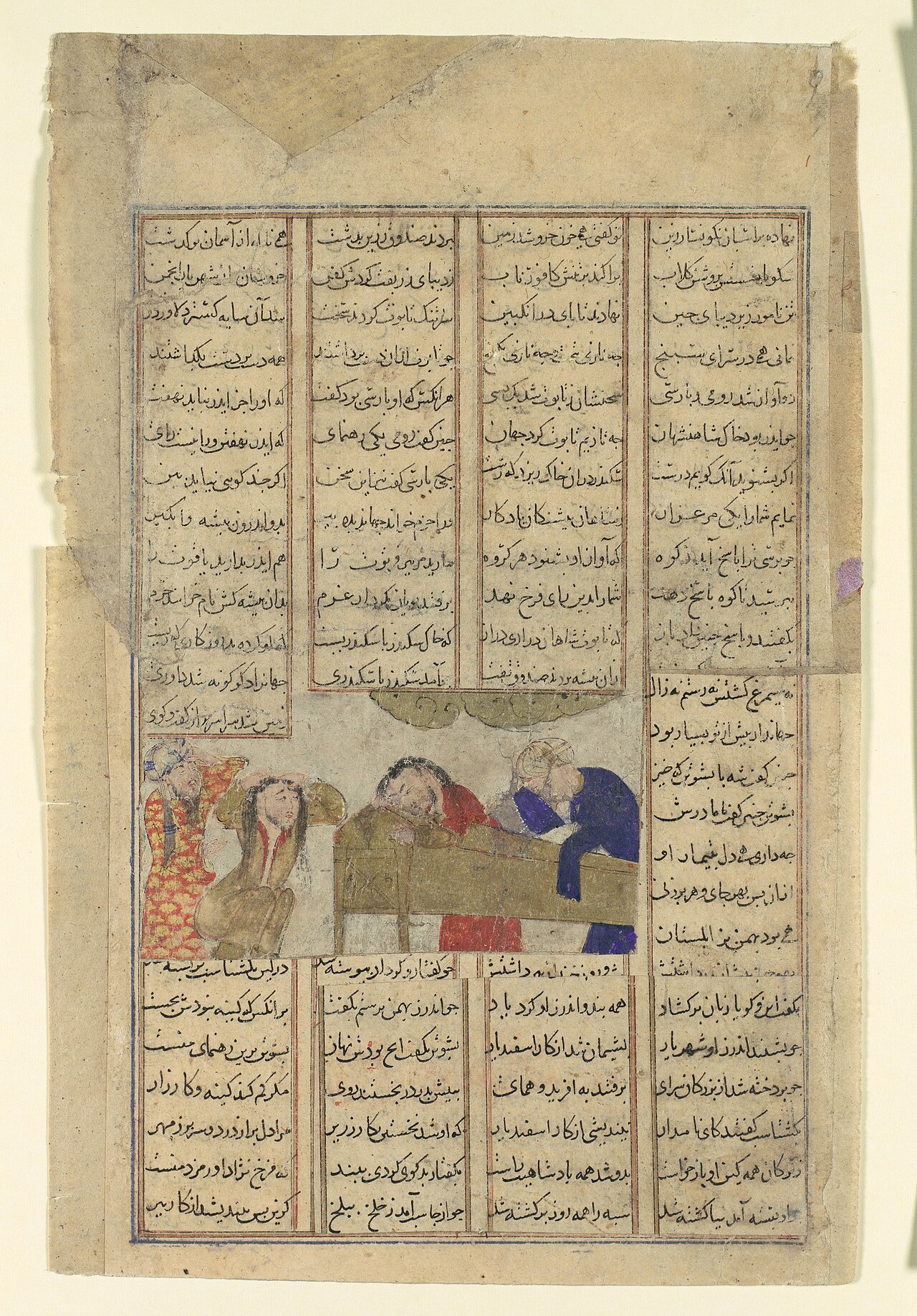

The partition of Babylon and the Iranian satrapies
The real power lay in the provinces, which the generals shared out at Babylon. For the Iranian lands the main decisions were:
- Media, with its capital Ecbatana (Hamadan) and its famous horse pastures, was split. The Macedonian Peithon took the larger southern part. The Persian Atropates, Alexander’s satrap and Perdiccas’s father-in-law, kept the north-west. He made it a hereditary kingdom, known as Media Atropatene, whose name lives on in Azerbaijan.
- Persis, the Persian homeland, stayed with Peucestas, the Macedonian who had learned Persian and dressed as a Persian.
- Other eastern provinces, from Parthia to Bactria and Arachosia, went to a mixture of Macedonians and the Iranian governors Alexander had left in place.
The revolt of the Greek settlers
The first crisis came from Alexander’s colonists. Thousands of Greek mercenaries settled in Bactria and the other eastern provinces had never wanted to stay there. On hearing of the king’s death, they rose and set out for home. Diodorus says they numbered over 20,000 infantry and 3,000 cavalry. Perdiccas sent Peithon of Media against them. Peithon won, partly by bribing some of their commanders, and hoped to take the survivors into his own service, but Perdiccas had ordered that they be killed, and the Macedonian soldiers massacred them after they had surrendered. The incident showed both how fragile the Greek presence in the east was and how ambitious Peithon had become.
A new settlement at Triparadisus
Perdiccas was murdered by his own officers in Egypt in 320 BCE. One of them was Seleucus, who had commanded the elite Companion cavalry. At a new conference at Triparadisus in Syria, the aged Antipater became regent and Seleucus was given the satrapy of Babylonia, his base for everything that followed. Peithon kept Media and Peucestas kept Persis. Antigonus “the One-eyed” was named general in Asia with the task of crushing the last supporters of Perdiccas, above all Eumenes of Cardia, Alexander’s former secretary.
Peithon against the eastern satraps
When Antipater died in 319, the empire had no real centre. Peithon tried to make himself master of the upper satrapies, the Iranian provinces east of Mesopotamia. He killed the satrap of Parthia and put his own brother in his place. The other eastern governors saw what was coming. They joined forces under Peucestas, the strongest of them, defeated Peithon and drove him out of Parthia and back into Media.
Peucestas’s position rested partly on Persian support. Diodorus describes a great sacrifice and feast he held at Persepolis in 317 for the whole eastern army, with the guests seated in four rings around the altars, generals and Persian nobles in the centre. Alexander’s idea of a mixed Macedonian and Iranian elite had survived him, at least in Persis.
Eumenes and Antigonus fight for Iran
In 317 Eumenes, now appointed royal general by the regent Polyperchon, came east with the veteran Macedonian infantry known as the Silver Shields and joined the eastern satraps at Susa. Antigonus followed with a large army. After a failed attempt to cross the Coprates river near Susa in the summer heat, Antigonus moved up into Media, and the two armies met in the Zagros. The battles that followed, at Paraitakene in autumn 317 and Gabiene in the winter of 316, are told on the Battles of Paraitakene and Gabiene.
At Gabiene Antigonus’s cavalry captured Eumenes’s baggage train, which held the families and savings of the Silver Shields. To get them back, the veterans handed Eumenes over, and Antigonus had him killed.
Antigonus clears the board
Antigonus now held all of Iran, and he moved quickly to remove anyone who might rival him. Peithon, who had fought on his side, was accused of plotting and executed at Ecbatana early in 316. Peucestas was removed from Persis. According to Diodorus, a leading Persian named Thespius protested that the Persians would obey no one else, and Antigonus had him put to death. Antigonus collected the treasuries of Ecbatana and Susa and marched west toward Babylon.
Seleucus saw that he was next. In 315 he fled from Babylon with a few horsemen to Ptolemy in Egypt.
Seleucus returns, 312 to 311 BCE
Seleucus came back after he and Ptolemy defeated Antigonus’s son Demetrius at Gaza in 312. With only a small force he retook Babylon. Babylonian records date the start of his rule from that time, and the “Seleucid era”, counted from 312 or 311 BCE depending on the calendar, became the standard dating system across the Near East for centuries. Seleucus then defeated Nicanor, Antigonus’s governor of Media, and won over the upper satrapies. His rise is told on Seleucus I Nicator and the Seleucid Empire.
The wars ended the Argead royal house. Philip III was murdered in 317, and Roxana and Alexander IV were killed in Macedonia around 310 (see Roxana and the Susa weddings). From 306 onwards the generals called themselves kings.
Iran in the successor wars
For the people of Iran these years meant armies living off the land, treasuries emptied and governors changed by the season. Yet much stayed the same. The Achaemenid road network, the provincial system and many local Iranian lords carried on, and two Iranian houses, Atropates in Media and the local rulers who appear later as the fratarakas of Persis, would outlast the Macedonian generals.
- 323 BCE Alexander dies at Babylon; partition of the satrapies
- 323 BCE Revolt of Greek settlers in the east crushed by Peithon
- 320 BCE Triparadisus settlement; Seleucus satrap of Babylonia
- 317 BCE Eastern satraps drive out Peithon; Eumenes arrives; feast at Persepolis; battle of Paraitakene
- 316 BCE Battle of Gabiene; Eumenes and Peithon executed
- 315 BCE Seleucus flees to Egypt
- 312 to 311 BCE Seleucus retakes Babylon and the east
Persian words from this page
| بابل | Bâbel | Babylon |
| ماد | Mâd | Media |
| پارس | Pârs | Persis, the Persian homeland (Fars) |
| همدان | Hamedân | Hamadan, ancient Ecbatana |
| آذربایجان | Âzarbâyjân | Azerbaijan, from Atropatene |
Sources and further reading
- Diodorus Siculus, Library of History, Books 18 and 19.
- Plutarch, Life of Eumenes; Arrian, Events after Alexander (fragments).
- A. B. Bosworth, The Legacy of Alexander: Politics, Warfare and Propaganda under the Successors (Oxford University Press, 2002).
- Robin Waterfield, Dividing the Spoils: The War for Alexander the Great’s Empire (Oxford University Press, 2011).
- Encyclopaedia Iranica, “Atropates”; Cambridge Ancient History, vol. VII part 1, The Hellenistic World (2nd ed., 1984).
Want to learn Persian? Get the free Starter Pack
Get the 14-page printable Starter Pack (all 32 letters, a 7-day reading plan, 100 core words and 20 survival phrases) and a short 5-email course. Free.
More in Alexander and the Seleucid Empire (330–141 BCE)
- Alexander the Great in Iran
- Spitamenes and the Revolt of Bactria and Sogdiana
- Roxana and the Mass Weddings at Susa
- Alexander’s Death and the Wars of the Successors in Iran
- The Battles of Paraitakene and Gabiene
- Seleucus I Nicator and the Seleucid Empire
- Iran under the Seleucids
- The Greco-Bactrian Kingdom
- Antiochus III’s Eastern Anabasis
- The Fratarakas: Local Rulers of Persis
- Greek Culture in Iran
- How the Seleucids Lost Iran