The Seleucid kingdom lost Iran over about a century, from the breakaway of Parthia and Bactria around the 240s BCE to the Parthian capture of Media in the 140s and of Seleucia on the Tigris in 141 BCE. A last attempt to win it back ended with the death of Antiochus VII in Media in 129 BCE. This page follows that process from the Seleucid side; the Parthian side begins with the Parni and Arsaces I.
| Period | c. 245 to 129 BCE |
|---|---|
| First losses | Parthia (Andragoras, then Arsaces) and Bactria (Diodotus), mid 3rd century BCE |
| Decisive losses | Media c. 148/147 BCE; Babylonia and Seleucia on the Tigris 141 BCE |
| Last Seleucid campaign | Antiochus VII Sidetes, 130 to 129 BCE |
| Main Parthian kings | Arsaces I, Mithridates I, Phraates II |
A kingdom stretched too far
From the start, the Seleucid kingdom had two centres of gravity: Syria and the Mediterranean, where its rivals were the Ptolemies of Egypt and later Rome, and the vast lands east of the Tigris. A king could not be in both places. Seleucus I dealt with this by making his son Antiochus viceroy of the east, but later kings rarely had a son old enough, or trustworthy enough, to spare. The east was left to governors who were far from the court and close to rich provinces and frontier armies.
The first breaks: Parthia and Bactria
Around the middle of the 3rd century BCE, while Seleucus II was fighting the Third Syrian War against Egypt and then a civil war against his brother Antiochus Hierax, the north-east slipped away. Two developments, which ancient writers already linked, came close together.
- Bactria. The satrap Diodotus gradually made himself an independent king (see the Greco-Bactrian kingdom).
- Parthia. The satrap of Parthia, Andragoras, also seems to have broken away. Then, around 238 BCE, the Parni, a nomadic people from the steppe east of the Caspian, led by Arsaces, invaded the province, killed Andragoras and took it over. The Parthians later counted their era from 247 BCE.
Seleucus II marched east around 230 to 227 BCE to recover Parthia. Justin says he was defeated, and the Parthians celebrated the day of their victory for centuries afterwards. Whether that is exactly true or not, the Seleucids did not get the province back.
A recovery: Antiochus III
Antiochus III’s great expedition of about 210 to 205 BCE (see Antiochus III’s eastern anabasis) seemed to reverse these losses. He took Hecatompylos, forced the Parthian king to become his ally, besieged the Bactrian king in Bactra and returned as “Great King”. But he left the local kings in place. Their obedience depended on the Seleucids staying strong.
Rome and the cost of Apamea
The turning point came in the west. Antiochus III was defeated by Rome at Magnesia in 190 BCE, and the Peace of Apamea in 188 required him to pay 15,000 talents over twelve years and give up his war elephants and most of his fleet. The money had to come from somewhere. Antiochus himself was killed in 187 trying to seize a temple treasure in Elymais, in the mountains north of Susa. His son Antiochus IV, after being humiliated by Rome in Egypt in 168, went east in 165 to raise money and reassert royal power, and died at Tabae in Persis in 164, again after a failed raid on a temple in Elymais.

Civil wars and usurpers
After 164 the Seleucid house tore itself apart. Rival claimants, often backed by Rome, Egypt or the city of Antioch, fought for the throne almost without pause. The eastern governors drew their own conclusions. Timarchus, satrap of Media, proclaimed himself king, even “Great King”, around 162 BCE, and held Babylon until Demetrius I defeated him in 160. In Elymais and in Characene at the head of the Persian Gulf, local rulers set up their own kingdoms. In Persis the local rulers (see the fratarakas) became more independent.
Mithridates I takes Media and Babylonia
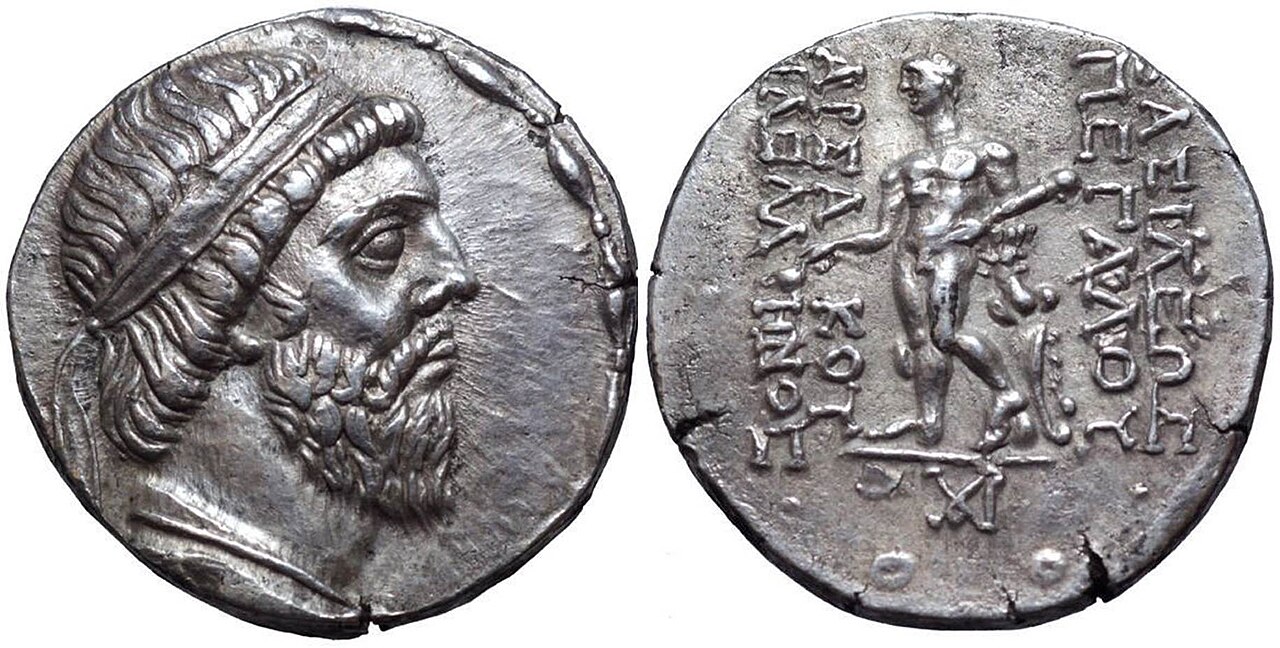
The Parthian king Mithridates I, who came to the throne around 171 BCE, used these years well. He first took territory from the Bactrian Greeks in the east and then turned west. A Greek inscription at Bisotun shows a Seleucid governor of the upper satrapies still in office in June 148 BCE; soon afterwards Media fell to Mithridates. In 141 BCE he entered Seleucia on the Tigris, the greatest Greek city in the east, and Babylonian documents begin to be dated by his reign. The story from the Parthian side is on Mithridates I and the making of an empire.
The last attempts to win Iran back
Demetrius II, 139 to 138 BCE
Demetrius II marched east to recover Mesopotamia and Iran. He was supported by the Greek cities and by local rulers who preferred a Seleucid overlord. After early successes he was defeated and captured in 138. Mithridates treated him as a royal guest, sent him to Hyrcania and married him to his daughter Rhodogune: a useful hostage and a claimant he could release whenever he wished.
Antiochus VII Sidetes, 130 to 129 BCE
Demetrius’s brother, Antiochus VII, made the last great Seleucid effort. In 130 BCE he marched east with a large army, won three battles, retook Babylonia and advanced into Media. Then he spread his troops out in winter quarters among the cities of Media. Ancient writers say they behaved so badly that the cities rose against them. The Parthian king Phraates II attacked, and in 129 Antiochus was killed in battle. Phraates had already released Demetrius II to stir up trouble in Syria. After this no Seleucid king crossed the Euphrates again.
Why Iran was lost
Historians usually give several reasons together:
- Distance. The kingdom’s heart was in Syria. Iran was weeks away, and kings could only campaign there when the west was quiet.
- Wars in the west. Six wars with Egypt and the clash with Rome used up money, men and attention.
- Dynastic conflict. From Antiochus Hierax to the civil wars after 164, rivals within the royal house invited governors to act for themselves.
- A narrow ruling class. The Seleucids governed Iran largely through Greeks and Macedonians, and Iranian elites had little stake in the dynasty (see Iran under the Seleucids).
- Capable neighbours. The Parthians combined steppe cavalry with a willingness to keep Greek cities, coinage and officials, and offered local rulers the same kind of overlordship the Achaemenids had.
The Seleucids lasted in Syria until the Romans ended the kingdom in 63 BCE. But from 129 BCE Iran belonged to the Arsacids, and the Shahnameh would remember the centuries after Eskandar as the reign of the Ashkanian kings. The next chapter is the Parthian Empire.
- c. 245 BCE Andragoras and Diodotus begin to break away
- c. 238 BCE Arsaces and the Parni take Parthia
- c. 230 to 227 BCE Seleucus II fails to retake Parthia
- 209 BCE Antiochus III makes the Parthian king his ally
- 188 BCE Peace of Apamea with Rome
- 164 BCE Antiochus IV dies in Persis
- c. 148/147 BCE Mithridates I takes Media
- 141 BCE Parthians enter Seleucia on the Tigris
- 138 BCE Demetrius II captured
- 129 BCE Antiochus VII killed in Media
Persian words from this page
| پارت | Pârt | Parthia |
| اشک | Ashk | Arsaces |
| اشکانیان | Ashkâniyân | the Arsacids (Parthians) |
| مهرداد | Mehrdâd | Mithridates |
| فرهاد | Farhâd | Phraates |
| صددروازه | Sad-darvâze | “Hundred Gates”, Hecatompylos |
Sources and further reading
- Justin, Epitome of Pompeius Trogus 41 and 38 to 39; Polybius, Histories 10 and 31.
- Strabo, Geography 11.9 (the Parthians).
- Susan Sherwin-White and Amélie Kuhrt, From Samarkhand to Sardis: A New Approach to the Seleucid Empire (Duckworth, 1993).
- Josef Wiesehöfer, Ancient Persia from 550 BC to 650 AD (I. B. Tauris, 1996).
- Cambridge History of Iran, vol. 3 (1) (1983), chapters by Bickerman and Bivar.
Want to learn Persian? Get the free Starter Pack
Get the 14-page printable Starter Pack (all 32 letters, a 7-day reading plan, 100 core words and 20 survival phrases) and a short 5-email course. Free.
More in Alexander and the Seleucid Empire (330–141 BCE)
- Alexander the Great in Iran
- Spitamenes and the Revolt of Bactria and Sogdiana
- Roxana and the Mass Weddings at Susa
- Alexander’s Death and the Wars of the Successors in Iran
- The Battles of Paraitakene and Gabiene
- Seleucus I Nicator and the Seleucid Empire
- Iran under the Seleucids
- The Greco-Bactrian Kingdom
- Antiochus III’s Eastern Anabasis
- The Fratarakas: Local Rulers of Persis
- Greek Culture in Iran
- How the Seleucids Lost Iran