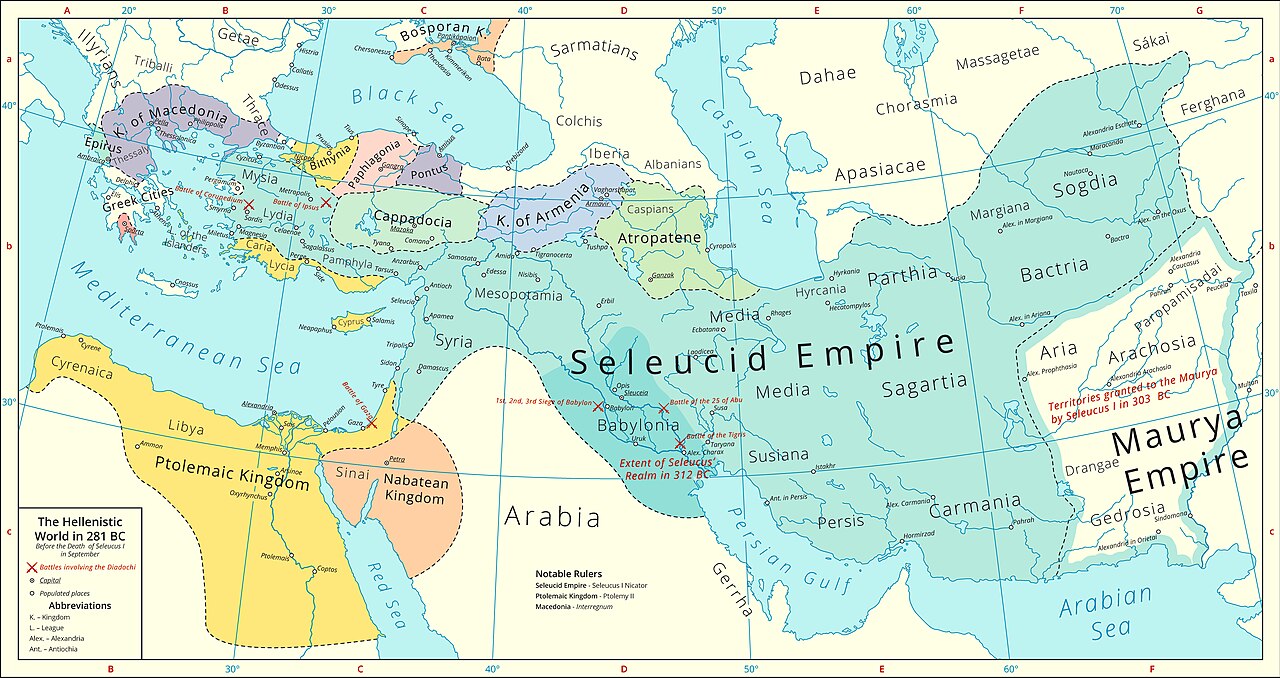
For about 170 years, from around 311 to 141 BCE, most of Iran belonged to the Seleucid kingdom, a Macedonian dynasty ruling from Syria and Mesopotamia. The Seleucids kept much of the Achaemenid system, added a network of Greek and Macedonian settlements, and relied on local Iranian rulers in regions they could not control directly. Their hold on the plateau was always thinner than on Syria, and it gave way province by province to the Parthians.
| Period | c. 311 BCE (Seleucus I takes the east) to 141 BCE (Parthian conquest of Media and Babylonia) |
|---|---|
| Seleucid centres for Iran | Seleucia on the Tigris; Ecbatana; Susa (Seleucia on the Eulaios) |
| Main Iranian provinces | Media, Persis, Susiana, Parthia and Hyrcania, Areia, Bactria |
| Semi-independent | Media Atropatene; the fratarakas of Persis; Elymais |
| Official languages | Greek; Aramaic still widely used |
An empire run from the west
The founder, Seleucus I, won Iran from Babylon, and his son Antiochus I spent years in the east as joint king. After that, the dynasty’s attention moved west. The Seleucids fought six wars with the Ptolemies of Egypt over southern Syria, and their main capital became Antioch on the Orontes. Iran was governed at a distance, by viceroys and satraps who could be weeks away from the king.
This shaped everything. In the 3rd century BCE a king usually came east only for a crisis: Antiochus I to repair the north-eastern frontier, Seleucus II against the Parthians around 230, and Antiochus III on his great expedition of 210 to 205 (see Antiochus III’s eastern anabasis). Between those visits, the men on the spot had a great deal of freedom, and some used it to break away.
Satraps, generals and the “upper satrapies”
The Seleucids kept the Achaemenid word and idea of the satrapy, but the provinces were generally smaller, and civil and military power was often combined in one governor, sometimes called strategos, general. Over the Iranian provinces as a group there was often a senior governor “of the upper satrapies”, a kind of viceroy of the east. That post was powerful and dangerous. Molon, who held it under the young Antiochus III, rebelled in 222 BCE, proclaimed himself king, and briefly took Seleucia on the Tigris before he was defeated in 220. In 148 BCE a Greek inscription at Bisotun still names a Kleomenes as governor of the upper satrapies, one of the last signs of Seleucid rule in western Iran.
The royal roads, post stations and storehouses of the Persian Empire stayed in use. Taxes were paid in silver and in kind, and the kingdom struck coins in mints at Seleucia on the Tigris, Susa, Ecbatana and in Bactria. Silver tetradrachms with the king’s portrait and Greek legends replaced the old Persian darics and sigloi. Aramaic, the language of the Achaemenid chancery, carried on in daily use alongside Greek.

Greek and Macedonian settlements
Alexander had founded garrison towns in the east; the Seleucids went much further. They planted settlers, mostly veterans and immigrants from Greece and Asia Minor, in new or renamed towns along the main routes across the plateau, from the Zagros to Merv and Bactria. The settlers received land in return for military service and lived under Greek-style city institutions with a council, magistrates and a gymnasium. Some of the new names survive only in Greek geographers. A few are known from discoveries in Iran itself:
- Laodicea in Media, at modern Nahavand. A Greek inscription found there, dated 193 BCE, preserves a royal order of Antiochus III setting up a cult and priestesses for his queen Laodice in the province. It is written in the same words as copies found in Asia Minor, showing how uniform royal administration could be.
- Antioch in Persis, probably on the coast of the Persian Gulf. Around 205 BCE its citizens voted to recognise a festival of Artemis at Magnesia on the Maeander in western Asia Minor. Their decree, preserved at Magnesia, says that settlers from Magnesia had been brought to the city by Antiochus I.
- Susa, renamed Seleucia on the Eulaios, which had a Greek civic life. Inscriptions there include Greek poems and records of freed slaves.
- Rhagae, near modern Rey, refounded as Europos (see the historic city of Rey).
Archaeology in Iran itself has found less of this world than one might expect. Much Seleucid evidence comes from Babylonia, with its cuneiform tablets and astronomical diaries, and from Ai-Khanoum in Afghanistan. The cultural side is explored on Greek culture in Iran.
Iranian elites under Macedonian kings
How far the Seleucids shared power with Iranians is debated. Christian Habicht, studying the names of known royal officials and courtiers in 1958, found that only a very small share, about 2.5 percent, were not Greek or Macedonian. That suggests a closed ruling class, a step back from Alexander’s mixing of elites.
Other historians, especially Susan Sherwin-White and Amélie Kuhrt, have argued that the court lists do not tell the whole story. Below the top level, local elites carried on running estates, temples and towns. In Babylon the Seleucid kings acted as traditional Babylonian kings, restoring temples. In the Iranian lands, local dynasts kept or won real power:
- Media Atropatene, in today’s Iranian Azerbaijan, was ruled by the descendants of the Persian satrap Atropates and was never fully under Seleucid control.
- Persis, the Persian homeland, was governed for much of the period by local rulers called fratarakas, who struck their own coins with Aramaic legends and Zoroastrian-style imagery. They are the subject of the fratarakas of Persis.
- Elymais, in the mountains north of Susa, emerged in the 2nd century BCE as a local kingdom. Antiochus III was killed there in 187 BCE while plundering a temple of Bel.
A frontier that moved inward
The north-east broke away first. Around the middle of the 3rd century BCE the satrap of Bactria, Diodotus, made himself independent (see the Greco-Bactrian kingdom), and the Parni nomads under Arsaces took over the province of Parthia. Antiochus III restored Seleucid authority for a time, but his defeat by Rome in 190 BCE and the indemnity imposed at Apamea in 188 left his successors short of money and men. By 141 BCE the Parthian king Mithridates I held Media and Babylonia. The story of that collapse is on how the Seleucids lost Iran.
What the Seleucid period left behind
Seleucid rule was long enough to leave marks: Greek as a language of government and coinage that the Parthians kept on their coins for centuries; a calendar, the Seleucid era, still used in parts of the Near East long after; and towns and roads that later dynasties used. But Iranian tradition barely remembers the Seleucids at all. The Shahnameh moves from Eskandar straight to the Ashkanians (Arsacids), and Persian historians of the Islamic period called the whole span the age of the “petty kings” (ملوک الطوایف).
Persian words from this page
| نهاوند | Nahâvand | Nahavand, Seleucid Laodicea |
| ساتراپ | sâtrâp | satrap |
| سلوکیان | Salukiyân | the Seleucids |
| اشکانیان | Ashkâniyân | the Arsacids (Parthians) |
| ملوک الطوایف | moluk ot-tavâyef | “petty kings”, the era between Alexander and the Sasanians |
Sources and further reading
- Susan Sherwin-White and Amélie Kuhrt, From Samarkhand to Sardis: A New Approach to the Seleucid Empire (Duckworth, 1993).
- Getzel M. Cohen, The Hellenistic Settlements in the East from Armenia and Mesopotamia to Bactria and India (University of California Press, 2013).
- Cambridge History of Iran, vol. 3 (1), The Seleucid, Parthian and Sasanian Periods, ed. Ehsan Yarshater (1983), chapter by Elias Bickerman, “The Seleucid Period”.
- Polybius, Histories Book 5 (the revolt of Molon).
Want to learn Persian? Get the free Starter Pack
Get the 14-page printable Starter Pack (all 32 letters, a 7-day reading plan, 100 core words and 20 survival phrases) and a short 5-email course. Free.
More in Alexander and the Seleucid Empire (330–141 BCE)
- Alexander the Great in Iran
- Spitamenes and the Revolt of Bactria and Sogdiana
- Roxana and the Mass Weddings at Susa
- Alexander’s Death and the Wars of the Successors in Iran
- The Battles of Paraitakene and Gabiene
- Seleucus I Nicator and the Seleucid Empire
- Iran under the Seleucids
- The Greco-Bactrian Kingdom
- Antiochus III’s Eastern Anabasis
- The Fratarakas: Local Rulers of Persis
- Greek Culture in Iran
- How the Seleucids Lost Iran