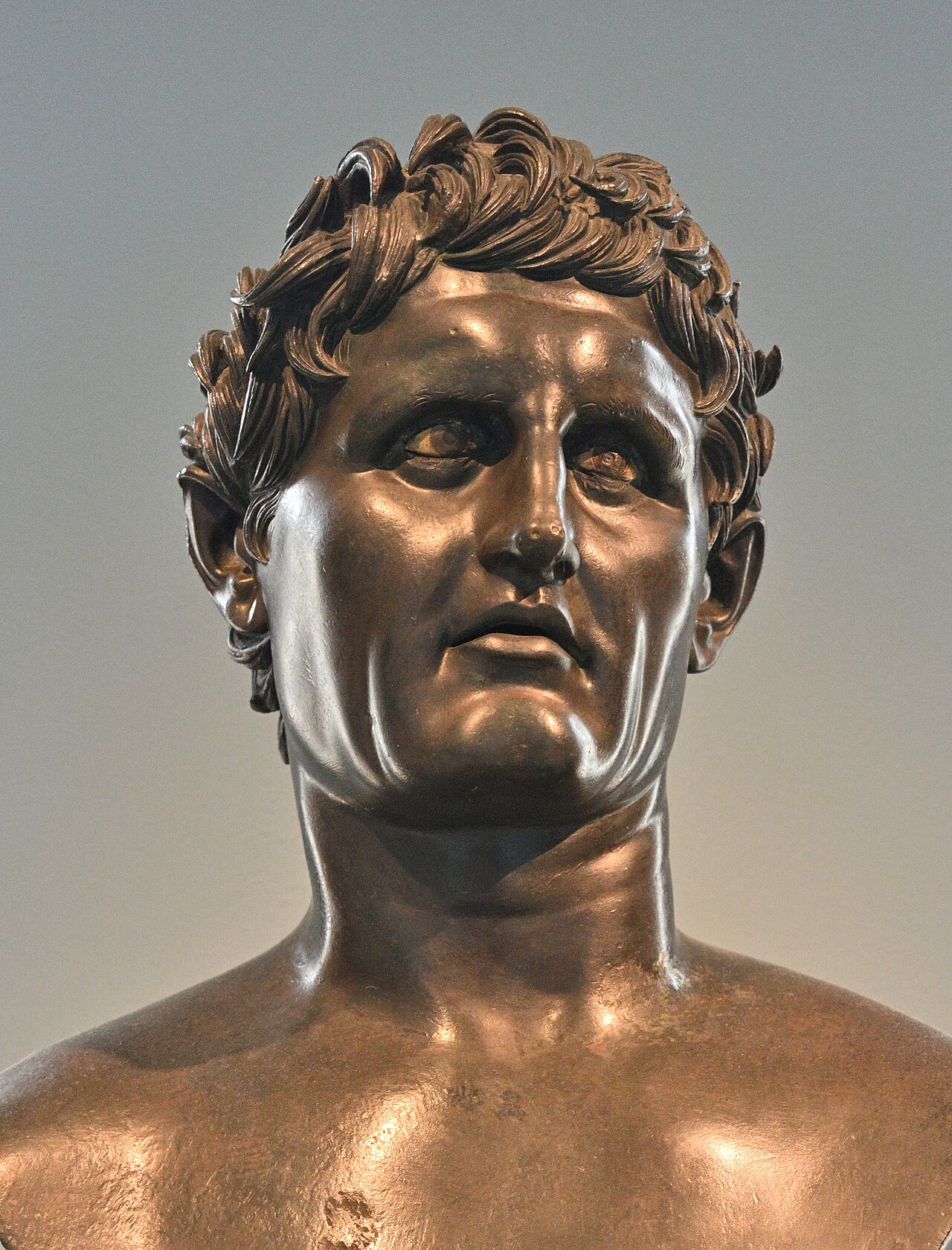
Seleucus I Nicator (“the Victor”, c. 358 to 281 BCE) was the Macedonian general who built the largest of the kingdoms that came out of Alexander’s empire. From his base in Babylon he took control of Iran after 311 BCE, made a treaty with the Indian emperor Chandragupta Maurya, and founded a dynasty, the Seleucids, that ruled much of Iran until the Parthians pushed it out in the 2nd century BCE.
| Lived | c. 358 to 281 BCE |
|---|---|
| Ruled | Satrap of Babylonia from 320; king from 305; died 281 BCE |
| Wife | Apama, daughter of the Sogdian leader Spitamenes; later Stratonice |
| Capitals | Babylon, then Seleucia on the Tigris; Antioch in Syria |
| Successor | Antiochus I, his son by Apama |
| Persian name | سلوکوس Selukus; the dynasty سلوکیان Salukiyân |
An officer of Alexander
Seleucus was born in Macedonia around 358 BCE, the son of a nobleman named Antiochus. He crossed into Asia with Alexander and by the Indian campaign of 326 commanded the royal foot guard. He was not one of the famous marshals, but he was close to the king. At the mass weddings at Susa in 324 he married Apama, daughter of Spitamenes, the Sogdian lord who had led the revolt in the north-east (see Roxana and the Susa weddings). Unlike almost all the other officers, he never put her aside. She was the mother of his heir, and the Seleucid kings were therefore part Iranian from the start.
From Babylon to the upper satrapies
In the struggles after Alexander’s death Seleucus first rose by helping murder the regent Perdiccas in 320, and was rewarded with the satrapy of Babylonia. Antigonus drove him out in 315, but he returned with Ptolemy’s help in 312, retook Babylon with only a small force, and then turned east (the story is on Alexander’s death and the wars of the successors). He defeated Antigonus’s general Nicanor and won over the satraps of Media, Susiana and the Iranian plateau.
Antigonus fought back in the so-called Babylonian War of 311 to 309. Babylonian chronicles describe years of fighting, plundering and famine around the city. Seleucus held on, and Antigonus gave up the east. The Babylonians counted Seleucus’s reign from 311 BCE, and that count became the Seleucid era, used for dating documents across the Near East for many centuries.

The treaty with Chandragupta
Seleucus then marched across Iran to recover Alexander’s Indian provinces. He found that a new power had taken them. Chandragupta Maurya had built an empire across northern India and pushed into the Indus valley. The details of the war, if there was one, are lost; the result is known. Around 305 to 303 BCE the two kings made a treaty. Seleucus gave up the easternmost Iranian provinces, including Gandhara and the Paropamisadae, and most of Arachosia and Gedrosia, roughly south-eastern Afghanistan and Baluchistan. In return he received 500 war elephants. The treaty included a marriage agreement of some kind, and Seleucus sent an ambassador, Megasthenes, to the Mauryan capital Pataliputra. Megasthenes’s account of India was read by Greek writers for centuries.
Some historians see the treaty as a defeat, since Seleucus lost territory. Others think it was good bargaining: the lost provinces were hard to hold, and the elephants won him an empire in the west.
Ipsus and the empire from Syria to Bactria
In 305 or 304 Seleucus followed the other generals in calling himself king. In 301, allied with Lysimachus, he met Antigonus at Ipsus in Phrygia. His Indian elephants blocked Antigonus’s cavalry from rescuing the infantry, Antigonus was killed, and his kingdom was divided. Seleucus received Syria.
The Seleucid kingdom now ran from the Mediterranean to Bactria. That was its great strength and its problem. A king in Syria could not watch the Iranian plateau and Central Asia at the same time. Seleucus’s solution, from about 294 BCE, was to make his son Antiochus joint king and give him command of the “upper satrapies”, the lands east of the Euphrates, with a base at Seleucia on the Tigris. Antiochus spent years in the east, repairing cities damaged by nomad raids, including Merv, which was rebuilt as Antioch in Margiana.
Antiochus and Stratonice
At the same time Seleucus handed over his young second wife Stratonice, the daughter of Demetrius, to Antiochus. Ancient writers tell a romantic story: the prince was wasting away from a secret love for his stepmother, until the court physician noticed his pulse quickened whenever she entered the room. Whatever the truth, the marriage tied the eastern viceroy firmly to the dynasty.
A builder of cities
Seleucus was one of the great city founders of antiquity. In Syria he built a group of four cities, Antioch, Seleucia Pieria, Apamea (named for his Iranian wife) and Laodicea. In Mesopotamia he founded Seleucia on the Tigris, which replaced Babylon as the region’s main city and later grew into a twin with the Parthian capital Ctesiphon across the river (see Ctesiphon). In Iran, Strabo says Seleucus refounded Rhagae, near modern Rey, under the Macedonian name Europos. These cities, with Greek institutions and Greek and Macedonian settlers, were the backbone of Seleucid rule, as described on Iran under the Seleucids.
Death at the edge of Europe
In 281 BCE, at about 77, Seleucus defeated Lysimachus at Corupedium in western Asia Minor, the last of Alexander’s generals to fight another. He crossed into Europe intending to claim Macedonia itself, the homeland he had left more than fifty years earlier. Near Lysimachia he was murdered by Ptolemy Keraunos, a son of Ptolemy I who had taken refuge at his court. Antiochus I succeeded him without trouble.
Seleucus and Iran
For Iran, Seleucus’s reign meant that Alexander’s conquest was followed by a stable state rather than permanent civil war. He kept the Achaemenid framework of satrapies, roads and royal treasuries, worked with local elites, and his heir was half Sogdian. But his kingdom was centred on Syria and Mesopotamia, not on the plateau, and Iranians remained subjects rather than partners in power. Within forty years of his death the north-eastern provinces were breaking away, a process followed on the Greco-Bactrian kingdom and how the Seleucids lost Iran.
Persian words from this page
| سلوکوس | Selukus | Seleucus |
| سلوکیان | Salukiyân | the Seleucids |
| ری | Rey | Rey, ancient Rhagae |
| مرو | Marv | Merv |
| پادشاه | pâdeshâh | king |
Sources and further reading
- Appian, Syrian Wars 52 to 64; Diodorus Siculus, Books 19 and 20; Plutarch, Life of Demetrius.
- Strabo, Geography 15.2.9 (the treaty with Chandragupta) and 11.13.6 (Rhagae).
- John D. Grainger, Seleukos Nikator: Constructing a Hellenistic Kingdom (Routledge, 1990).
- Susan Sherwin-White and Amélie Kuhrt, From Samarkhand to Sardis: A New Approach to the Seleucid Empire (Duckworth, 1993).
- Paul J. Kosmin, The Land of the Elephant Kings: Space, Territory, and Ideology in the Seleucid Empire (Harvard University Press, 2014).
Want to learn Persian? Get the free Starter Pack
Get the 14-page printable Starter Pack (all 32 letters, a 7-day reading plan, 100 core words and 20 survival phrases) and a short 5-email course. Free.
More in Alexander and the Seleucid Empire (330–141 BCE)
- Alexander the Great in Iran
- Spitamenes and the Revolt of Bactria and Sogdiana
- Roxana and the Mass Weddings at Susa
- Alexander’s Death and the Wars of the Successors in Iran
- The Battles of Paraitakene and Gabiene
- Seleucus I Nicator and the Seleucid Empire
- Iran under the Seleucids
- The Greco-Bactrian Kingdom
- Antiochus III’s Eastern Anabasis
- The Fratarakas: Local Rulers of Persis
- Greek Culture in Iran
- How the Seleucids Lost Iran