The Greco-Bactrian kingdom was a Greek-ruled state in Bactria, the land between the Hindu Kush and the Amu Darya in today’s northern Afghanistan and southern Uzbekistan and Tajikistan. It broke away from the Seleucid Empire around the middle of the 3rd century BCE and lasted until nomads overran it around 130 BCE. Its kings ruled an Iranian population from cities like Bactra (Balkh) and Ai-Khanoum, and most of what we know about them comes from their coins.
| Dates | c. 250 BCE (independence, date disputed) to c. 130 BCE |
|---|---|
| Capital | Bactra (Balkh); other major city Ai-Khanoum |
| Notable kings | Diodotus I and II, Euthydemus I, Demetrius I, Eucratides I, Heliocles I |
| Population | Mostly Iranian-speaking Bactrians, with Greek and Macedonian settlers |
| Successors | Yuezhi and Saka nomads in Bactria; Indo-Greek kings south of the Hindu Kush |
Bactria, “land of a thousand cities”
Bactria was one of the core lands of the eastern Iranian world. Under the Achaemenids it was a rich satrapy, often governed by a royal prince, and it was there that Bessus tried to keep up Persian resistance after Darius III died. Alexander needed two years of hard fighting to subdue it (see Spitamenes and the revolt of Bactria and Sogdiana), and he and the Seleucids settled thousands of Greeks there. Ancient writers called it the land of a thousand cities. Irrigation canals from the Amu Darya and its tributaries made it a land of grain, fruit and horses, and it stood on the routes from Iran to India and to the steppe.
Diodotus breaks away
The Roman historian Justin says that Diodotus, governor of the thousand cities of Bactria, rebelled and took the title of king at about the same time that Arsaces led the Parni into Parthia. Exactly when, and how suddenly, is one of the most argued questions of the period. The coins show a gradual process. Early issues carry Diodotus’s portrait but the name of the Seleucid king Antiochus; later ones carry the name of Diodotus himself, with a figure of Zeus hurling a thunderbolt. Most historians now date the full break to somewhere between about 255 and 235 BCE.
His son Diodotus II made peace with the Parthian king Arsaces, according to Justin. That alliance did not save him. Around 230 to 225 BCE he was overthrown by Euthydemus, a Greek from Magnesia in Asia Minor.
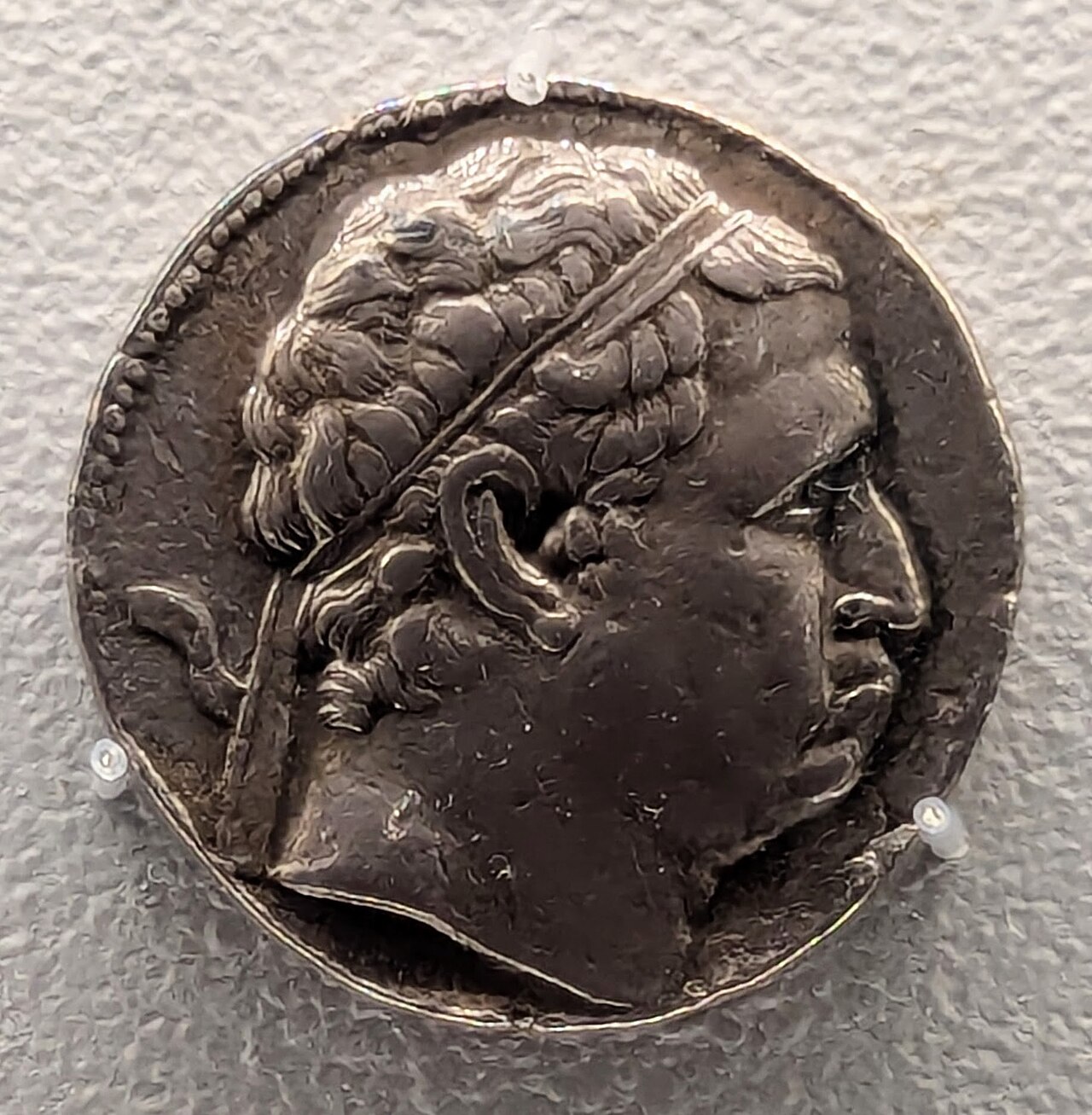

Euthydemus and the siege of Bactra
The Seleucid king Antiochus III came east to restore his empire, and around 208 BCE he defeated Euthydemus’s cavalry at the Arius river (near Herat) and besieged him in Bactra. Polybius says the siege lasted about two years. In the end they negotiated. Euthydemus argued that he was no rebel, since he had overthrown the family of the original rebels, and warned that if the Greeks of Bactria kept fighting each other, the steppe nomads would overrun the country and Greek life there would be lost. Antiochus accepted. He recognised Euthydemus as king, received his elephants, and promised one of his daughters to Euthydemus’s son Demetrius. The campaign is told on Antiochus III’s eastern anabasis.
The coin portraits of Euthydemus, from a young man to a heavy-jowled old king, are among the most realistic royal portraits of the Hellenistic world.
Demetrius and the turn to India
After the Mauryan empire weakened, Demetrius I crossed the Hindu Kush, perhaps around 190 to 180 BCE, and conquered lands in what are now southern Afghanistan and Pakistan. His coins show him wearing a headdress made from an elephant’s scalp, a symbol of victory in India borrowed from portraits of Alexander. From then on, Greek kings ruled on both sides of the Hindu Kush. Those who ruled to the south, in Gandhara and the Punjab, are called Indo-Greeks. The most famous, Menander, appears in a Buddhist text, the Questions of Milinda.
Eucratides and the Parthian advance
Around 170 BCE Eucratides I seized power in Bactria. Justin says he fought endless wars with neighbours and was murdered by his own son. He issued the largest gold coin known from the ancient world, a twenty-stater piece weighing about 169 grams, now in the Bibliothèque nationale de France.
His reign shows the kingdom caught between two rising powers. To the west, the Parthian king Mithridates I took over two provinces of Bactria from Eucratides, according to Strabo. To the north, nomadic peoples were on the move.
The end of Greek Bactria
Around 145 BCE the city at Ai-Khanoum was sacked and abandoned. The excavators found its treasury looted and its palace burned. Over the next twenty years, Saka groups and then the Yuezhi, a people driven west from the borders of China, took over the country. The Chinese envoy Zhang Qian, who reached Bactria (in Chinese, Daxia) around 128 BCE, found it already under Yuezhi control, with many walled towns and busy markets but no great king. Heliocles I was probably the last Greek king to rule north of the Hindu Kush. The Indo-Greek kingdoms to the south lasted until around the start of the Common Era.
The Yuezhi later gave rise to the Kushan empire, which wrote its official documents in Bactrian, an Iranian language, in the Greek alphabet. That is one of the clearest legacies of Greek rule in the region.
A Greek kingdom in the Iranian world
Because almost no histories of Greek Bactria survive, historians have rebuilt its story from coins, a few lines in Justin, Strabo and Polybius, and archaeology. William Tarn imagined a grand Greek-Indian partnership; A. K. Narain answered that the Indo-Greeks belonged mainly to Indian history. Recent work by Frank Holt, Rachel Mairs and others uses the excavations at Ai-Khanoum and finds of documents to show a mixed society: Greek-speaking rulers and soldiers, an Iranian-speaking majority, local gods worshipped alongside Greek ones, and Greek letters adapted for local use. The city life of that world is described on Greek culture in Iran.
For Iranian history, Bactria matters because it was where the Seleucid hold on the east first broke, alongside Parthia. The whole process is told on how the Seleucids lost Iran, and the Parthian side on the Parni and Arsaces I.
- c. 255 to 235 BCE Diodotus I makes Bactria independent
- c. 230 to 225 BCE Euthydemus I overthrows Diodotus II
- c. 208 to 206 BCE Antiochus III besieges Bactra, then makes peace
- c. 190 to 180 BCE Demetrius I crosses into India
- c. 170 BCE Eucratides I seizes power
- c. 145 BCE Ai-Khanoum destroyed
- c. 130 BCE Yuezhi and Saka take over Bactria
Persian words from this page
| باختر | Bâkhtar | Bactria |
| بلخ | Balkh | Bactra |
| هندوکش | Hendukosh | Hindu Kush |
| سکه | sekke | coin |
| یونانی | yunâni | Greek |
Sources and further reading
- Polybius, Histories 10.49 and 11.34; Justin, Epitome of Pompeius Trogus 41.
- Strabo, Geography 11.11.
- Frank L. Holt, Thundering Zeus: The Making of Hellenistic Bactria (University of California Press, 1999).
- Rachel Mairs, The Hellenistic Far East: Archaeology, Language, and Identity in Greek Central Asia (University of California Press, 2014).
- W. W. Tarn, The Greeks in Bactria and India (Cambridge, 1938); A. K. Narain, The Indo-Greeks (Oxford, 1957).
- Encyclopaedia Iranica, “Bactria”.
Want to learn Persian? Get the free Starter Pack
Get the 14-page printable Starter Pack (all 32 letters, a 7-day reading plan, 100 core words and 20 survival phrases) and a short 5-email course. Free.
More in Alexander and the Seleucid Empire (330–141 BCE)
- Alexander the Great in Iran
- Spitamenes and the Revolt of Bactria and Sogdiana
- Roxana and the Mass Weddings at Susa
- Alexander’s Death and the Wars of the Successors in Iran
- The Battles of Paraitakene and Gabiene
- Seleucus I Nicator and the Seleucid Empire
- Iran under the Seleucids
- The Greco-Bactrian Kingdom
- Antiochus III’s Eastern Anabasis
- The Fratarakas: Local Rulers of Persis
- Greek Culture in Iran
- How the Seleucids Lost Iran